Healthcare Minimum Viable Product Development: How to Build an MVP and Optimize Your Budget for Medical Application

Slava Khristich


Vlad Nazarov

In this article, we’ll talk about creating a minimum viable product (MVP) for a healthcare startup. Going to market with an MVP can become a reasonable and desired step for certain health-tech projects, but not for all market sectors. Let’s take a look at healthcare areas that are good for starting with an MVP, and why this can be the right approach for keeping your costs low. Also, we’ll discuss the processes and challenges of minimum viable product development for a medical startup.
Unfortunately, many business managers and even software professionals still underestimate MVPs and believe that introducing a health-tech MVP (minimum viable product) means going to market with a piece of half-baked, under-tested software. That’s a totally inaccurate perception. Let’s find out why….
What is an MVP in healthcare? A minimum viable product (MVP) refers to the first stable, usable version of a health management application that comes with core features only. An MVP can be provided to early customers to accumulate their feedback and use the findings for further product development.
An MVP is expected to be transformed into the final product after several iterations of the development process. Partnering with a healthcare software development company can streamline this transformation, ensuring that your product meets industry standards and user expectations.
| ➡️ An MVP possesses minimum valuable features sufficient for successful market introduction, as they bring essential competitive value to users/patients. The rest of the potential product features and product capabilities can be selected and later, built in response to real-life customer demands, and released with the final version and/or newer product updates. An MVP is expected to be free of critical software bugs so customers can explore core functionalities and make sure your alleged killer features work efficiently for their real-life needs. |
Let’s be clear. Going to market with an MVP…
- Doesn’t mean launching a deficient or poorly tested product. An MVP should be stable and debugged, with a platform for adding more features in the future.
- Mostly refers to consumer-grade healthcare software, like mobile applications for health control, fitness/wellness, and more. Professional-grade medical MVPs are tested under controlled clinical conditions different from a free-market examination.
- Is about clever prioritization of product features in nearshore software development management.
- Can bring certain benefits to healthcare product development startups.
Let’s delve into the details of MVP healthcare…
| Who are we? TATEEDA GLOBAL is a company with a great deal of experience in minimum viable product development for medical startups. Our benefits include… ✅ We know everything about healthcare product development! We are partners with one of the largest travel nurse agencies in the United States, AYA Healthcare. ✅ We created a group of mobile applications for their nursing job-management platform. Learn more about how we helped AYA Healthcare here ⇒ ✅  HQ in San Diego, California: We provide AI software development services in a convenient time zone for North American customers, backed by a deep understanding of American requirements and industry nuances. HQ in San Diego, California: We provide AI software development services in a convenient time zone for North American customers, backed by a deep understanding of American requirements and industry nuances.✅ Outstanding experience and skills in building hybrid healthcare software products with Cloud, IoT, mobile, web, and desktop components. ✅ Dedicated project managers and engineers offering personalized communication and unlimited consulting. If you are interested in building a minimum viable product for a healthcare startup, contact us today! |
Let’s Build a Medical MVP Together
We’ve been helping our clients build MVPs and PoCs for healthcare projects since 2013.
Table of Contents
The Benefits of Going to the Healthcare Market with an MVP
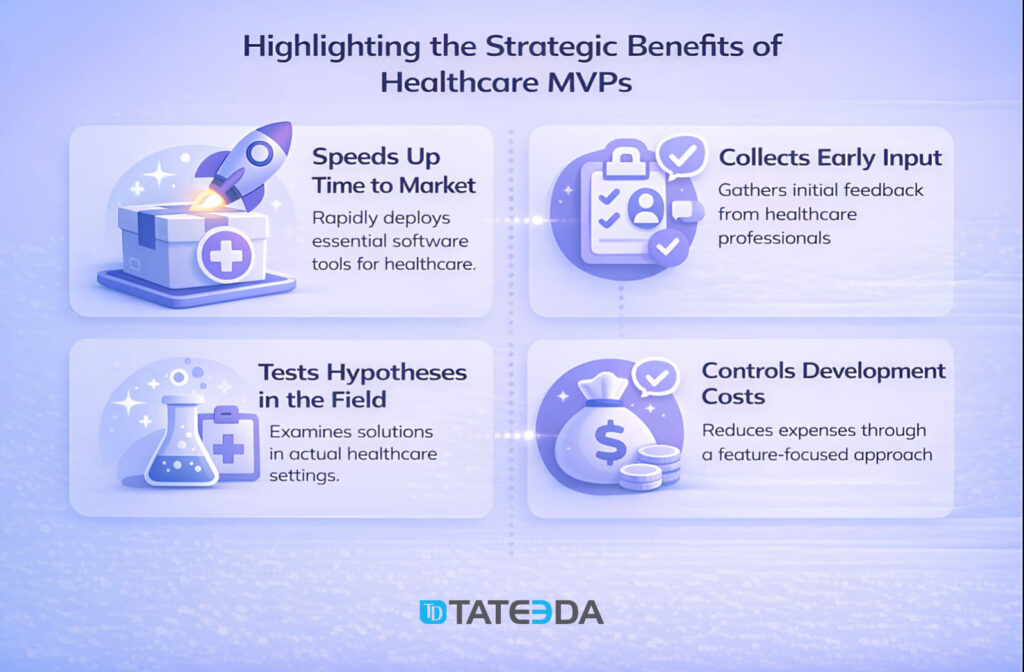
What are the business advantages of medical startup minimum viable product development? Let’s take a look:
Better Time/Cost Balance for Building a Healthcare MVP
The MVP development life cycle is relatively fast, and therefore cheaper in comparison to full-cycle healthcare application development. That’s why an MVP can be a great money-saving strategy for a health app startup!
Average MVP development time horizon ranges from 3 to 6 months. In contrast, a typical end-to-end development process can take 12 months or longer. Spending a year or more to produce a fully-featured healthcare application in accordance with a preplanned roadmap is an unbearable approach for most young companies and startups.
The traditional attitude involves many extra hours of costly design, development, and quality assurance work. At the same time, these efforts are not guaranteed to pay back in the future, as market risk levels in both models are equally high.
Takeaway: Both MVP and full-featured healthcare software products can either fail or succeed in the market, but an MVP is cheaper and faster to develop and deploy with real-life users who can explore and comment on your product.
| MVP | Full-featured |
| 3-6 months | 12+ months |
| More affordable | Expensive |

What “viable” Really Means in an MVP for Healthcare
Cost efficiency in an MVP for healthcare rarely comes from cutting corners; it comes from narrowing scope without weakening the foundations. The fastest way to burn an MVP budget is to build “small” features that still require rework later—because the workflow logic is unclear, usability is inconsistent, or security and integration were postponed until “after validation.”
This is why mature MVP development methods in healthcare treat viability as two things at once: (1) a minimal workflow that produces measurable value, and (2) an implementation that is stable enough to withstand real users, real data paths, and early iteration cycles. A first release can be lean and still be professionally engineered.
In practice, the most budget-friendly MVPs tend to share a few traits:
- Outcome-first scope: one or two measurable goals tied to a specific patient or provider workflow.
- End-to-end core slice: the minimum set of features that completes the workflow without handwaving “later.”
- Usability under pressure: interfaces that work for patients and clinicians, not just demo flows.
- Security aligned with data reality: if PHI is in scope, HIPAA-grade controls are treated as baseline, not backlog.
- Integration posture: a clear plan for operating alongside existing systems (even if the first iteration uses simplified connectors).
This framing also explains why “launch success” is more than shipping quickly. Early wins come from focused functionality and a clean user experience, while the ability to scale the product responsibly depends on security and integration decisions that are made early enough to support iteration—rather than blocking it later.
Testing Your Healthcare Application Concepts with Real Users
When a health-tech startup takes off, its business decisions and concepts are driven by marketing hypotheses that should be either approved or disapproved. The earlier these ideas can be approbated by real users/patients, the more efficient corrections can be made at a moderate cost.
By launching your MVP to market, you can identify…
- If your healthcare software product is interesting to your potential customers
- The next features to be put on your product development roadmap
- Redundant features to be excluded from your roadmap
- User reaction and feedback to help define the next steps in your project
- Problems in your product to be solved as early as possible.
Takeaway: Going to market with a health-management software MVP will empower you to align further project development with actual user demands. Customer requirements and vision can help you rethink your product roadmap and improve upon previous concepts.
Turning Early Users into Measurable Learning
Early users provide more than sentiment; they generate evidence that tightens the scope and reshapes the roadmap. The real healthcare MVP benefits show up when a release is treated as an instrumented experiment—fast enough to run in the market, disciplined enough to produce signals that product and clinical stakeholders can trust.
For teams that build MVPs for healthcare, “feedback” becomes actionable when it is structured and repeatable. A limited pilot (patients, clinicians, care coordinators, or admin staff) typically exposes friction that internal reviews miss: confusing UI cues, missing edge cases, workflow mismatches, and onboarding drop-offs. This is also where expectations around a high-quality healthcare MVP become concrete—stable core flows, clear safety boundaries, and careful handling of any sensitive data, even at an early stage.
A common question surfaces early—“can I build healthcare MVP without professional coders”—and the practical answer depends on risk and domain. No-code tools can validate a concept and UI flow, but once real integrations, security controls, auditability, and production reliability enter the picture, engineering becomes the mechanism that keeps learning fast without turning iteration into uncontrolled exposure.
To convert real-user testing into product decisions (instead of a pile of opinions), MVP teams typically track:
- Hypothesis-to-metric mapping: each assumption tied to a measurable signal (activation, completion rate, adherence, time saved).
- Workflow success criteria: what “done” means for patient tasks vs. staff tasks, including acceptable error thresholds.
- Drop-off diagnostics: where users abandon flows (onboarding, permissions, data entry, handoffs).
- Qualitative evidence: short interviews, in-app prompts, and support tickets categorized by theme and severity.
- Safety and privacy guardrails: data minimization, least-privilege access, and explicit handling rules for sensitive inputs.
- Iteration cadence: fixed review cycles so insights reliably convert into backlog changes and releases.
Learn more: How to Launch a Healthcare Startup: The Guide to Building Great Health-tech Products
A Fast Product Introduction to the Market
The early bird gets the worm! The healthcare software market is highly competitive. Learn more about custom mobile application development for healthcare.
Entering the market with an MVP in healthcare can be the right thing to do when you want to occupy a certain niche ahead of your competitors, who might be preparing similar products. Once you have your main “killer features” in place, you can release your MVP to a limited group of early users and try to win their loyalty over the long term.
Takeaway: If you plan to break into the healthcare app market as fast as possible, opt for MVP development because…
- With tight deadlines and limited resources needed, you can meet your customers’ needs sooner.
- It makes it easier for you to find funding from investors. ?

Do you need help building a minimum viable product for a healthcare product?
TATEEDA GLOBAL can help you with medical startup minimum viable product development, including different types of technologies and platforms like mobile, desktop, and IoT solution development in California.
Building a medical MVP with us will allow you to:
| ✔️ Save time/money, thanks to a shorter MVP development process. ✔️ Develop your application in accordance with real-life user demands and needs. ✔️ Enter the market fast and occupy your targeted niche to overcome potential competitors. |
If you need free technical consulting and a free project estimate from tech experts, contact us today! ??
Building a Medical MVP is a Serious Venture!
Our top nearshore and offshore specialists are dedicated to making your digital health MVP not only fully functional but also cost-effective.
Challenges in Creating an MVP for a Healthcare Startup
What challenges and difficulties are inherent to creating a minimum viable product in the health industry?
Certain medical limitations should be considered before introducing a healthcare MVP….
Consider Health Risks Before Approaching Certain Patients
Not all medical situations and health conditions can be approached with MVPs. Of course, it’s not recommended that developers offer an MVP for acute medical conditions.
If a patient requires vital or urgent support via professional-grade software, they should not rely on an MVP. Professional-grade products should be tested in clinical facilities under the direct control of medical professionals. ? Learn more: Virtual Nursing App Development Guide
What types of customer-grade applications can be introduced to the market in the format of an MVP?
| Let’s look at the specific areas where an MVP-based market entrance strategy can work the best… ✅ Health, diet, wellness, and fitness management apps ✅ Remote health-monitoring apps (like step/heartbeat/temperature trackers) ✅ Clinical information and medical-reference management apps ✅ Productivity management apps for medical needs ✅ Chronic care management (tips, advice, content, and more) ✅ Medical data visualization development ✅ Medication reminder apps ✅ Wearable and mobile device integration ✅ Rehydration control apps. |
A Practical Workflow for Healthcare MVP Development
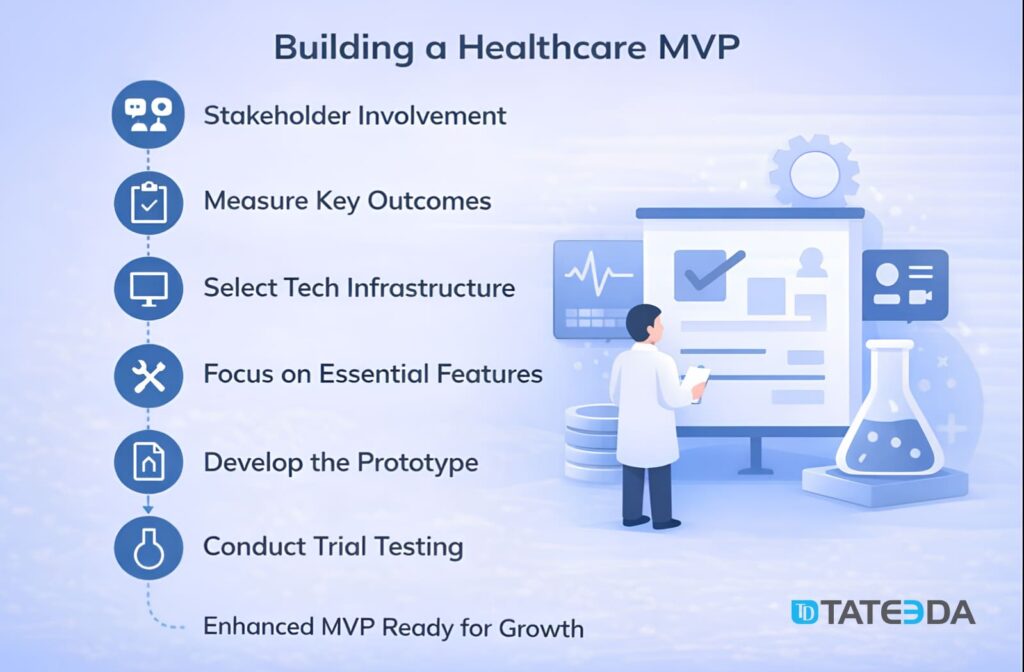
To keep an MVP from turning into “a smaller version of everything,” it helps to treat it as a sequence of decisions—not a single build sprint. In MVP development for healthcare, the early work is less about coding speed and more about alignment: getting clinicians, operations, compliance, and product owners to agree on the problem, the workflow boundaries, and what “works” means in measurable terms.
That’s why the most reliable healthcare software MVP development process starts with stakeholder involvement and outcome metrics. If you can’t define what success looks like (reduced admin time, higher task completion, fewer errors, faster triage, better adherence), you can’t validate the MVP—only ship features. Once outcomes are clear, infrastructure choices (hosting, identity, data flows, integrations) become easier and safer, because you’re designing for a specific clinical use case rather than a generic app.
From there, the discipline is to narrow the scope to essential features, build a prototype that supports one or two core user journeys end-to-end, and then run trial testing in conditions that resemble real care delivery. That last step is what turns a “working demo” into an MVP that’s actually ready to scale—because you’re learning from live friction, not assumptions.
Prioritize Kickstart Features to Ensure MVP Success
It’s important to identify the most valuable features and focus all your resources on building them. Efficient prioritization requires joint effort and the combined talents of project managers, the marketing department, UI designers, software engineering, business development specialists, and developers.
For medical MVPs, prioritization is a crucial factor that encompasses…
- A perfect vision for product priorities plus kickstart features and related processes
- The ability to determine the most important items on the product’s roadmap
- Well-coordinated efforts from marketers and developers
- Research and formulation of deeper market opportunities
- Efficient collaboration between technical and business teams.
If you are interested in finding a reliable partner for building your MVP in healthcare, contact TATEEDA GLOBAL. We are ready to collaborate with your entire team as an app development augmentation partner and efficiently build your medical startup’s minimum viable product.
Check more about our healthcare software services:
Custom Healthcare Solutions
See how we can engineer healthcare software, validate your ideas, and manage project costs for you.

Technologies for MVP Creation
This table provides a snapshot of various technologies along with their primary domains and how they are typically used in the context of MVP development.
| Technology | Domain | How is Used |
|---|---|---|
| C# Custom Development | Backend | Used for server-side logic and APIs in custom .NET development service environments. |
| ASP.NET Custom Development | Backend | Framework for building robust web applications and services. |
| Node.js Custom Development | Backend | Runtime environment for executing JavaScript server-side. |
| JavaScript Development Services | Frontend & Backend | Core scripting language for both client-side and server-side development. |
| React.js Custom Development | Frontend | Library for building user interfaces, primarily for single-page applications. |
| Vue.js Custom Development | Frontend | Progressive framework for building user interfaces and single-page applications. |
| Flutter | Mobile | SDK for crafting high-quality native interfaces on iOS and Android. |
| Azure Development Services | Cloud | Cloud platform providing integrated cloud services for hosting and managing apps. |
| AWS Development Services | Cloud | Secure, scalable cloud computing services to handle backend, storage, and hosting. |
| SQL Server | Database | Relational database management system for storing and retrieving data. |
| MongoDB | Database | NoSQL database used for high-volume data storage without a predefined schema. |
| Django | Backend | High-level custom Python web development framework that encourages rapid development and clean, pragmatic design. |
| Ruby on Rails | Backend | Server-side web application framework written in Ruby under the MIT License. |
MVP Compliance Requirements in Medical Startups
Not all healthcare applications require HIPAA compliance. If your MVP does not work with PHI (protected health information), it should not be HIPAA-compliant. Learn more about PHI concepts and other details: How Custom Healthcare Software Is Developed for Secure HIPAA Compliance.
Best practices when creating MVP for healthcare startups:
HIPAA Compliance for a Healthcare Product Development
If you are sure that PHI is used in your application with information like…
- patient and physician names
- telephone numbers
- geographic data
- social security numbers
- medical record numbers
- health plan beneficiary numbers
…then your MVP should be aligned with the following medical data regulations:
✔️ HIPAA Privacy Rule (2003)
✔️ HIPAA Security Rule
✔️ HITECH Act (2009).
Learn more: Mobile Hospital App Development: the Ultimate Guide
Healthcare Product Development Quality Requirements
As we stated at the beginning, an MVP has nothing to do with a deficient or undertested version of the software, but instead an intentionally simplified yet high-quality application that can be successfully presented to a group of early users.
Medical or health management MVPs should be…
- Well-debugged and stable
- Well-built
- Scalable platforms (more features can easily be added)
- Well-designed with UI/UX
- Clearly organized in terms of business logic
- Well-configured in terms of modules and middleware
- Protected and secure.
Learn more: How to Build a Medical Second Opinion Telemedicine Platform
Healthcare Software Buildout Team Compliance
Building a minimum viable product for a healthcare startup requires a powerful application development team with knowledge of HIPAA and secure SDLC principles. This approach is comprised of the following components:
✔️ Software engineering for medical products
✔️ Software developers (mobile, web, etc.)
✔️ Breach-prevention strategy
✔️ A QA team (application testers and tasting engineers)
✔️ UI/UX design competency
✔️ Marketing team involvement.
Do You Need Help with Healthcare MVP Compliance?
TATEEDA GLOBAL has all the necessary resources and expertise to help you create a medical or healthcare-related minimal viability product, including…
- HIPAA compliance
- Multiple combined platforms
- Intelligent platform architecture
- Well-designed tech stack
- Scalability for adding additional features
- Security of data storage and transactions
- Cloud and other infrastructure.
Compliance with Local Legislation
If you want to target the local healthcare IT market sectors and shares, you should build your healthcare application MVP in accordance with local compliance codes…
 GDPR (the E.U., the United Kingdom, and other affiliated territories)
 PIPEDA (the Canadian equivalent of HIPAA)
FDA requirements (must be obeyed for professional-grade products).
Are you unsure how to make your medical MVP compliant with all requirements? TATEEDA GLOBAL can help you. Contact us today for a free consultation!
Review our portfolio here:
Delivered Healthcare Software Portfolio
The leading American healthcare companies benefit from working with us.

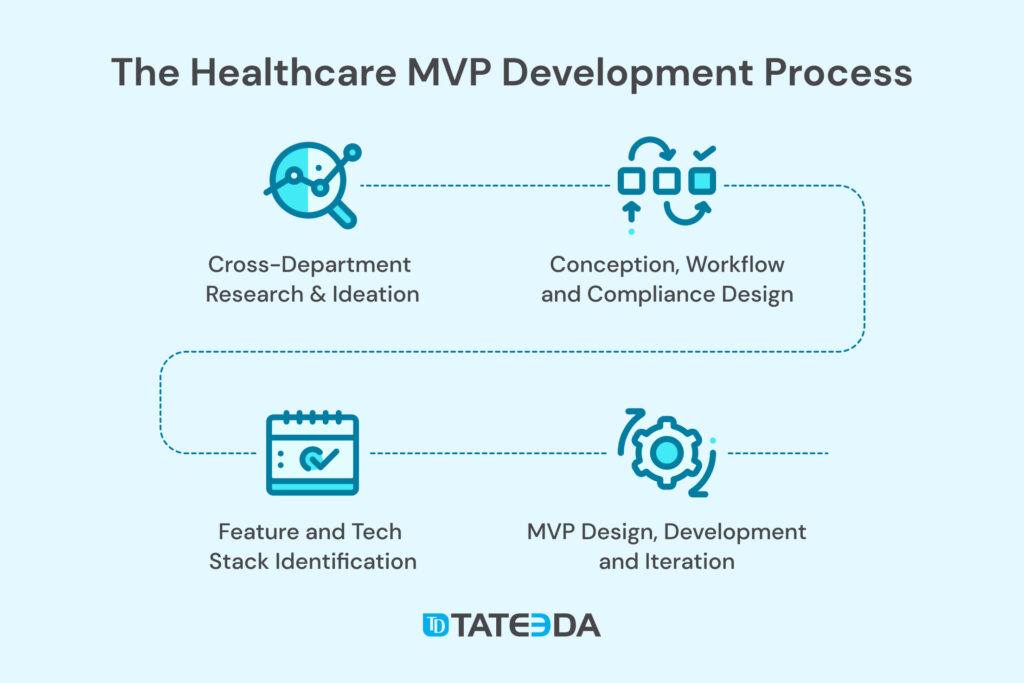
The Healthcare MVP Development Process
Building an MVP for the healthcare domain includes several stages. Let’s consider them in detail…
1. Cross-Department Research & Ideation
❎ MVP development always starts with deeper marketing research efforts and the discovery of niche opportunities.
At this stage, it’s necessary to establish a mixed cross-department team with marketing, development, and business specialists on board. The crucial focus should be brainstorming and finding a consensus between different organization domains in terms of USPs and kick-off features sufficient for a healthcare MVP.
Some of the questions to be answered at this stage include…
- What are the healthcare conditions and issues to be targeted by your MVP?
- How will its core features help patients, doctors, and other users?
- Will the core features be sufficient for successful resolution of targeted health issues?
- Will you be able to develop these features within tight deadlines?
Learn more: Health Insurance App Development Guide
2. Conception, Workflow, and Compliance Design
? At this stage, it’s necessary to clarify your project’s organizational structure and collaboration frameworks while writing the project’s roadmap. The key deliverables of this stage include…
- MVP business model
- Service offerings and delivery plan (decide how to get your early users)
- Key audience and early user portrayal
- Project team structure aligned with your business model
- Legal compliance plan
- MVP roadmap
3. Feature and Tech Stack Identification
It’s time to identify minimum viable product features and the best ways to build them. The results of this stage include…
- A list of key MVP features to be designed and implemented
- Platforms for MVP deployment (mobile, web, combined, etc.)
- Specific technologies, Android frameworks, and programming languages
- The necessary tech talents and skill sets
- Encryption and security strategy in accordance with HIPAA, GDPR, and/or other regulations, including healthcare data management interoperability.
4. MVP Design, Development, and Iteration
When all of your preparation is done, it’s time to design and develop your health-tech MVP in practice…
- Get your MVP engineering done.
- Reach out to your potential early users to engage them.
- Make sure your project team is ready (QA, developers, UI designers, etc.).
- Break your project down into smaller tasks.
- Prepare your budget and set timelines.
- Make sure an experienced project manager is in place to deliver results on time.
- Go through design, development, and quality-assurance steps.
- Release your MVP to early users!
- Collect feedback and set successive iterations of offshore web development services until the final product is ready.
Learn more: Medication Tracker App Development: Guidelines, Features, and Costs
Build your MVP with TATEEDA GLOBAL
We know everything about the development of medical and healthcare products/applications, including MVPs. We have designed and created a series of full-fledged applications for medical startups and mature companies in San Diego’s custom software development service industry.
AYA Healthcare
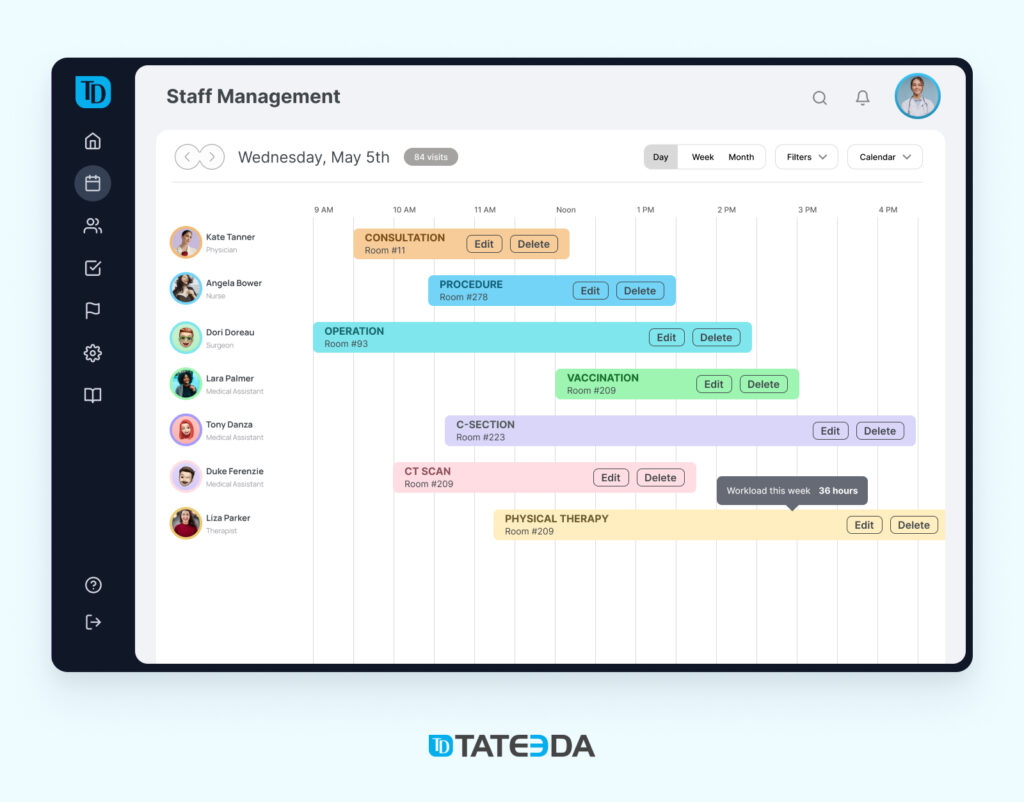
TATEEDA helped one of the largest travel nurse agencies in the United States with the development of their sophisticated mobile applications for different types of users, including nurses and healthcare representatives. Learn more about this project: →
| Project Features | ||
| Automated financial reporting and time-management modules. | Distinct mobile applications for different user groups: nurses, admins, and healthcare representatives. | A protected portal for nursing staff and medical representatives for clinical use. |
VENTRILINK
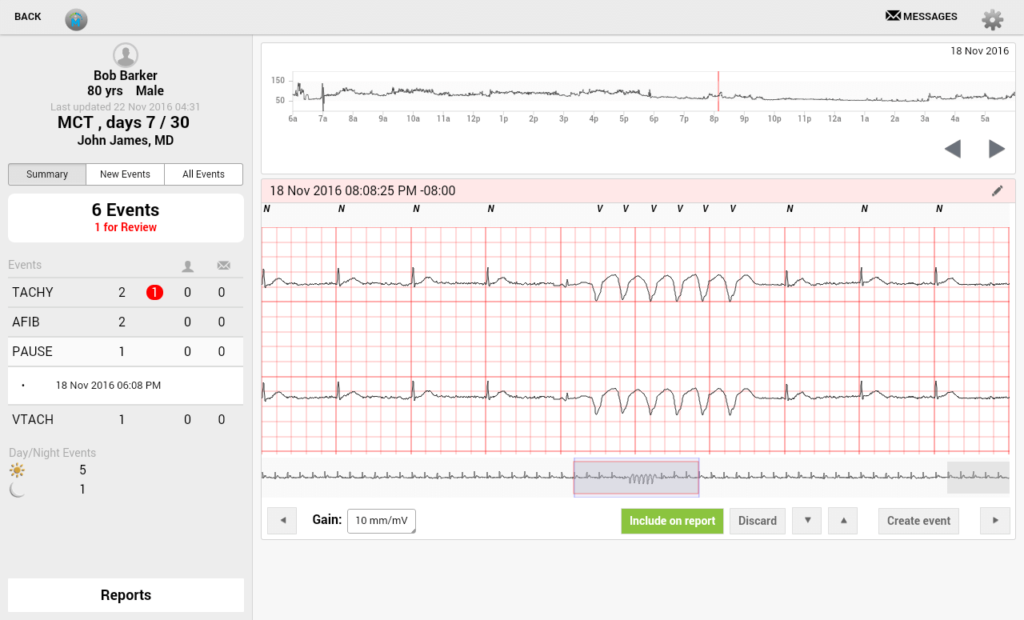
TATEEDA GLOBAL helped build a fully functional IoMT system to be offered to patients and physicians as a reliable instrument for remote heart monitoring. Learn more about this project: →
| Project Features | ||
| Patient ECG data profiling and visualization. Convenient, scalable view of patient cardiogram records. | Automatic identification of unusual and/or abnormal heartbeat patterns (events) such as arrhythmia, tachycardia, etc. | Efficient synchronization of mobile app with server application. |
FAQ: Building MVP healthcare products with TATEEDA
What’s the difference between PoC and MVP for healthcare product?
In the realm of software development, we have two main players: MVP (Minimum Viable Product) and PoC (Proof of Concept). In the context of healthcare startup PoC, these concepts are instrumental for technological validation.
MVP (Minimum Viable Product): The MVP is the star of the show—a streamlined version of a product with just enough features to meet user needs. It’s like a sneak peek for early users, complete with a user-friendly interface. It is a software product, typically with a user interface, and is intended to be released to real users to validate the market and collect data on user behavior. This is crucial in healthcare technology MVP and PoC.
PoC (Proof of Concept): PoC in healthcare startup is an experimental prototype designed to showcase a specific technology or solution. Although it involves some software development, the PoC is more of a dazzling glimpse into the technical feasibility of a groundbreaking idea rather than a full-fledged product.
In the healthcare tech world, these concepts play a crucial role. Imagine the MVP as a streamlined healthcare app addressing essential user needs, while a healthcare startup PoC acts as a technical showcase, proving the feasibility of innovative healthcare solutions. It’s a dynamic duo, each with its unique contribution to the tech theater.
Do you provide staff augmentation services for health-tech product development?
Sure. If you want to create your MVP at an affordable price and under a tight deadline, we’ll partner with you and provide you with our extensive resources for all types of MVP engineering, development, app testing, and UI design. Contact us today for more information!
Are you an onshore or offshore healthcare product development company?
Our headquarters are located in San Diego, California. TATEEDA is an American onshore software development company. We offer personalized connections with our project managers in a convenient time zone for North American clients. Our engineers are seasoned technical experts with rich on-site experience building MVPs for U.S.-based IoT, healthcare, biotech, and pharma companies. However, we operate a well-developed network of pre-vetted, skilled engineers in remote locations, including Ukraine, Brazil, and Colombia, for offshore mobile development services and more, ensuring you get the best value for the final product.



![8 Medical Billing Automation Developers in California [2026]](https://tateeda.com/wp-content/uploads/2026/10/Cover.png)
