How to Assemble a Healthcare Tech Team in 2026

Slava Khristich



Vlad Nazarov

In this article, we explore how building a successful healthcare tech team in 2026 is no longer about maximizing headcount, but about strategic composition and precision. You’ll discover how the integration of AI specialists and compliance-minded engineers, combined with a smart blend of local and remote talent, allows leaner teams to outpace traditional models. See how modern tools and intentional staffing can help your organization ship high-quality, regulated software with more speed and less friction.
In 2026, building a healthcare product team is less about stuffing a project with headcount and more about choosing the right mix of people, tools, and operating discipline. The market is active, but selective. U.S. digital health startups pulled in $14.2 billion in 2025, and Q1 2026 alone brought in $4 billion across 110 deals. At the same time, capital is clustering around fewer companies, which means buyers and founders are under more pressure to ship useful software without bloated delivery models.
That pressure changes the staffing question.

If you need practical assistance in creating a healthcare software development team with AI engineers and more, please contact our IT experts for individualized IT staffing consultation!
A few years ago, many healthcare organizations still defaulted to a familiar pattern: hire a large internal team, split work by function, then absorb delays as the cost of doing business in a regulated field. That model now looks expensive and slow. Software labor demand is still strong, with U.S. Bureau of Labor Statistics projections showing 15% growth for software developers, QA analysts, and testers from 2024 to 2034, plus about 129,200 openings each year on average. Meanwhile, HIMSS continues to frame workforce development, retention, and clinician burnout as central health IT issues rather than side topics.
So the winning question is no longer, “How big should the team be?” It is, “How small can the team stay while still covering architecture, compliance, product quality, and delivery speed?”
That is the right question for healthcare technology in 2026.
Why TATEEDA is qualified to talk about healthcare team building
TATEEDA can speak about healthcare team building from direct delivery experience, not theory alone. The company has supported U.S. healthcare and health-tech organizations through blended team models that combine local client-facing leadership with nearshore engineering and QA talent.
A strong example is its long-running AYA Healthcare engagement, where TATEEDA rotated roughly 60 to 80 engineers and QA specialists over time while maintaining delivery continuity and team quality.
That perspective is grounded in several practical areas of experience:
- long-term healthcare team scaling for U.S. clients
- mixed delivery models that combine local and nearshore talent
- dozens of completed and ongoing health-tech software projects
- work as both a contractor and subcontractor for U.S. healthcare companies
- health-tech staffing support paired with medical software architecting expertise
- supervised use of AI code generation, AI copilots, and senior engineer review in live delivery environments
Beyond AYA Healthcare, our San Diego custom software development company has contributed to dozens of completed and active healthcare software projects for U.S. health-tech companies, assembling teams of architects, developers, QA engineers, and other specialists around regulated products and delivery goals.
The company also brings hands-on experience with newer development workflows, including an NDA-covered case where supervised AI-generated codebases, AI copilots, and senior engineer oversight helped accelerate parts of development by 4x without losing technical control.
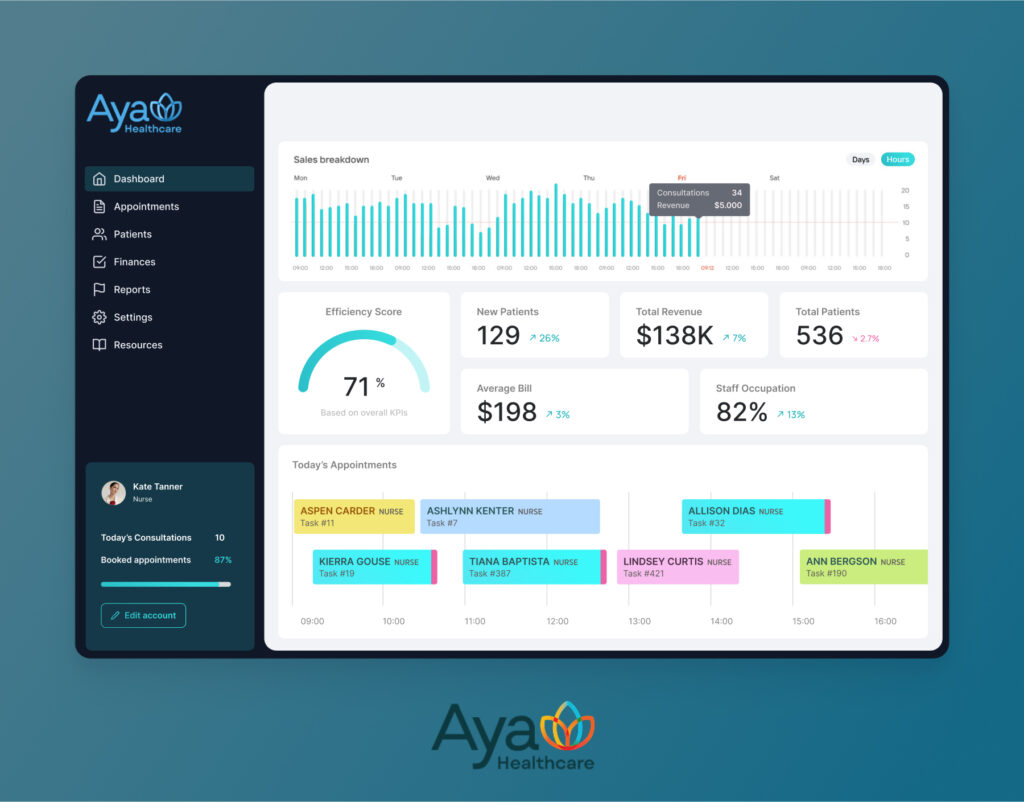
Table of Contents
The current market situation: active demand, tighter scrutiny
The momentum in healthcare technology persists, bolstered by steady funding and the enduring relevance of AI. Interoperability requirements have not become easier. But the AI health-tech market in the U.S. has grown more disciplined.
There are at least four forces shaping team design right now:
- Digital health investment is still flowing, but into a narrower set of companies and clearer use cases
- Physicians’ use of AI has risen sharply; the AMA reports an 81% use rate among surveyed physicians, more than double the rate from 2023
- Software talent remains in demand, especially for AI, IoT, automation, and security work
- Provider and clinical workforces are still under strain, which raises the bar for products that reduce burden instead of adding more clicks.
That combination creates a very specific hiring environment.
Healthcare companies still need engineers. They still need product thinkers. They still need QA, DevOps, security, and interoperability talent. But they are less willing to carry oversized teams that produce average output. Boards want tighter cost control. Product leaders want faster iterations. Compliance leaders want cleaner documentation and stronger controls. Buyers want proof, not promises.
That is why healthcare teams in 2026 are becoming more intentional: not necessarily bigger, but better composed.
What a modern healthcare tech team actually needs
A serious healthcare project still needs classic roles. That part has not changed. You usually need some form of:
| Team area | Why it matters |
| Product leadership | Keeps the build tied to business and clinical goals |
| Solution architecture | Prevents a pile of disconnected features |
| Front-end and back-end engineering | Delivers the product itself |
| QA and test automation | Cuts release risk |
| DevOps and cloud operations | Keeps environments stable, secure, and cost-aware |
| Security and compliance input | Turns HIPAA and related obligations into actual delivery rules |
| UX/UI | Reduces user friction for staff and patients |
| Interoperability expertise | Helps with FHIR, HL7, data exchange, and integration logic |
But in 2026, two more roles are becoming far more important…

AI engineers
AI integration specialists are no longer side characters brought in late to “add something smart.” In many projects, they now influence product design from the start.
Their job is not just model work. It often includes:
- selecting the right use cases for AI
- designing safe human review points
- helping engineering teams use copilots responsibly
- shaping document processing or knowledge retrieval flows
- improving automation in support, intake, scheduling, claims, coding assistance, or internal search
The market signals are hard to ignore. BLS specifically links strong demand for developers to the expansion of software development for AI, IoT, robotics, and automation applications. The AMA’s 2026 survey also shows that physician use of AI has moved into the mainstream, with seven in ten physicians seeing AI as a way to automate tasks that contribute to burnout.
“The shift is clear: AI specialists are now central architects, not just model builders. Their expertise in safe, use-case-driven integration—from compliance-aware human review points to optimizing operational flows—is the difference between a functional product and a regulated, impactful health solution.”
– Slava K., TATEEDA’s CEO
That does not mean every project needs a large AI lab. It does mean modern healthtech teams need at least one person who understands how to use AI safely, where it fits, and where it clearly does not.
Interoperability and compliance-minded engineers
In healthtech, an engineer who can code but cannot think through data sharing, access control, auditability, and regulated workflows is only half-formed for the job.
The ONC’s HTI-1 final rule keeps pushing the U.S. market toward stronger interoperability, more transparency, and more accountable health IT. It adopts USCDI v3 as the baseline standard in the ONC Health IT Certification Program as of January 1, 2026, and also adds transparency requirements for AI and predictive algorithms in certified health IT.
That is not abstract policy language. It directly affects team composition. It means healthcare projects increasingly need people who understand:
- Structured health data exchange
- FHIR and adjacent interoperability work
- Certified health IT constraints
- Traceability
- Algorithm transparency expectations
- How product design affects downstream compliance work.
How teams are being formed for the U.S. market
For U.S. healthcare projects, the most practical staffing model is often a blend of local and remote talent. This is not a matter of random global sprawl, but a deliberate, strategic split.
In many cases, the strongest setup looks like this:
Keep these functions close to the client and the U.S. market
- product owner or senior product lead
- client-facing delivery manager
- compliance owner or compliance-aware architect
- senior solution architect
- sometimes lead UX for patient or provider-facing flows
Add remote delivery strength in overlapping time zones
- application engineers
- QA and test automation
- DevOps and cloud engineers
- data engineers
- AI engineers
- mobile engineers
- support or maintenance contributors
This model works because healthcare delivery has two clocks running at once. One is business alignment. The other is build velocity.
The business clock benefits from proximity: shared language, similar work hours, easier workshops, faster approvals, and less friction when discussing legal, clinical, or operational details.
The build clock benefits from range: broader access to senior talent, faster team assembly, lower overhead, and the ability to avoid overpaying for every role just because the buyer is U.S.-based.
Done badly, distributed staffing creates confusion. Done well, it gives a healthcare company something valuable: a senior core near the decision-makers and a wider engineering bench behind it.

How HIPAA and health standards turn into team decisions
A lot of companies talk about HIPAA as if it were a legal label you apply after coding. That is part of why healthcare projects get expensive.
HIPAA is not just a policy review item. It changes who you need on the team, how environments are handled, what gets logged, how access is limited, which vendors are acceptable, and what your engineers are allowed to improvise.
HHS states that the HIPAA Security Rule sets administrative, physical, and technical safeguards to protect electronic protected health information. HHS also makes clear that cloud use is allowed in healthcare, but covered entities and business associates still need the proper safeguards in place, and appropriate business associate agreements with third-party providers that access ePHI.
Translated into team matters, that means:
| Standard or obligation | What it means for staffing |
| Access control | Engineers, DevOps, and QA need role-based access planning |
| Auditability | Developers and architects must think about logs and system events from the start |
| Vendor controls and BAAs | Cloud and delivery leads must know which providers are acceptable |
| Secure handling of ePHI | Front-end, back-end, QA, and infrastructure teams all need shared rules |
| Interoperability | Teams need FHIR/HL7 literacy or certified health IT experience |
| AI transparency in some health IT contexts | AI engineers and product leads need stronger documentation discipline |
That is why healthcare teams benefit from compliance-aware engineers, not just a compliance officer reviewing work later.
The better model is simple: make compliance part of product design, architecture, DevOps, QA, and vendor selection. Put it inside the team, not above it.
Why smaller teams can now move faster
A smaller team was once seen as a compromise. In 2026, for many healthcare projects, it can be an advantage. The reason is not magic. It is tooling.
AI code generation, AI copilots, test generation, code explanation tools, documentation assistants, and AI-supported review workflows allow senior engineers to produce more in less time, especially on repetitive, lower-variance work.
That includes:
- scaffolding standard components
- drafting integration layers
- generating first-pass tests
- documenting old modules
- surfacing suspicious code paths
- speeding up refactoring prep
- helping QA create broader test coverage faster
That said, healthcare is not a place for blind trust in machine output. The right model is not “replace engineers with AI.” It is “let senior engineers use AI to compress routine work and spend more time on decisions that actually matter.”
That distinction is huge.
A smaller healthcare team can outperform a larger one when:
- Architecture is set by experienced people
- AI helps with repetitive coding and test work
- Human review remains mandatory
- Requirements are kept tight
- Interoperability work is planned early
- Compliance constraints are turned into clear build rules.
The result is a team that stays lean without becoming fragile.
The role of AI engineers inside healthtech teams
It is worth separating AI engineers from engineers who simply use AI tools.
“Every developer now uses copilots, but the role of the AI engineer is fundamentally different. They are the architects who strategically shape how AI enters the product and the delivery process, ensuring its compliance and impact from the start.”
– Slava K., TATEEDA’s CEO
In a modern healthcare project, an AI engineer may help with:
Product-side AI
- summarization features
- intelligent search across internal knowledge
- document extraction
- workflow classification
- anomaly detection
- support routing
- coding or billing assistance under review
Delivery-side AI
- code generation workflows
- AI-assisted refactoring
- test creation
- internal engineering documentation
- log analysis
- troubleshooting support
The physician side of the market is already moving in this direction. AMA reporting shows doctors are using AI for documentation, research summarization, discharge instructions, and similar activities, while also expressing concerns around privacy, validation, and skill loss. That is exactly why AI engineers matter: they help teams build useful systems without pretending the risks are imaginary.
A good AI engineer in healthtech is not a hype machine. They are part engineer, part systems thinker, part risk translator.
How to manage team costs without wrecking delivery
Cost control in healthcare software should not mean hiring the cheapest people available. That route often ends in rework, slower releases, and compliance trouble.
Better cost control comes from structure.
Here are the main levers:
1. Keep the seniority where it counts
Do not underpay for architecture, compliance-aware engineering, cloud decisions, or interoperability work. Cheap mistakes there are expensive later.
2. Avoid role inflation
Not every project needs a full-time person in every specialty from day one. Some roles can come in part-time or phase-based.
3. Use remote capacity for delivery scale
Local product and architecture leadership plus remote engineering depth is often a cleaner economic model than a fully local build team.
4. Use AI to compress routine work
That lowers delivery hours without lowering standards, provided review stays in place.
5. Keep technical debt visible
A project that ships quickly but leaves behind brittle code will become more expensive every month after release.
6. Watch cloud spend early
Infrastructure cost is part of team cost, because engineers spend time compensating for bad environment decisions.
A cost-aware team plan might look like this:
| Cost issue | Better response |
| Too many full-time niche roles too early | Bring some roles in by phase |
| Overreliance on junior labor | Use fewer, more experienced people |
| All-local staffing | Blend local leadership with remote engineering |
| Manual coding of repeatable tasks | Use copilots and AI-assisted workflows |
| No shared standards | Create common patterns for code, security, and testing |
| Delayed refactoring | Fix high-friction code before it becomes a tax on the whole team |
A practical example of a lean 2026 healthcare team
For many U.S. healthcare software projects, a good early-stage team might look like this:
- 1 product owner
- 1 solution architect
- 1 delivery manager
- 2 to 4 senior engineers
- 1 QA automation engineer
- 1 DevOps/cloud engineer
- 1 UX/UI designer, full-time early, then part-time
- 1 AI engineer, part-time or shared, depending on scope
- 1 interoperability or compliance-minded specialist, shared if needed
That is not tiny. But it is far leaner than the old habit of starting with a large committee-shaped team.
If the architecture is sound and the team uses modern tools well, that kind of group can move very quickly.
How TATEEDA helps you build health tech teams
TATEEDA fits this 2026 team model well because the company combines a U.S. presence with a wider engineering bench, and it already works across healthcare, pharma, biotech, patient-facing products, connected devices, and regulated workflows. Its materials describe a team of over 100 IT professionals, engineers based across 16 countries, rapid project setup, and a mix of local and remote talent.
They also show hands-on work in HIPAA-related software, including patient portal and mobile app development for La Maestra, remote heart monitoring for VentriLink, healthcare staffing platforms, patient payment portals, EDC work, and lab-device software.
That matters because healthcare buyers rarely need just “developers.” They need a team shape that can cover architecture, cloud, compliance-aware delivery, mobile or web engineering, QA, and often AI-assisted development without losing control of the codebase. TATEEDA’s project materials also point to work in mobile, cloud integration, IoT-connected applications, codebase upgrades, and flexible team augmentation, which is exactly the kind of breadth many healthcare projects now need.
Final takeaway
The best healthcare tech teams in 2026 are not assembled by chasing volume. They are assembled by reducing waste.
Start with a senior core. Keep product and compliance ownership close to the U.S. customer. Add remote engineers where capacity matters most. Put AI engineers where they can influence both product and delivery. Treat HIPAA, interoperability, and cloud decisions as staffing issues, not just technical issues. Then let a leaner team, using better tools, do more with less friction.
That is how modern healthcare software gets built now.
Not by throwing bodies at the problem. By assembling the right team.

![The 11 Best Offshore Software Development Companies Suitable for the U.S. Market [2026]](https://tateeda.com/wp-content/uploads/2024/04/The-Best-Offshore-Software-Development-Companies-e1731060509127.jpg)



![8 Medical Billing Automation Developers in California [2026]](https://tateeda.com/wp-content/uploads/2026/10/Cover.png)
