How to Build an AI Chronic Care Management Agent: Architecture, Compliance, and Clinical Safety

Slava Khristich



Vlad Nazarov

| In this article, we explain how to build an AI chronic care management agent for Medicare CCM workflows, from FHIR R4 data architecture and HIPAA-compliant AI inference to FDA SaMD classification, CMS billing documentation, RPM device integration, and EHR-connected care coordination. |
A production-grade AI chronic care management agent requires four design constraints built in from day one: FHIR R4 data integration, FDA Software as a Medical Device (SaMD) classification review, Health Insurance Portability and Accountability Act (HIPAA)-compliant inference architecture, and Centers for Medicare and Medicaid Services (CMS) billing documentation automation.
A care coordinator at a 200-physician practice in Houston manages 800 Medicare patients enrolled in Chronic Care Management. Her tools are a spreadsheet, a patient portal, and a phone. Each month, her team logs 20-minute interactions manually, codes them against CPT 99490, and submits claims.
Last year, the practice’s billing department calculated that 340 of those 800 patients never hit the 20-minute documentation threshold, not because the care was not delivered, but because it was not captured. That is more than $200,000 in unclaimed CMS reimbursement, gone.
The problem is not a staffing problem. It is an architecture problem.
This guide covers what an AI chronic care management agent is, how the FDA classifies it, how to design the FHIR data layer, how to handle Protected Health Information (PHI) in the AI inference pipeline, and how to wire CMS billing documentation directly into the agent’s activity log so that reimbursable care is captured automatically.
| Key Takeaways ✅ An AI chronic care management agent that provides condition-specific clinical recommendations may qualify as FDA-regulated SaMD; general wellness reminders typically do not. Know which side of that line your system is on before writing a line of code. ✅ The CarePlan, Condition, Observation, and Goal FHIR R4 resources are the correct data model for chronic disease management workflows. Building against them enables EHR interoperability from day one. ✅ Retrieval-Augmented Generation (RAG) against condition-specific clinical guidelines (ADA, JNC-8, GOLD) is what makes AI responses clinically credible rather than generic wellness content. ✅ When an AI agent sends a patient’s medication list and condition profile to an LLM API, that is PHI in an inference request. A Business Associate Agreement (BAA) with the AI provider is legally required. ✅ The new Advanced Primary Care Management (APCM) codes G0556-G0558 introduced in 2025 offer $60-$210+ per patient per month with no time minimum. An AI agent that auto-documents eligible interactions makes this billing category functionally automatic. |
Table of Contents
What Is an AI Chronic Care Management Agent?
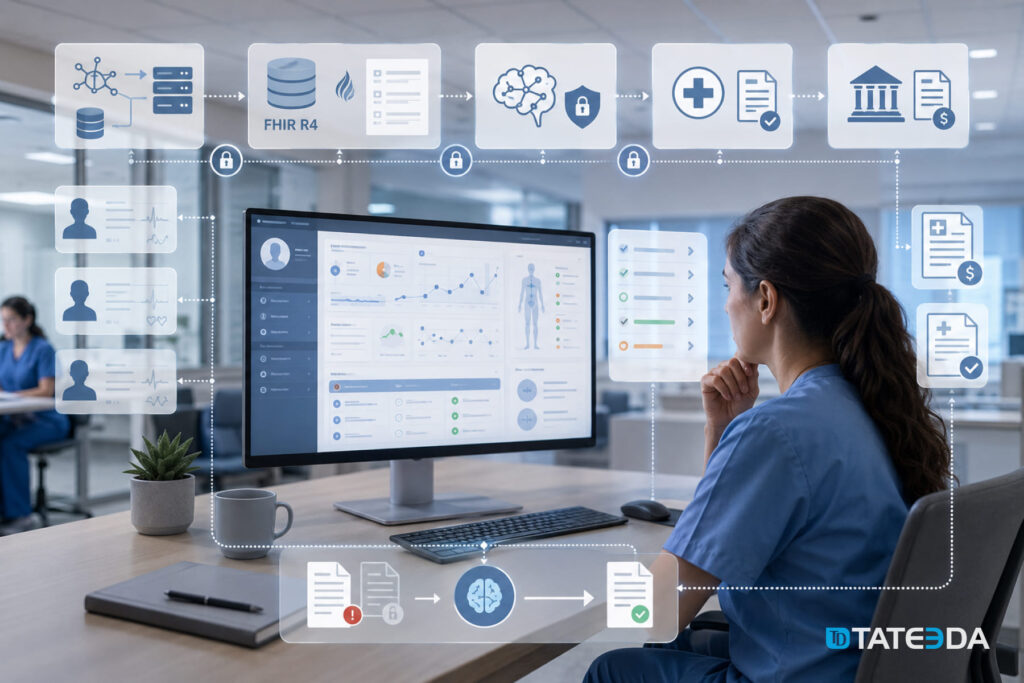
An AI chronic care management agent is a software system that automates patient self-management support, care coordination tasks, and clinical documentation for patients with one or more chronic conditions. It operates across conversational interfaces (patient portal chat, SMS, voice), pulls clinical context from connected Electronic Health Record (EHR) systems, and generates PHI-bound activity logs for CMS billing compliance.
According to CMS Chronic Care Management guidelines, eligible patients must have two or more chronic conditions expected to last at least 12 months and that place them at significant risk of acute exacerbation, functional decline, or death. The CCM market has grown to $5.57 billion in 2024 and is projected to reach $17.28 billion by 2033, reflecting the scale of the opportunity.
The term covers two architecturally distinct systems that are often conflated.
Self-management vs. care coordination: two distinct agent types
A self-management agent operates patient-facing. It sends medication reminders, answers condition-specific questions, tracks symptom journals, and flags adherence gaps. The clinical risk is modest if the agent avoids treatment recommendations. The FDA regulatory exposure is limited.
A care coordination agent operates clinician-facing or in the background. It reads EHR data, identifies patients approaching a billing threshold, surfaces care gaps, generates care plan updates, and routes escalations to the care team. This agent touches treatment decisions more directly, which changes the FDA SaMD analysis significantly.
Most production systems combine both. The architecture must account for both risk profiles.
Where AI agents fit in the CMS Chronic Care Management framework
Under the current fee schedule, CPT 99490 covers the first 20 minutes of care management activities per calendar month at approximately $63 per patient. CPT 99439 covers each additional 20 minutes. CPT 99487 covers complex CCM requiring 60 minutes, and 99489 covers each additional 30 minutes of complex CCM.
In 2025, CMS introduced APCM codes G0556, G0557, and G0558, ranging from $60 to $210+ per patient per month with no time minimum for qualifying practices. These codes represent the largest billing opportunity for AI-powered practices because the documentation threshold is activity-based, not time-based.
An AI agent that captures every patient interaction, links it to a CPT or APCM code, and generates compliant CMS activity logs converts a manual compliance burden into an automated revenue stream.
FDA SaMD Classification: Does Your AI Agent Need Clearance?
Software as a Medical Device (SaMD) is software intended to perform a medical purpose without being part of a hardware medical device. Under FDA’s framework, an AI chronic care agent that influences clinical decisions may qualify as SaMD Class I or Class II and require regulatory review before deployment.
This is the question every engineering team building a chronic care AI agent needs to answer before writing the first line of production code, and it is the question every competitor article ignores entirely.
The Food and Drug Administration (FDA) regulates artificial intelligence and machine learning-based Software as a Medical Device under its Digital Health Center of Excellence framework and the 21st Century Cures Act clinical decision support (CDS) rules.
The clinical decision support carve-out: when AI is exempt vs. regulated
The 21st Century Cures Act created a carve-out for CDS software that is not SaMD. Software falls outside FDA regulation if it: (1) displays, analyzes, or prints medical information; (2) is not intended to replace clinical judgment; (3) presents clinical recommendations in a way that allows the clinician to independently review the basis for the recommendation; and (4) is intended for conditions that are not serious or life-threatening.
An AI agent that sends a patient a reminder to take their metformin, prompts them to log their blood glucose reading, and provides ADA-aligned dietary education content most likely falls outside SaMD. A clinician can review the underlying rationale, and the agent is not making a treatment decision.
An AI agent that analyzes trending glucose values, compares them against a patient’s current insulin dose, and recommends a dose adjustment is making a condition-specific clinical recommendation that influences treatment decisions. That system is likely SaMD Class II under FDA’s framework.
Class I vs. Class II SaMD for chronic care AI
Class I SaMD poses minimal risk and may qualify for General Controls only, with no premarket submission required. Class II SaMD poses moderate risk and typically requires a 510(k) premarket notification, demonstrating substantial equivalence to a legally marketed predicate device.
For most AI chronic care management agents targeting patient self-management with clinical oversight in the loop, the design goal is to stay within the CDS carve-out. This means building a human-in-the-loop architecture where the AI surfaces information and the clinician makes the decision, rather than an autonomous system that prescribes.
IEC 62304 software lifecycle requirements for regulated AI agents
If your system crosses into SaMD territory, IEC 62304 applies. This international standard defines software development lifecycle requirements for medical device software, covering risk management, architecture design, unit verification, integration testing, and maintenance. TATEEDA’s healthcare software development practice includes IEC 62304-aligned development processes for clients building regulated health software.
The practical implication for engineering teams: document your intended use statement and risk classification before architecture design. That document determines whether you need FDA clearance and which development process controls are required.
Core Architecture of an AI Chronic Care Management Agent
FHIR R4 data layer: CarePlan, Condition, Observation, and Goal resources
FHIR chronic disease management workflows rely on a canonical data model defined by the CarePlan Resource in Fast Healthcare Interoperability Resources (FHIR) R4. It references the conditions being managed, the care team, the patient’s goals, and the planned activities. An AI agent that reads and writes to CarePlan operates within clinical systems rather than as a parallel data silo.
The core resource set for a chronic care management agent:
CarePlan: The longitudinal care plan, linking conditions, goals, and activitiesCondition: The patient’s chronic diagnoses with ICD-10 coding, clinical status, and onset dateObservation: Lab results, vital signs, symptom reports, and device readingsGoal: Patient-specific treatment targets (A1C below 7%, systolic blood pressure below 130 mmHg)MedicationRequestandMedicationStatement: Current medications and adherence recordsCareTeam: The care team members responsible for the patient
An agent that grounds its reasoning in these resources generates clinically accurate and EHR-consistent responses. One that maintains a parallel patient database creates reconciliation problems and compliance gaps the moment the EHR record diverges.
RAG pipeline: clinical guideline knowledge base for diabetes, hypertension, COPD
Generic LLM responses are clinically useless and potentially dangerous. An AI chronic care agent that answers a diabetic patient’s carbohydrate question with a response grounded in a general-purpose training dataset is one audit away from a liability incident.
The correct architecture is Retrieval-Augmented Generation (RAG) against a curated knowledge base of condition-specific clinical guidelines:
- Diabetes: American Diabetes Association (ADA) Standards of Care in Diabetes, updated annually
- Hypertension: JNC-8 guidelines and the 2017 ACC/AHA High Blood Pressure guideline
- COPD: Global Initiative for Chronic Obstructive Lung Disease (GOLD) strategy document
- Heart failure: 2022 AHA/ACC/HFSA Heart Failure guideline
When a patient asks why their doctor reduced their insulin dose after adding a new blood pressure medication, the agent retrieves the relevant drug-interaction section from the ADA Standards and the ACC/AHA guideline before generating a response. The answer is grounded, auditable, and clinically defensible.
Peer-reviewed research confirms this approach: a 2025 PMC study on AI in chronic disease self-management found that AI systems grounded in clinical guidelines significantly outperformed general-purpose AI on condition-specific accuracy metrics.
Multi-condition comorbidity safety layer
More than 60% of Medicare CCM-eligible patients have two or more chronic conditions. Comorbidity creates recommendation conflicts that a single-condition RAG pipeline cannot resolve safely.
Consider a 71-year-old patient named David, enrolled in CCM for both Type 2 diabetes and COPD with significant cachexia. His AI agent’s diabetes module recommends reducing simple carbohydrates to manage glycemic control. His COPD management protocol calls for calorie-dense foods to prevent dangerous weight loss. When David asks the agent what he should eat for breakfast, both protocols apply, and they conflict directly.
Without a comorbidity safety layer, the agent provides one recommendation and contradicts it in the next session, or worse, provides a recommendation without flagging the conflict at all. This is not a user experience failure; it is a clinical safety failure.
The comorbidity layer must:
- Load all active
Conditionresources before generating any care recommendation - Cross-reference the active guideline set against all active conditions
- Identify conflicting protocol recommendations before response generation
- Escalate conflicts to the care team rather than attempting autonomous resolution
This is the layer that separates a clinically safe chronic care agent from an AI chatbot with a condition dropdown.
Conversational interface: voice vs. SMS vs. patient portal chat
The choice of conversational interface is not a UX decision alone; it carries HIPAA implications. SMS messages containing PHI require technical safeguards or patient consent for non-secure transmission. Voice AI over PSTN (public switched telephone network) has different PHI-in-transit requirements than encrypted VoIP.
The practical recommendation for most chronic care implementations: start with patient portal chat (encrypted, HIPAA-compliant by design, requires patient authentication) and add SMS for non-PHI-bearing appointment reminders and medication alerts. Add voice AI when the patient population includes elderly or low-literacy users who need hands-free interaction.
TATEEDA’s patient portal development team has built HIPAA-compliant conversational interfaces for health systems, including multilingual support for community health centers.

Ready to Build Your AI Chronic Care Management Agent?
TATEEDA’s senior engineers deliver HIPAA-compliant AI systems with FHIR R4 integration, CMS billing automation, and FDA-ready architecture.
Wearable and RPM Device Integration via FHIR
Bluetooth glucometer and CGM data via FHIR Observation
Remote patient monitoring (RPM) data from connected devices integrates into the FHIR data layer through Observation resources. A Bluetooth glucometer paired to a smartphone app generates a blood glucose Observation reading with the patient reference, device reference, LOINC code 15074-8 for plasma glucose, value, and timestamp.
A continuous glucose monitor (CGM) generates streaming Observation data every 5-15 minutes. The AI agent does not process every reading in real time; it aggregates the CGM stream into trend-level context: mean glucose over 24 hours, time in range, and coefficient of variation. These aggregated metrics feed the Observation layer that drives the RAG reasoning context.
TATEEDA’s IoT engineering practice, including work on remote patient monitoring systems, covers Bluetooth device pairing, FHIR Observation mapping and clinical threshold alert pipelines.
Blood pressure and pulse oximeter integration patterns
Blood pressure monitors and pulse oximeters connect through the same Observation pattern with different LOINC codes: systolic blood pressure at LOINC 8480-6, diastolic at LOINC 8462-4, and oxygen saturation at LOINC 59408-5.
The integration challenge is not the FHIR mapping; it is the device connectivity layer. Consumer-grade RPM devices use Bluetooth LE profiles (Bluetooth Health Device Profile for medical devices) that require a bridge application to translate device data into FHIR resources. That bridge runs on the patient’s smartphone or a cellular-connected hub device.
TATEEDA’s VentriLink remote cardiac monitoring system demonstrates this architecture: ECG events captured at the device layer, transmitted through a bridge, mapped to FHIR-compatible clinical events, and surfaced to the care team with physician event logging and arrhythmia detection. The same pattern applies to glucometer and blood pressure RPM integration.
Alert thresholds and escalation workflow design
The Observation-to-alert pipeline requires threshold configuration at the patient level, not the population level. A systolic blood pressure of 145 mmHg may be within an acceptable range for a 78-year-old patient on a stepped medication plan; it may trigger an escalation for a 52-year-old patient with a recent hypertensive crisis.
The agent reads the patient’s Goal resources for personalized targets, compares incoming Observation values against those targets, and routes escalations through the CareTeam resource. Escalation pathways should be configurable per patient and per condition, with response SLAs that the care team can set in the system configuration.
HIPAA Compliance in the AI Inference Layer
This is the engineering concern that separates teams who have built regulated healthcare systems from those who have not.
PHI in LLM prompts: the data minimization requirement
When the AI agent constructs a reasoning prompt for the LLM, it typically includes the patient’s active conditions, current medications, recent lab values, and symptom history. This is PHI. The moment that data leaves your system boundary and reaches an LLM API endpoint, it is a PHI disclosure under HIPAA.
There are three architecturally valid approaches:
- BAA with the LLM provider: Use an AI provider that offers a signed Business Associate Agreement. OpenAI Enterprise, AWS Bedrock, and Azure OpenAI Service all offer BAA execution for covered entities and business associates. This is the most common path for health systems and is appropriate when you need frontier model capability.
- De-identification before inference: Strip or substitute all 18 HIPAA identifiers before constructing the LLM prompt, then re-associate the de-identified response with the patient record post-inference. This approach works for population-level tasks but is architecturally complex for real-time conversational agents.
- On-premises LLM deployment: Run the model on infrastructure you control within your HIPAA-compliant environment. Open-weight models deployed on AWS GovCloud or on-premises GPUs keep all PHI inside your security boundary. This requires significantly more infrastructure investment and limits model capability.
The HIPAA data minimization principle applies in all three scenarios: send only the minimum PHI necessary for the AI to complete the specific task.
BAA requirements for AI/ML service providers
The BAA chain for an AI chronic care agent typically includes your EHR vendor, your cloud infrastructure provider, your LLM API provider, and your AI orchestration layer provider. Each vendor that receives PHI must execute a BAA with the covered entity or business associate.
TATEEDA’s custom AI development for healthcare practice includes BAA framework review as part of architecture engagements. Our healthcare IT consulting services team evaluates vendor BAA chains for health systems before AI system deployment.
Audit logging for AI-generated patient interactions
Every AI-generated response that constitutes a patient interaction under the CMS CCM framework must be logged with: patient identifier (via session token), timestamp, interaction type, content summary, and clinician review status. This log serves two purposes: HIPAA audit trail and CMS billing documentation.
The audit log must be immutable. Write it to append-only storage (AWS S3 Object Lock, Azure Immutable Blob Storage) and ensure it cannot be modified by application-layer code.
Integrating CMS CCM Billing Documentation into the Agent
CPT 99490, 99439, 99487, 99489: what the agent must document
CMS requires specific documentation for each CCM billing code. For CPT 99490, the agent must generate a monthly activity log demonstrating:
- At least 20 minutes of care management activities per calendar month
- The date, start time, and end time of each activity
- The type of activity: medication reconciliation, patient education, care coordination, or health monitoring review
- The identity of the care team member responsible for each activity
- Evidence of a comprehensive care plan created, reviewed, or revised during the billing period
An AI agent that automatically captures session start and end timestamps, classifies the interaction type from the conversation content, associates the session with the reviewing care team member, and aggregates the monthly total against the 20-minute threshold converts this documentation burden from manual to automatic.
APCM codes G0556-G0558: the 2025 opportunity for AI-powered practices
The 2025 Physician Fee Schedule introduced Advanced Primary Care Management codes as a replacement pathway for CCM billing in qualifying practices. G0556 covers the lowest-complexity patients at approximately $60/month. G0557 covers moderate complexity at approximately $130/month. G0558 covers the highest-complexity patients at approximately $210+ per month.
Unlike CPT 99490, the APCM codes do not require a monthly time minimum. They require that the practice maintain a comprehensive care plan, provide 24/7 access to care team members, and deliver care management services at any time during the month. An AI agent that maintains a living CarePlan resource, provides 24/7 automated response capability, and logs every patient interaction automatically, fulfilling the APCM documentation requirements with zero additional staff time.
For a practice with 500 Medicare CCM-eligible patients averaging G0557 complexity, that represents $65,000 per month in CMS reimbursement, substantially more than the same population billed under CPT 99490.
Automating time capture and activity logging for CMS compliance
The billing documentation engine within the agent architecture requires three components:
- Session tracker: Captures start time on first patient message, end time on session close, and total elapsed time per session
- Activity classifier: Categorizes the interaction content against CMS-recognized activity types using the same LLM inference pipeline as the conversational agent
- Monthly aggregator: Rolls up individual session records into a monthly billing summary, flags patients who have crossed billing thresholds, and generates CMS-compliant activity logs ready for submission
This module integrates with the practice management system or EHR billing module rather than operating as a standalone billing tool.
EHR Integration for Bidirectional Clinical Context
Connecting the agent to Epic, Oracle Health, and athenahealth via SMART on FHIR
The SMART on FHIR authorization framework enables EHR-connected applications to authenticate and access patient data through standardized OAuth 2.0 flows. Each major EHR vendor runs a FHIR sandbox environment:
- Epic: MyChart FHIR APIs with OAuth 2.0, available through Epic’s App Orchard
- Oracle Health (formerly Cerner): FHIR R4 APIs with the Ignite app marketplace
- athenahealth: athenaflex FHIR API with OAuth 2.0 and SMART on FHIR launch support
The AI agent requires read access to Patient, CarePlan, Condition, Observation, MedicationRequest, Goal, and CareTeam resources. Write access is needed for Observation (agent-captured vitals and symptom logs), CarePlan updates, and care coordinator notes.
TATEEDA’s EHR integration services team has built SMART on FHIR integrations across Epic, Oracle Health, and athenahealth for US health system clients.
Writing care coordinator notes back to the EHR encounter
The AI agent’s activity log belongs in the EHR, not in a standalone document. Each CCM interaction should generate a structured note written back to the EHR encounter through the DocumentReference or Communication FHIR resource. This keeps the care team’s EHR record current without manual entry.
The note template should capture the AI interaction summary, the patient’s reported symptoms or concerns, any care plan modifications triggered, the date and care team member review, and the CCM billing activity classification.
Alert routing: when the agent escalates to the care team
The escalation logic is a state machine, not a series of if/else conditions. Triggers include:
- An
Observationvalue outside the patient’s personalizedGoalthreshold - A reported symptom matching a condition-specific red-flag criterion (chest pain in a heart failure patient; shortness of breath at rest in a COPD patient)
- A detected comorbidity conflict in the recommendation pipeline
- A patient expressing distress or safety concerns in the conversational interface
Escalation routes the alert to the appropriate CareTeam member with a context package: current vitals, condition list, recent Observation trend, and the agent’s assessment. The care team member’s response closes the escalation and is logged in the audit trail.
How TATEEDA Builds AI Chronic Care Management Systems
TATEEDA has built regulated healthcare software for US health systems, digital health startups, and multispecialty practices since 2013. Our engineering work directly informs the architecture described throughout this guide.
VentriLink, a remote cardiac monitoring system, demonstrates the RPM integration architecture described in the device section above: Bluetooth ECG capture, device-to-cloud data pipeline, arrhythmia detection, and physician event logging. The same architectural pattern applies to glucometers, blood pressure, and pulse oximeter integration in a chronic care agent.
La Maestra Family Clinic is a community health center for which TATEEDA built a patient portal and mobile application, including HIPAA-compliant messaging, multilingual patient communication, and appointment management at the community health scale. The patient-facing conversational layer in a CCM agent is architecturally similar.
| What happens when this step is skipped: One digital health client came to TATEEDA after spending 18 months building a CCM automation tool on top of an off-the-shelf chatbot platform. They had integrated appointment reminders and medication alerts successfully. But the system had no FHIR data layer; it maintained its own patient database that synced with the EHR via nightly batch export. When the EHR updated a patient’s medication list mid-day, the CCM agent was working from stale data until midnight. After a near-miss where a patient received diabetes coaching that contradicted a same-day medication change, they rebuilt on FHIR R4 with real-time MedicationRequest reads. The batch sync problem is architectural, not operational, and the only fix is a real-time FHIR integration layer. |
Our custom AI development for healthcare practice covers the full AI agent stack: LLM integration with BAA-covered providers, RAG pipeline design with clinical knowledge bases, FHIR R4 data layer architecture, and HIPAA-compliant inference pipeline design. Teams integrate within 48–72 hours.
Choosing a chronic care management software development partner
If you are evaluating whether to build a custom AI chronic care management agent or purchase an off-the-shelf CCM platform, our team can help you model the total cost of ownership and identify compliance gaps in vendor offerings. The critical questions to ask any chronic care management software development partner: Do they have signed BAA templates for the LLM providers you plan to use? Have they built against FHIR R4 CarePlan and Condition resources in production? Do they understand IEC 62304 requirements if your system crosses the SaMD threshold?
Estimate your project cost or speak directly with a solution architect.
Frequently Asked Questions
Does an AI chronic care management agent require FDA clearance?
It depends on what the agent does. An AI agent that provides general wellness information, medication reminders, and symptom tracking without making condition-specific clinical recommendations that influence treatment decisions may fall within the 21st Century Cures Act CDS carve-out and require no FDA clearance. An agent that provides clinical recommendations that could substitute for clinical judgment, or that targets serious or life-threatening conditions without human oversight, is more likely to be classified as SaMD. A formal FDA-intended use assessment should be completed before system design begins.
What FHIR resources does a chronic care management agent need to read and write?
At minimum: CarePlan, Condition, Observation, Goal, MedicationRequest, CareTeam, and Patient. For RPM integration: Device and DeviceRequest. For EHR write-back: DocumentReference or Communication.
For alert routing: Task. All resources should conform to FHIR R4 and the relevant US Core Implementation Guide profiles.
How does the AI agent handle PHI when calling an LLM API?
Any patient data included in an LLM API request is PHI and requires HIPAA protection. The three compliant architectures are: (1) use an LLM provider with a signed Business Associate Agreement such as OpenAI Enterprise, AWS Bedrock, or Azure OpenAI; (2) de-identify the prompt and re-identify the response using a separate data tokenization service; or (3) deploy an open-weight model on HIPAA-compliant infrastructure you control. Each approach involves tradeoffs in model capability, cost, and operational complexity.
What does a custom AI chronic care management agent cost to build?
Cost varies significantly based on feature scope, EHR integration targets, and compliance requirements. A focused self-management agent with FHIR integration, RAG pipeline, and HIPAA-compliant inference typically runs $150,000–$350,000 for initial build. A full care coordination system with CMS billing automation, RPM device integration, and bidirectional EHR write-back typically runs $350,000–$700,000.
The timeline is 6–12 months, depending on EHR integration complexity. Use TATEEDA’s project cost estimator for a scoped estimate.
How long does it take to deploy an AI chronic care management agent?
A focused MVP covering patient-facing conversational AI, FHIR data layer, and basic CMS billing documentation typically deploys in 6–8 months. Full production deployment with RPM integration, bidirectional EHR write-back, and FDA SaMD documentation (where applicable) typically requires 10–14 months. Timeline depends heavily on EHR vendor API access and BAA execution timelines with LLM providers. TATEEDA’s senior engineering teams begin integrating within 48–72 hours of contract execution.
Conclusion
Building an AI chronic care management agent is a compliance architecture problem as much as an AI problem. The FDA SaMD classification question determines your regulatory pathway before design begins. The FHIR R4 data layer determines whether the agent operates within clinical systems or creates a parallel data silo.
The HIPAA inference layer determines whether every LLM call is a compliance event. The CMS billing documentation engine determines whether the agent pays for itself.
The practices and health systems that will capture the APCM billing opportunity through 2025 and beyond are the ones that build the documentation automation layer into the agent from day one, not as a post-launch feature. The ones that retrofit compliance into an AI system not designed for it will spend more on remediation than the system cost to build.
TATEEDA’s team of senior engineers has built the FHIR integrations, HIPAA-compliant data pipelines, and clinical AI systems this guide describes for regulated US healthcare clients. If you are ready to scope a custom AI chronic care management agent, talk to a solution architect today.



![10 Healthcare Data Engineering Companies for AI-Ready EHR Data [2026]](https://tateeda.com/wp-content/uploads/2026/10/Cover-image-6.png)

![8 Medical Billing Automation Developers in California [2026]](https://tateeda.com/wp-content/uploads/2026/10/Cover.png)