Build or Buy for Healthcare AI Chatbots: How to Decide when to Go Custom

Slava Khristich



Vlad Nazarov

How to decide between building vs. buying a chatbot? That is what this article is about: a fast, practical way to decide when to build a custom healthcare AI chatbot versus buying off the shelf. It also explains why developing a custom healthcare AI chatbot can be the right move when safety, data ownership, and deep EHR ties matter most. Along the way, you’ll get a simple decision scorecard, real-world examples from U.S. providers, and a short list of pitfalls to avoid so your next step is clear and defensible.
The momentum is unmistakable: the U.S. AI-in-healthcare market is projected to reach ~$102B by 2030 at ~36% CAGR. That pace reshapes budgets, timelines, and what “good” looks like for digital programs. Inside the clinic, adoption is no longer theoretical, with 66% of physicians using AI in 2024 for everyday work like documentation, translation, and drafting care instructions.
Across hospitals, the AI-based stack is spreading like wildfire, getting smarter as 65% of U.S. hospitals use predictive models integrated into their EHRs, supporting triage, throughput, and resource planning. Leaders are backing what frees up time first, which is why 83% of health system executives now prioritize ambient AI scribes to cut documentation drag and return minutes to patient care. Returns are arriving quickly as well, with 54% reporting meaningful ROI in the first year of GenAI deployments… a signal that pilots are maturing into scaled programs.
Proof points are concrete, from OSF HealthCare’s virtual assistant generating $2.4M in its first year to revenue teams posting 13–37% improvements across claim accuracy, payment speed, denial prevention, and workforce efficiency.
AI agents in healthcare: what a custom healthcare AI chatbot does and why it matters
An AI agent is a goal-oriented software helper that perceives context, reasons about next steps, and takes actions via tools or APIs to reach an outcome. In healthcare, it augments staff by planning tasks, moving data across systems, and escalating to humans when risk or policy requires it.
An AI agent is a smart assistant that determines what to do and executes it using other apps. In custom healthcare software development services, here is what that looks like in practice:
- Book visits and manage scheduling
- Check insurance benefits and eligibility
- Summarize clinical notes for clinician review
- Monitor patient data and raise timely alerts.
| Role | Core actions | Impact | How it differs |
| Patient support & scheduling | Verify identity, book or change visits, update records | Shorter waits, fewer no-shows | Plans steps, and writes back to systems, not just Q&A |
| Benefits & prior-auth | Check coverage, gather evidence, track status | Fewer denials, faster approvals | Handles multistep decisions, not one-form automation |
| Clinical documentation | Extract key data, draft summaries for review | Less clerical time, more consistent charts | Maintains context and outputs structured notes |
| Remote monitoring | Watch vitals, apply thresholds, alert care teams | Earlier interventions, fewer false alarms | Continuous reasoning plus rules, not static alerts |
| Pharmacy support | Check formulary, suggest alternatives, coordinate refills | Faster refills, better adherence | Balances coverage with clinical rules, not a single script |
| Revenue cycle | Validate data, answer billing questions, initiate follow-ups | Cleaner claims, clearer patient bills | Coordinates next actions, not only fixed edits |
Why TATEEDA is qualified to talk about healthcare AI chatbots and agents
Since 2013, TATEEDA has built and tested healthcare systems in San Diego with senior nearshore teams in LATAM and Europe. Our work spans EHR and EMR integrations (HL7, FHIR), custom patient portals, custom pharmacy software platforms, revenue cycle automation, and remote patient monitoring under HIPAA and, where relevant, GDPR. Results include fivefold cuts in pharmacy-claims manual work, 30% faster patient-payment processing, and a travel-nurse platform with 4,000 daily users and contracts nearly doubling within three years.
AYA project: AI for HR and medical staff operations
We helped power a high-volume staffing platform for AYA Healthcare (one of the largest nurse staffing agencies in the United States), with AI components for workforce management:
- NLP intake: extract skills, licenses, and locations from resumes and forms.
- Matching and ranking: align shifts to credentials and availability.
- Credentialing: OCR, license capture, renewal alerts, audit trails.
- Scheduling optimization: demand forecasts and conflict checks.
- Timekeeping checks: flag anomalies before payroll.
- Assistant for recruiters and staff: quick answers and next-best actions.
These patterns translate directly to healthcare AI chatbots: coordinating intake, verifying benefits, assembling prior-auth packets, and drafting clinical or administrative notes with safe escalation to humans.
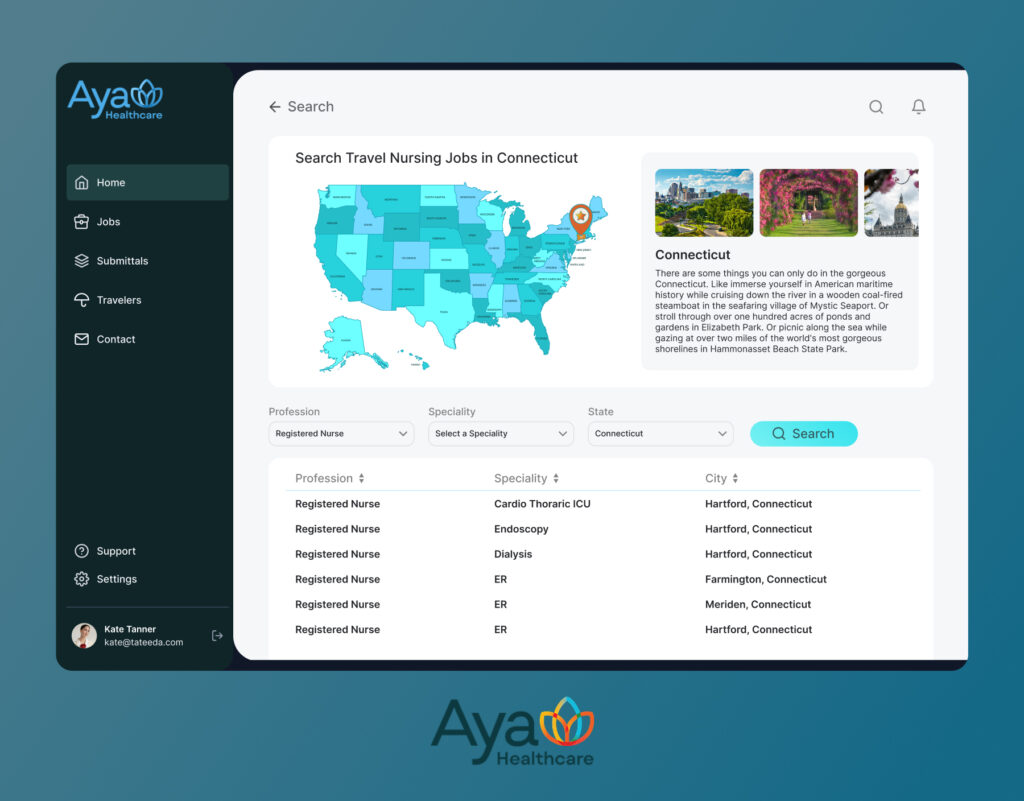
Table of Contents
Why the Build vs. Buy Decision for Healthcare AI Chatbots Matters Now
Healthcare teams continue to ask the same question with increasing urgency: Should we build or buy a healthcare AI chatbot? The market offers shiny “agentic” assistants that promise intake, triage, scheduling, billing, and care navigation; many work well for narrow tasks, while some are just dressed-up workflows with a friendly UI.
Meanwhile, clinical operations, pharmacy, and revenue cycle want an AI system that lives inside real healthcare documentation workflows, respects PHI, and holds up during audits. That is where the choice bites. When to build your custom healthcare AI chatbot is not a branding exercise. It is a decision based on control, safety, and longevity.
At a glance, buying a preconfigured healthcare chatbot gives you speed, predictable pricing, and a clear feature list. It fits best when your use case is standard and your deadlines are short. Building a custom healthcare AI chatbot takes longer and asks more of your team, yet it returns deeper custom healthcare software integration, stronger control of data, and the freedom to evolve the roadmap on your own terms. In between sits the configurable platform track: faster than ground-up work, more flexible than plug-and-play, often good for layered rollouts and pilots.
Healthcare adds extra weight to this calculus. You carry HIPAA obligations; you may sign a BAA; you probably integrate with EHRs using HL7 v2 or FHIR; you store sensitive artifacts in clinical data lakes; you route tasks to humans when risk thresholds trigger. A decision here touches identity (SSO with OAuth 2.0 or OIDC), audit trails, redaction, data retention, and model governance. If your assistant will explain prior-auth decisions, adjust care pathways, or nudge patients about adherence, “good enough” automation can backfire. This is the heart of why to develop a custom healthcare AI chatbot in certain cases: you need fine control of memory, tools, and escalation, because compliance and patient safety are not optional.
Before you select a path, anchor on outcomes. What will “good” look like in six months: higher containment for patient questions; lower call wait times; fewer denied claims; faster refill cycles; safer decision support? Define those targets first. If you plan to integrate an AI platform into your custom medical solution, capture requirements for HIPAA eligibility, EHR connectors, and safe-action guardrails early. The rest of this guide breaks down capabilities, sourcing paths, a decision checklist, and practical triggers for when to build your healthcare AI chatbot versus buying off the shelf.
What “Agentic” Means in a Clinical Setting
“Agentic” gets thrown around; in healthcare or AI-enhanced biotech operations, it must mean something concrete. A custom healthcare AI chatbot with agentic behavior should do at least four things reliably: plan, remember, use tools, and coordinate. Planning means the system can translate a user’s intent into steps; for example, confirm identity, retrieve benefits data, check formulary, propose a prior-auth pathway, and hand off to a human if risk rises.
Memory means the chatbot keeps context across encounters while obeying PHI rules; think encounter-scoped memory with strict retention plus masked transcripts in your data warehouse. Tool use means safe calls into EHR APIs (HL7 v2, FHIR, SMART on FHIR), payer portals, billing rules engines, pharmacy systems, AI-powered medical diagnostics engines for decision support, and patient-facing apps. Coordination means the bot works with other agents or services: one handles eligibility, another handles clinical triage, and a third drafts patient messages for clinician approval.
Buying a preconfigured bot can supply parts of this stack, but it often caps autonomy. You might get templated flows for scheduling or FAQs; that helps, yet once you ask for healthcare AI chatbot custom-built behaviors such as dynamic prior-auth evidence gathering, multi-system reconciliation, or pharmacist counseling prompts, platform templates can run out of road.
“When platform templates cap autonomy and integrations run out of road, that is your signal to develop a custom healthcare AI chatbot: you need reliable tool-use policies, deterministic fallbacks, and a model that does not ‘forget’ safety when prompts get messy.”
Slava K., CEO, TATEEDA
Security posture shapes the architecture. Your chatbot should run with least privilege, keep secrets in a vault, enforce role-based access control, and write tamper-evident audit logs. You will want prompt-injection defenses, output filters, and a human-in-the-loop for clinical advice.
Data flows must separate PHI from analytics where possible; retrieval-augmented generation should point to vetted content, not random web copy. In short, when to build your custom healthcare AI chatbot often correlates with the need to tune these controls yourself rather than wait on a vendor roadmap!
Finally, success is operational, not just technical. In healthcare, an agent that can schedule visits, explain benefits, remind patients about meds, refills, and appointments, and operate inside your mobile experience after you integrate an AI assistant into your healthcare mobile app is effective only if it is measurable and governable.
Define KPIs such as first-contact containment, time to resolution, escalation rate to clinicians, denial reduction in billing, refill cycle time, and safe-action rate. For mobile specifically, track in-app adoption, task completion rates, tap-through rates on reminders, and the session drop-off rate to tune both the assistant’s behavior and the user experience.
A platform may report some of this. A custom healthcare AI chatbot development effort lets you instrument everything you care about, in your format, on your infrastructure.

Three Sourcing Paths for Healthcare AI Assistants
Path A: Build from Scratch (Custom)
You compose the stack: model access, guardrails, vector search, orchestration, tool adapters, identity, logging, and analytics. You decide on hosting, data residency, and how PHI moves. Choose this route when building your custom healthcare AI chatbot is driven by integration depth, safety rules, or differentiation you cannot buy.
| Pros | Cons |
| Full control over data and IP | Slower start |
| Deep EHR and RCM integrations | Higher up-front cost |
| Precise governance and audit | Requires seasoned engineers in AI and clinical systems |
| A roadmap you own | Greater delivery responsibility on your team |
Path B: Configurable Platform
You begin with a vendor framework or SDK, add flows, and wire in tools. Good for pilots, narrow domains, or phased programs where you prove value, then extend. Many teams use this path while they work out edge cases for healthcare AI chatbot custom build phases later.
| Pros | Cons |
| Faster time to a working MVP | Subscription plus add-ons over time |
| Hosting, patches, and plumbing covered | Partial vendor lock-in |
| Still possible to craft unique integrations | Limits around memory, routing, or audit detail |
Path C: Preconfigured Solution
You buy a chatbot targeted at a function: appointment scheduling, FAQs, prescription refills, or benefits questions. Choose this when needs are standard and speed dominates.
| Pros | Cons |
| Quickest launch | Fixed features and tight lock-in |
| Lightest demand on your team | Processes may bend to the tool |
| Vendor handles hosting and often HIPAA eligibility with a signed BAA | Limited integration depth and customization |
There is no universal winner. If your board wants results next quarter for a clearly bounded use case, a prebuilt or platform option fits. If you need autonomy, fine-grained PHI handling, custom triage rules, and multi-system reconciliation, that is why to develop your custom healthcare AI chatbot. Many organizations start on Path B or C to earn quick wins, then shift to Path A once data proves the case and the integration list grows.
The Practical Decision Checklist: Build, Buy, or Hybrid
Use this checklist to decide when to build your custom healthcare AI chatbot versus buying:
Use-case complexity. If all you need is eligibility questions answered or a scheduling flow, buying works. If you require dynamic care triage, prior-auth document assembly, or pharmacist prompts that reflect formulary changes, custom healthcare AI chatbot development becomes attractive.
Integration depth. Count systems: HL7 feeds, FHIR endpoints, payer gateways, billing rules, pharmacy systems, patient payment portals, RPM device telemetry, identity providers, and telemedicine platforms. If you plan to integrate AI in telemedicine software for triage, visit documentation, or post-visit follow-ups, orchestration needs increase. The more systems involved, the more you will want your own orchestration, adapters, and observability. That is why many teams develop a custom healthcare AI chatbot: you avoid brittle glue and can debug every hop.
Data and IP control. If you must keep all PHI and transcripts in your environment, audit them your way, and tune models against your knowledge base, custom wins. If vendor storage with a BAA is fine and you are comfortable with export tools, buying stays viable.
Speed to value. If you need relief in weeks, start with a preconfigured platform. Plan the handoff to custom later if pilots prove sticky.
Budget profile. Custom front-loads spend, then flattens as you reuse building blocks across departments. Platform or prebuilt lowers the initial bill yet can accrue per-seat, per-message, or enterprise add-on costs. Create a 12–24 month view before deciding.
Team capacity. Do you have architecture, security, data, and testing covered? If yes, the risk drops for a custom program. If not, a platform with professional services can bridge the gap.
Governance and safety. If you must implement your own redaction, toxicity filters, prompt-injection defenses, safe-action gates, clinical escalation, and tamper-proof logs, that is a strong driver for a healthcare AI chatbot custom build.
Measurement. If you require exact KPIs tied to your data warehouse and BI, custom instrumentation is easier when you own the stack.
Turn the checklist into a simple scorecard: rate each factor from low to high. Scores tilting toward control, complexity, and compliance signal when to build your custom healthcare AI chatbot. Scores tilting to speed and standardization point to buying. A hybrid plan is common: deploy a platform-based MVP in one clinic; run hard metrics; document integration friction; then commit to custom work where it truly pays off.
When to Go Custom: Triggers, Scenarios, and Payoffs
Here are clear triggers for why to develop your own healthcare AI chatbot:
1) Safety-critical workflows. If the assistant suggests care steps, interprets device data, or prepares clinical summaries, you will need your own guardrails, escalation ladders, and audit workflows. A custom healthcare AI chatbot lets you specify safe-action thresholds, clinician approvals, and record-keeping rules that align with your policies.
2) Deep EHR and billing ties. When the assistant must read and write across HL7 v2, FHIR, appointment books, problem lists, benefits, and RCM rules, platform scaffolding may not expose the control you want. Custom orchestration means idempotent calls, retries, backoff, and reconciliation built specifically for your systems.
3) Pharmacy and eRx nuance. If the bot handles formulary checks, alternatives, and counseling prompts, you will likely need custom logic around state rules and payer quirks. That complexity is a textbook case for when to build a custom healthcare AI chatbot.
4) Remote patient monitoring. Combining device telemetry with symptom checks and risk scores requires careful model prompts, thresholding, and clinician alerts. A bought bot may read data; a custom assistant can decide when to notify, whom to notify, and how to document it.
5) Multi-department reuse. Support now, HR next, IT after that. Custom work pays off when you plan for modular agents that share memory services, tool adapters, and policy engines. You avoid repeating fees and you control cadence.
6) Long-term roadmap control. If your leadership wants to add multilingual support, custom triage rules, patient-education personalization, or claims analytics at your pace, owning the core matters. This is another reason to develop your custom healthcare AI chatbot instead of waiting for vendor timelines.
The payoff is not only autonomy. A well-built custom healthcare AI chatbot can reduce denied claims by handling front-end accuracy, shorten hold times by resolving routine questions, shorten refill cycles by pushing clean data, and improve clinician satisfaction by drafting structured notes for review. The catch is discipline: you will need strong QA, privacy reviews, and change control. That effort is the price of durability and differentiation.

When to Buy, Plus the Hybrid That Most Teams Pick
Buying is sensible when your needs are standard and time is tight. A HIPAA-eligible preconfigured chatbot with a BAA can answer benefit questions, schedule visits, route refills, and deflect easy calls. A configurable platform can deliver a healthcare AI chatbot MVP quickly while you validate intent detection, tone, and handoff rules. This is often step one in a hybrid plan that later introduces healthcare AI chatbot custom-built features where they matter most.
Avoid common traps:
- Do not accept “agentic” claims without a pilot on your data.
- Map integration early: identity, SSO, data flows, eventing, and logging.
- Negotiate export options and exit clauses so you can pivot if costs spike or features stall.
- Design for reuse from day one: shared knowledge bases, shared adapters, a clear taxonomy for intents.
- Plan post-launch care: model updates, prompt changes, new tools, safety tests, and rollback procedures.
- Treat the chatbot as a product with a backlog and owners.
Between evaluation and rollout, establish a simple operating model: appoint a product owner, a security lead, and a data steward; agree on KPIs and reporting cadence; document safe-action gates and human escalation; and set clear runbooks for incidents, rollback, and model updates. This creates the governance spine that keeps speed and safety in balance.
A practical hybrid path looks like this:
- Quarter 1: Deploy a platform bot for scheduling and FAQs in one specialty.
- Quarter 2: Add benefits checks and refills; connect to BI for KPIs like containment, escalation, and CSAT.
- Quarter 3: Start custom healthcare AI chatbot development for the trickiest integration, for example, prior-auth assembly that pulls evidence, drafts forms, and prepares a packet for staff approval.
- Quarter 4: Move the custom components into production, keep the platform for simpler tasks, and decide what to absorb next.
In the end, there is no single right answer. The right answer is sequenced. Buy where speed wins and the work is common. Develop a custom healthcare AI chatbot where safety, integration depth, and roadmap control determine outcomes. Keep the scorecard, measure trade-offs, and iterate so your assistant stops being a demo and becomes infrastructure.
Proof-of-Value Pilot Blueprint: 30, 60, 90 Days to a Confident Decision
Use this section to turn intent into evidence. The goal is simple: prove where a platform is enough and where a custom healthcare AI chatbot earns its keep.
Pre-work checklist:
- Business guardrails: success criteria, stakeholders, clinical escalation rules, and a signed BAA.
- Data readiness: sample encounters, test PHI handling, EHR sandbox access, payer and pharmacy test endpoints.
- Security setup: least-privilege service accounts, audit logging, redaction policy, prompt-injection tests.
- Integration scope: EHR (HL7, FHIR), billing and RCM, pharmacy, telemedicine, and mobile SDKs if you plan to integrate an AI assistant into your healthcare mobile app.
Pilot timeline:
| Phase | Primary goals | Key deliverables | Accountable owner |
| Day 0–30 | Stand up MVP in one workflow | Connected sandbox, safe-action gates, draft prompts, baseline metrics | Product owner with security lead |
| Day 31–60 | Run controlled live traffic | A/B rules, KPI dashboard, error and drift logs, weekly review notes | Data steward with clinical lead |
| Day 61–90 | Harden and decide | Remediation plan, integration backlog, TCO view, go or grow decision | Steering group |
What to measure during the pilot:
| KPI | Definition | Pilot target |
| First-contact containment | % of inquiries resolved without human handoff | 25–40% for standard tasks |
| Time to resolution | Median time from first contact to outcome | 20–30% faster vs. baseline |
| Escalation quality | % of escalations with all required context attached | 95% or better |
| Denial reduction | Change in payer denials on touched encounters | 10–20% reduction |
| Refill cycle time | Time from request to fulfillment | 15–25% faster |
| Safe-action rate | % of actions passing policy checks | 99% or better |
| In-app adoption (if mobile) | % of eligible users completing tasks in app | 30–50% within pilot cohort |
Go or grow criteria:
- Go with a platform where KPIs meet or exceed targets and integrations stay simple.
- Grow into custom healthcare AI chatbot development where safety rules, EHR depth, prior-auth assembly, pharmacy nuance, or telemedicine workflows require finer control.
- Defer or redesign where error patterns persist or business value is unclear.
Lightweight ROI sketch:
- Annualized benefits: (minutes saved per task × tasks per year × fully loaded rate) plus recovered revenue (fewer denials, higher show rates).
- Annual costs: licenses or cloud spend, support effort, and one-time integration amortized over 2–3 years.
- ROI % = (Annualized benefits − Annual costs) ÷ Annual costs.
- Tip: track both cash savings and capacity released so you can choose whether to redeploy staff time or reduce overtime.
Handoff into production:
- Promote only what cleared success thresholds, then expand one workflow at a time.
- Keep a monthly “safety and drift” review: prompts, models, redaction, and audit reports.
- Maintain a shared backlog for platform features and custom components so the hybrid stays coherent.
Ask Us to Help You Decide, Build, and Scale Your Custom Healthcare AI Chatbot
Build where control, safety, and deep hooks into your systems set the bar; buy where speed and standardization carry the day. The smart move is sequenced: prove value fast, then invest in custom healthcare AI chatbot capabilities where they change outcomes—fewer denials, shorter wait times, cleaner data, better patient follow-through.
Since 2013, our San Diego team—backed by senior engineers in LATAM and Europe—has built HIPAA-ready solutions with EHR integrations (HL7, FHIR), pharmacy and billing ties, and mobile experiences that integrate an AI assistant into your healthcare app.
If you are deciding on build vs. buy for healthcare AI chatbots, we can help you scope a proof-of-value pilot, map integrations, and stand up the pieces that matter most.
Ready to move? Share your goals and constraints, and we will return a concise plan with a timeline, integrations, and clear success metrics.
FAQ
1) How much does it cost and how long does it take to build vs. buy?
- Preconfigured chatbot (buy): setup in 2–6 weeks; software fees typically low five figures/year, plus usage. Good for standard tasks like scheduling or FAQs.
Estimates only; actuals vary by scope, channels (web/voice/mobile), content prep, security reviews/BAA, and data migration. - Configurable platform (buy-plus-configure): MVP in 6–12 weeks; services and licenses often $100k–$400k to reach a pilot with EHR and billing ties.
Depends on integration depth with Epic/Oracle Health/athenahealth/NextGen, payer connections (UHC, BCBS, Elevance, Humana, Optum), analytics setup, and internal availability for testing. - Custom healthcare AI chatbot (build): phased delivery in 3–6 months for the first high-value workflow; investment commonly $300k–$1.2M across design, integrations, safety gates, and go-live.
Shifts with the number of use cases (e.g., prior auth, pharmacy via Truepill, telehealth via Amwell/Teladoc), HIPAA/GDPR requirements, hosting model, model evaluation/safety harness, and change management. - Tip: run a 30–60–90 day proof of value to anchor TCO and ROI before scaling.
Timelines assume sandbox access, timely stakeholder approvals, and vendor cooperation for APIs (e.g., Waystar, Salesforce, Nuance, Viz.ai, Komodo Health, Prognos Health).
2) What specific technologies are used under the hood?
- Language models and AI services: OpenAI for LLMs; IBM for NLP and data services; Nuance for ambient clinical documentation; Viz.ai for imaging triage; Komodo Health and Prognos Health for population insights.
- Orchestration and memory: tool-use policies, prompt routers, retrieval with vector stores, evaluation harnesses for safety and drift.
- Healthcare data pipes: HL7 v2, FHIR, SMART on FHIR; identity via OAuth 2.0/OIDC; full audit logging and redaction.
- Cloud and data: HIPAA-eligible stacks on AWS, Azure, or GCP; encrypted storage; CI/CD and observability.
3) What AI integration options do we have with our current systems and apps?
- EHR and clinical systems: Epic, Oracle Health (Cerner), athenahealth, NextGen.
- Payers and platforms: Blue Cross Blue Shield, UnitedHealthcare (UHC), Elevance Health, Humana, Optum; clearinghouse/payments via Waystar.
- Patient experience and telehealth: Amwell and Teladoc Health for virtual care; Salesforce for CRM and outreach; Truepill for pharmacy and fulfillment.
- AI and analytics layers: OpenAI for LLM capabilities; Nuance for scribing; Viz.ai for imaging workflows; Komodo Health and Prognos Health for data/insights.
- Channels: web portal chat, contact-center voice, and the option to integrate an AI assistant into your healthcare mobile app for refills, reminders, and secure messaging.
4) How do we decide build vs. buy for healthcare AI chatbots?
- Buy when the scope is standard, timelines are short, and vendor features already match ~80% of needs. Examples: appointment bots tied to Epic scheduling or a Teladoc Health front door for virtual visits.
- Build when you need deep EHR and billing ties, tight PHI controls, complex prior-auth logic across payers like UHC or Blue Cross Blue Shield, or a roadmap you control.
- Hybrid when you want speed plus differentiation: start on a platform, then add custom components where outcomes depend on fine-grained safety, auditing, and multi-system orchestration.
- Use a scorecard across complexity, integrations, data ownership, speed, budget horizon, team capacity, governance, and measurement to decide with evidence.




![8 Medical Billing Automation Developers in California [2026]](https://tateeda.com/wp-content/uploads/2026/10/Cover.png)
