AI mHealth App Development: Architecture, HIPAA Compliance, and FDA Framework

Slava Khristich



Vlad Nazarov

In this article, you’ll learn how AI mHealth app development works when engineering, HIPAA compliance, FDA/SaMD risk, on-device AI, cloud inference, and clinical model validation all have to fit together. The guide explains how to choose the right AI architecture, protect PHI, validate models for bias, avoid late compliance rebuilds, and plan a safer path from mobile health app idea to production.
AI mHealth app development requires four decisions made in sequence: defining the use case, determining the FDA regulatory pathway, designing a Health Insurance Portability and Accountability Act (HIPAA)-compliant data pipeline, and choosing an on-device or cloud inference architecture. Most engineering teams address these decisions in the wrong order — and spend months rebuilding.
The global mHealth market will exceed $86 billion by 2030. AI is now the primary feature differentiator in that market. It is also the fastest path to a HIPAA violation, an FDA enforcement action, or a model that delivers subtly biased clinical outputs to patients who trusted your app.
This guide is written for CTOs and VPs of Engineering at US healthtech companies. It covers the full engineering and compliance decision stack for mHealth AI integration — not a marketing overview of what AI can do, but a working framework for building it correctly from the first sprint.
| Key Takeaways: ✅ On-device AI (Core ML, ML Kit, NNAPI) keeps Protected Health Information (PHI) on the device. Cloud AI (Azure OpenAI, AWS HealthLake) requires a Business Associate Agreement (BAA) from every vendor whose infrastructure touches PHI. ✅ AI features that diagnose, treat, or inform clinical decisions may qualify as Software as a Medical Device (SaMD) under FDA rules. The January 2026 FDA clinical decision support guidance updated how this line is drawn. ✅ HIPAA requires feeding AI models only the minimum PHI necessary for the task, de-identifying training data via Safe Harbor or Expert Determination before it enters any training pipeline, and logging every AI-driven PHI access with tamper-evident audit records. ✅ Clinical mHealth AI must be validated for demographic bias. A model that achieves 92% accuracy at the population level can perform at 76% for specific patient subgroups. ✅ TATEEDA has shipped production AI features in mHealth, including AI-assisted intake and scheduling in the AYA Healthcare travel nurse platform and arrhythmia detection AI in the VentriLink remote cardiac monitoring app. |
Why TATEEDA is qualified to discuss AI in mHealth apps
TATEEDA has been building healthcare software since 2013, including patient portals, healthcare mobile apps, EHR/EMR integrations, remote monitoring systems, and AI-assisted workflows for U.S. healthtech teams. This gives us practical insight into the real engineering questions behind AI mHealth app development: PHI handling, HIPAA-ready architecture, FHIR data exchange, mobile performance, cloud vs. on-device AI, and clinician review gates.
Our experience includes production work for healthcare organizations such as AYA Healthcare and VentriLink, including AI-assisted intake, scheduling, and remote cardiac monitoring functionality. So when we write about AI in mHealth apps, we are not discussing abstract AI potential. We are looking at what it takes to build, validate, integrate, and safely release healthcare mobile software in regulated environments.
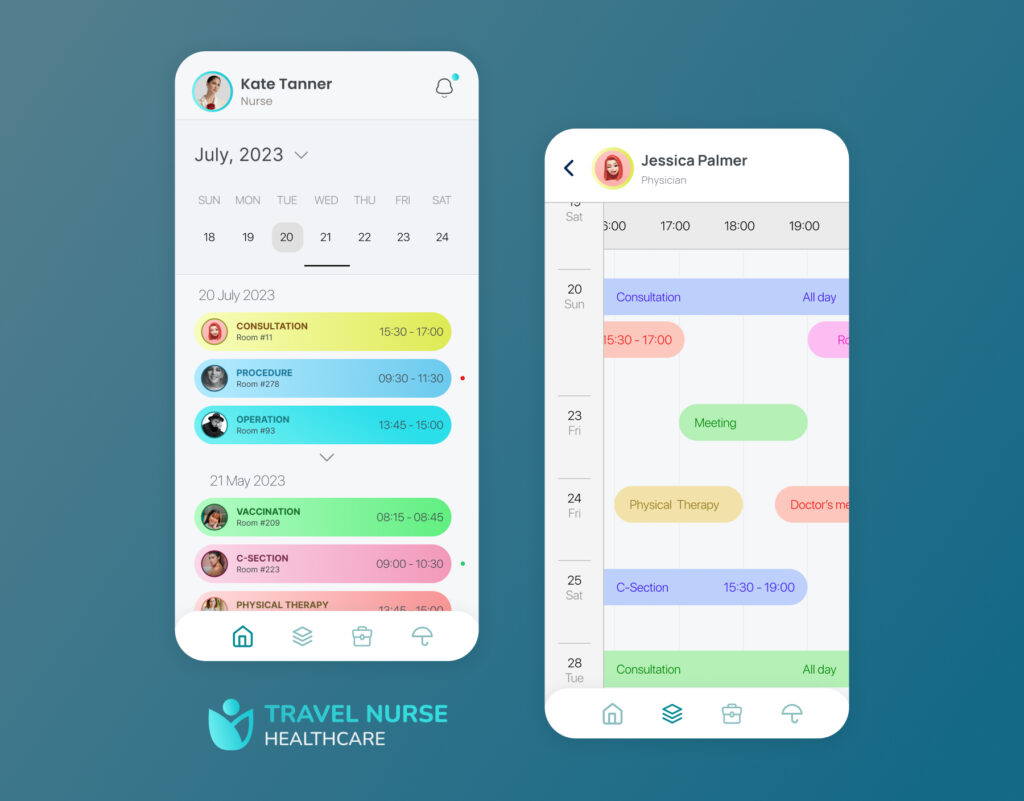
Table of Contents
What AI Can Actually Do in a mHealth App (and What It Cannot)
Before any architecture decision, establish which AI category you are building. The use case determines regulatory risk, data requirements, and validation standards.
Diagnostic AI
Computer vision models analyze skin lesion images for melanoma probability, classify cough audio to differentiate respiratory presentations, and detect arrhythmias in real-time ECG streams from wearables. All three are in production clinical mHealth deployments in 2026. The critical constraint: any feature that returns a clinical interpretation to a patient or provider without a clinician review gate likely qualifies as SaMD under FDA rules — addressed in detail below.
Predictive analytics
Supervised machine learning (ML) models trained on Electronic Health Record (EHR) data, wearable signals, and behavioral history to generate readmission risk scores, chronic disease progression timelines, and medication adherence predictions. Pilot programs at US health systems have used these models to reduce 30-day readmission rates. The training data must represent your patient population, and the model’s confidence intervals must be surfaced to clinicians rather than suppressed from view.
NLP for clinical context
Natural language processing (NLP) handles three high-value mobile use cases: clinical note summarization (transforming a recorded consultation into a SOAP note draft), symptom intake parsing (extracting structured clinical intent from unstructured patient input), and mental health sentiment detection (flagging linguistic markers associated with depression or crisis in journaling and messaging features).
Patient engagement AI
Personalized nudges calibrated to a patient’s specific biomarkers, care plan, and behavioral patterns require a rules engine plus a lightweight language model for natural phrasing. This category carries minimal regulatory exposure and delivers measurable engagement improvement in chronic disease management apps.
What AI should not do autonomously?
An AI model should not autonomously adjust medication doses, triage a patient record as low priority, or deliver a definitive diagnosis without a clinician review gate. The FDA’s January 2026 clinical decision support (CDS) guidance makes explicit that software replacing clinical judgment — rather than informing it — falls within mandatory SaMD regulatory review. Build the human-in-the-loop gate before you need it, not after a compliance review flags the feature.
| What happens when this step is skipped: Michael Rivera ran engineering at a 25-person digital health startup. In late 2025, his team integrated GPT-4 into a symptom journaling analysis feature — fast, low friction, impressively accurate in testing. Three months after launch, a HIPAA compliance review identified the problem: the feature was sending patient symptom data to OpenAI’s consumer API, which does not sign BAAs and may use input data for model training. The feature was taken down immediately. The team migrated to Azure OpenAI Service under a signed BAA and rebuilt the data pipeline from scratch. The AI capability was identical after migration. Everything that needed rebuilding was the compliance architecture that should have been designed in sprint one. |

Talk to our solution architects before the first sprint to map the right AI use case to your mHealth roadmap.
Choosing Your AI Architecture: On-Device vs. Cloud Inference
This is the most consequential engineering decision in an mHealth AI build. On-device AI healthcare applications achieve sub-100ms latency while eliminating PHI transmission risk; cloud inference unlocks full LLM capability at the cost of BAA overhead. The choice determines latency, offline capability, PHI exposure surface, and compliance overhead simultaneously.
| Factor | On-device AI | Cloud inference |
|---|---|---|
| Latency | Less than 100ms (local) | 200ms–2s (network-dependent) |
| Offline capability | Yes | No |
| PHI leaves device | No | Yes — requires BAA |
| Model capability | Edge-optimized (Core ML, TFLite, ONNX) | Full LLM (GPT-4o, Claude, Llama 3) |
| BAA required | No | Yes, from every cloud vendor |
| Model update cadence | App store review cycle | Real-time API updates |
| Cost at scale | Higher device requirements | Higher API costs per inference |
On-device inference
Apple’s Core ML framework supports on-device inference for classification, computer vision, NLP, and anomaly detection tasks on iOS. Google’s ML Kit provides the same capabilities on Android, with the Android Neural Networks API (NNAPI) providing hardware-accelerated inference on Android 8.1 and above. TensorFlow Lite and ONNX Runtime are the cross-platform options for teams building in React Native, Flutter, or .NET MAUI.
On-device inference is the correct architecture when: real-time vital sign anomaly detection requires sub-100ms response, camera-based diagnostic workflows cannot tolerate network latency, offline capability is required for rural or low-connectivity deployments, or PHI minimization design constraints prohibit data transmission.
The capability tradeoff is real and must be formally validated. A model achieving 98.3% accuracy on cloud infrastructure may perform at 94.8% on-device due to quantization and size constraints. For clinical applications, that delta requires documented validation — not an assumption that the accuracy difference is clinically acceptable.

Cloud inference
Azure OpenAI Service, AWS SageMaker with HealthLake, and Google Cloud’s Healthcare API all provide HIPAA-eligible cloud AI infrastructure. “Eligible” is not “compliant” — each vendor must sign a BAA covering their specific services. AWS’s BAA covers SageMaker and HealthLake under a single agreement. Azure’s BAA covers Azure OpenAI Service under the Microsoft Product and Services Agreement. Google’s BAA covers Healthcare API and the FHIR store, but not all Google Workspace products.
Cloud inference is the correct architecture when: the use case requires large language model (LLM) reasoning capability (SOAP note generation, prior authorization Q&A, complex benefit navigation), model capability outweighs latency requirements, or the inference workload evolves faster than the app store review cycle allows.
Hybrid architecture: the production standard
The most robust production pattern for clinical mHealth AI in 2026 is hybrid. On-device preprocessing handles real-time signal processing and PHI de-identification before any data leaves the device, then passes only the minimum necessary structured input to cloud models for reasoning and generation. The device handles latency-sensitive and PHI-exposure-sensitive work. The cloud handles reasoning-intensive work. PHI exposure is minimized at the source.
Building a HIPAA-Compliant AI Data Pipeline
The HIPAA Security Rule, Privacy Rule, and Breach Notification Rule apply to AI workloads exactly as they apply to any other PHI processing system. What distinguishes AI is the volume, granularity, and persistence of PHI flowing through inference pipelines — and the relative invisibility of that flow compared to traditional data transactions.
PHI minimization for inference
The Privacy Rule’s “minimum necessary” standard requires that PHI use be limited to what is needed for the stated purpose. Applied to AI inference: if a sentiment analysis model needs only journaling text, the full EHR record must not be sent to the inference API. Enforce PHI scoping at the data pipeline layer with access controls and request filtering — policy alone is not a technical safeguard.
De-identification for model training
Training a model on patient data requires de-identification before data enters the training pipeline. HIPAA provides two recognized methods. Safe Harbor requires removal of 18 specific identifiers, including names, geographic data below state level, dates other than year for patients over 89, device identifiers, and biometric data. Expert Determination requires a qualified statistician to certify that re-identification risk is “very small.” Safe Harbor is more predictable; Expert Determination allows more clinically useful training data at the cost of a documented formal assessment. De-identified data falls outside HIPAA’s PHI definition and can be used for model training without BAA requirements or individual consent.
Security requirements for AI API calls
Every API call carrying PHI to a cloud AI service must meet HIPAA technical safeguard requirements:
- TLS 1.3 in transit (TLS 1.2 minimum if TLS 1.3 is not supported by the endpoint)
- AES-256 encryption for PHI stored at rest, including any cached model inputs or outputs
- Role-based access control (RBAC) limiting which services and authenticated users can initiate inference requests carrying PHI
- Multi-factor authentication (MFA) for all administrative access to AI inference infrastructure
- Zero-trust network segmentation between the AI inference service boundary and core application data stores
Audit logging AI-driven PHI access
HIPAA’s audit controls requirement applies to all PHI access — including AI-initiated access. Every inference request that includes PHI must be logged with: timestamp, authenticated user or system identifier, PHI resource types included, model endpoint, and output classification or recommendation generated. Logs must be retained for a minimum of six years, must be tamper-evident, and must be accessible for review by authorized personnel and HHS investigators.
For the full HIPAA architecture applied to regulated healthcare software, see our HIPAA-compliant healthcare software development services.
Does Your AI Feature Require FDA Approval?
This question is asked too late in most mHealth development cycles. The answer determines whether your feature requires months of regulatory review or none at all — and whether your current timeline is realistic.
The SaMD definition
The FDA defines Software as a Medical Device (SaMD) — adopting the International Medical Device Regulators Forum (IMDRF) definition — as software intended to be used for one or more medical purposes without being part of a hardware medical device. Mobile app features fall within this scope. The operative word is “intended.” If your feature is designed to inform, aid, or replace clinical decision-making for a specific patient, the SaMD framework applies regardless of whether the feature is accurate or beneficial.
Clinical decision support: the current boundary
The 21st Century Cures Act established a statutory carve-out for software that displays or communicates clinical data without replacing clinical judgment. The FDA’s January 2026 CDS guidance operationalized the boundary:
Not SaMD — no FDA regulatory pathway required:
- Administrative and scheduling features
- General wellness and fitness tracking
- Features that display EHR data without making interpretive recommendations
- Features where a qualified clinician exercises independent evaluation before any clinical action
SaMD — FDA regulatory review required:
- Features that provide a diagnosis without requiring independent clinician review
- Features that recommend specific medication changes, dosing adjustments, or treatment modifications
- Features that trigger clinical alerts designed to substitute for physician evaluation
- AI that classifies or interprets medical images for diagnostic purposes
A symptom checker returning “your symptoms may suggest X — please consult your physician” sits near the boundary. A symptom checker returning “you have X; take Y mg of medication Z” is SaMD by definition.

The Predetermined Change Control Plan
The FDA’s August 2025 guidance on AI/ML-based SaMD introduced the Predetermined Change Control Plan (PCCP). If your AI model updates continuously through learning, or if you plan to retrain it on new data post-deployment, a PCCP documents what will change, what analytical validation occurs before changes are deployed, and how performance is monitored post-deployment. Without a PCCP, every model update that affects clinical performance may require a separate 510(k) submission. The FDA’s SaMD guidance framework is published at FDA.gov’s AI/ML SaMD resources.
| The cost of a late FDA determination: Jordan Chen led product at a 40-person healthtech company building a sepsis risk scoring feature inside an existing mHealth platform. The model reached 89% sensitivity in internal validation. Six weeks before launch, legal flagged the feature: it surfaced clinical risk scores directly to nursing staff without requiring physician review. Under FDA’s SaMD framework, that met the definition of a Class II medical device — a 510(k) submission was required. The six-week timeline became 18 months. The re-architecture cost four months. The feature was redesigned to surface scores to attending physicians who exercised independent clinical judgment before any intervention. The 510(k) cleared. The feature shipped. The question “is this SaMD?” costs almost nothing to ask before the feature is designed. It costs significantly more to answer after it is built. |
Our healthcare IT consulting team conducts SaMD determination assessments as a defined engagement before development begins.
Technology Stack for AI mHealth App Development
TATEEDA’s production mHealth AI stack covers four layers: mobile client, on-device inference, cloud AI services, and FHIR data integration.
Mobile frameworks
React Native and Flutter both support integration with platform-native inference libraries via native modules. For iOS-specific on-device inference, Core ML is the standard; for Android, ML Kit handles classification, text recognition, and custom TensorFlow Lite models. .NET MAUI supports cross-platform inference via ONNX Runtime on iOS, Android, and Windows. For clinical apps requiring tightly controlled data flows, Flutter with native inference bridges provides more predictable performance isolation than React Native in production — the native module boundary is cleaner.
Cloud AI services with HIPAA BAAs
Azure OpenAI Service provides GPT sync, and embedding models on HIPAA-eligible Microsoft Azure infrastructure. BAA coverage is available under the Microsoft Product and Services Agreement. Preferred for .NET-primary backend stacks and for clients already operating Azure infrastructure.
AWS SageMaker + HealthLake combines custom model training and inference (SageMaker) with a FHIR R4-native health data store (HealthLake). The AWS Business Associate Addendum covers both services under a single agreement. Preferred for teams already running infrastructure on AWS.
Google Cloud Healthcare API provides FHIR R4, HL7v2, and DICOM stores with HIPAA-eligible infrastructure under Google’s BAA. Preferred for teams using Vertex AI for custom model development.
FHIR R4 as the AI data layer
The most durable architecture for clinical mHealth AI feeds the inference pipeline from a Fast Healthcare Interoperability Resources (FHIR) R4 data layer. Patient data arrives via Patient, Observation, Condition, MedicationRequest, and Encounter FHIR resources. The AI pipeline queries the FHIR server for the relevant resource set, enforces PHI minimization at the query boundary, and passes structured inputs to the inference endpoint.
This separation keeps the clinical data layer and the AI layer independent. When the model changes, the FHIR data contracts stay stable. When EHR integrations change (Epic, Oracle Health, athenahealth), the AI pipeline stays stable. The FHIR R4 specification is published at HL7.org/fhir/R4.
Backend for model serving
For custom models, TATEEDA deploys inference APIs using Python (FastAPI + Uvicorn) containerized in Docker and orchestrated via Kubernetes on AWS ECS or Azure Kubernetes Service (AKS). For real-time inference requiring sub-200ms p95 latency, we configure autoscaling inference endpoints with capacity validated against peak usage load profiles before production release.
Our custom AI development for healthcare practice covers the full stack from model selection and validation through production deployment and monitoring.
AI Model Validation for Clinical mHealth
Shipping an AI feature into a clinical mobile context is not the same as shipping an AI feature into a consumer app. The bias, drift, and explainability requirements are qualitatively different — and the consequences of validation gaps reach patients directly.
Demographic bias testing
A model achieving 92% accuracy at the population level may perform at 76% for a specific patient subgroup. If that subgroup is already medically underserved, which is disproportionately common in the US healthcare system, the AI feature amplifies that disparity rather than addressing it.
Clinical mHealth AI models must be validated across the demographic dimensions relevant to your patient population: age cohort, sex assigned at birth, race and ethnicity, BMI range, and relevant comorbidity burden. Model cards documenting per-subgroup performance metrics should be completed before any clinical deployment and updated with each significant model revision.
Explainability in clinical contexts
Black-box outputs create liability exposure in clinical settings. A clinician who acts on an AI recommendation they cannot explain occupies a different liability posture than one who acted on a transparent risk score with documented clinical logic.
LIME (Local Interpretable Model-agnostic Explanations) and SHAP (SHapley Additive exPlanations) are standard post-hoc explainability approaches for structured ML models. For LLM-based features, chain-of-thought prompting with source citation makes model reasoning auditable for clinical reviewers.
Post-deployment monitoring for model drift
Model performance in production diverges from validation performance over time. Model drift in healthcare is accelerated by seasonal illness patterns, changes in care protocols, and demographic shifts in the patient population served. Production mHealth AI deployments should monitor prediction distribution stability, feature importance drift, and — where outcome data is available — correlation between model outputs and actual clinical outcomes. Alert thresholds for drift should trigger revalidation workflows, not automatic retraining.
| When validation gaps surface in production: Maria Santos led QA at a digital therapeutics startup. Their medication adherence prediction model for diabetic patients validated at 88% accuracy before launch. Eighteen months post-launch, clinicians started flagging anomalies: the model was triggering check-ins for high-adherence patients while underweighting risk signals for a specific cohort. Investigation revealed the cause. The original training data had overrepresented patients from one regional health system. As the product expanded nationally, the model encountered EHR documentation patterns and comorbidity profiles outside its training distribution. Aggregate accuracy remained stable. Subgroup performance had degraded. The fix — stratified retraining on a nationally representative dataset and per-demographic monitoring alerts — took three months. The harder cost was the clinician trust that eroded during the window of miscalibration. |
AI mHealth App Development Process: 10 Steps From Use Case to Production
- Define the use case and clinical boundaries.Is this diagnostic, predictive, administrative, or engagement AI? What decisions does it inform? What decisions does it automate?
- Conduct an FDA SaMD determination.Does the feature meet the SaMD definition under the January 2026 CDS guidance? If uncertain, engage FDA regulatory counsel or request a pre-submission meeting with FDA.
- Map PHI data flows.What PHI elements does inference require? Where do they originate? Where do they travel? Who handles them?
- Choose on-device, cloud, or hybrid architecture.Based on latency requirements, offline needs, PHI exposure tolerance, and required model capability.
- Select cloud AI vendors and execute BAAs.Verify BAA coverage for each vendor whose infrastructure touches PHI in the inference pipeline — not just the primary vendor.
- Design the HIPAA-compliant data pipeline.PHI minimization at the query layer, de-identification for training data, encryption at rest and in transit, RBAC, audit logging.
- Select, fine-tune, and validate the model.Benchmark against clinical performance requirements. Run demographic bias testing. Document the model card before any clinical deployment.
- Implement explainability and human-in-the-loop gates.Define risk score thresholds that trigger human review. Implement SHAP, LIME, or chain-of-thought for clinical reviewer transparency.
- Develop and file the PCCP if SaMD-applicable.Document the change taxonomy, pre-deployment validation protocol, and post-deployment monitoring framework.
- Deploy, monitor, and retrain on a defined cadence.Track per-subgroup performance, model drift metrics, and clinical outcome correlation from day one of production.
TATEEDA mHealth AI in Production
TATEEDA has shipped AI features in regulated clinical mobile applications. Two projects illustrate the architecture decisions in practice.
VentriLink — Remote Cardiac Monitoring integrates remote patient monitoring data from ECG wearables with an on-device anomaly detection model to flag arrhythmia events for physician review. The mobile app uses Flutter with ONNX Runtime for on-device signal preprocessing — PHI never leaves the device during the detection phase. Flagged event windows are transmitted to the cloud inference layer with a minimal, de-identified payload. A human-in-the-loop gate routes physician notifications before any patient-facing alert is generated.
AYA Healthcare — Travel Nurse Platform deployed AI-assisted intake and messaging across a React Native mHealth app serving tens of thousands of healthcare staff. The AI layer handles intake form pre-filling (NLP parsing of credential documents), benefits question-and-answer (retrieval-augmented generation over plan documents), and shift matching (ML on credential requirements, location preferences, and availability patterns). The entire stack operates under a HIPAA BAA with AYA Healthcare, with zero-trust network segmentation between the AI inference layer and core application data. TATEEDA’s AI-assisted development workflow — the same approach that delivered one healthtech product 4x faster in a documented case study — powered rapid delivery of the HIPAA-ready product for the client.
Our mobile app development and healthcare AI development practices can be mobilized within 48-72 hours for qualified engagements.
Frequently Asked Questions
What is the difference between an AI assistant feature and an AI diagnostic feature in a mHealth app?
An AI assistant feature handles administrative, communication, or general wellness functions — intake completion, scheduling, benefits navigation, personalized health nudges. These do not typically constitute SaMD under current FDA guidance. An AI diagnostic feature generates clinical interpretations — risk scores, image classifications, treatment recommendations — intended to inform specific care decisions for identified patients. Diagnostic features require an FDA SaMD determination and may require 510(k), De Novo, or PMA review depending on risk classification.
Do all AI features in mHealth apps require FDA approval?
No. Administrative and general wellness AI features typically fall outside FDA’s SaMD jurisdiction. Features meeting the SaMD definition — software intended to diagnose, treat, or inform specific clinical decisions without requiring independent clinician evaluation — require regulatory review. The FDA’s current framework for this determination is available through HHS.gov’s digital health resources.
How do you train an AI model on patient data without violating HIPAA?
Training data must be de-identified before entering the ML training pipeline. HIPAA’s Safe Harbor method specifies 18 identifiers that must be removed or generalized. Expert Determination requires a qualified statistician to certify that re-identification risk is “very small.” De-identified data falls outside HIPAA’s PHI definition and can be used for model training without BAA requirements or individual patient consent.
Which cloud AI platforms have HIPAA BAAs available?
AWS (Business Associate Addendum covers SageMaker, HealthLake, and most AWS services), Microsoft Azure (BAA covers Azure OpenAI Service and other Azure services under the MPSA), and Google Cloud (BAA covers Healthcare API and FHIR store). Consumer versions of OpenAI, Gemini, and Claude do not offer BAAs. Enterprise API access via Azure OpenAI, AWS Bedrock, or vendor-direct enterprise agreements may include BAA coverage — verify per-service before assuming coverage extends across a platform.
How long does it take to build an AI feature into a mHealth app?
The timeline for integrating AI into healthcare mobile apps depends on the use case category and regulatory pathway. Administrative AI (intake, scheduling, Q&A) requires 8-16 weeks for MVP. Predictive analytics on structured EHR data requires 16-24 weeks including model validation. Diagnostic AI with SaMD classification requires 12-18 months including FDA review. On-device computer vision features require 20-36 weeks including edge model optimization and on-device performance validation. Use our healthcare software cost estimator for a scoping estimate tailored to your use case.
Conclusion
Building a HIPAA-compliant AI mobile health app is simultaneously an engineering challenge and a compliance challenge. The engineering decisions — on-device vs. cloud inference, FHIR as the AI data layer, hybrid architecture, model serving infrastructure — are well-understood and well-documented. The compliance decisions — HIPAA data pipeline design, FDA SaMD classification, demographic bias validation, post-deployment drift monitoring — are less standardized and carry real consequences when handled late.
Teams that get AI mHealth app development right front-load the FDA determination, design PHI minimization from sprint one, verify BAA coverage before committing to a cloud AI vendor, and build human-in-the-loop review gates before the feature goes to clinical users.
TATEEDA has built AI features in clinical mobile contexts. Our senior engineers understand both the architecture and the compliance requirements that govern clinical AI in mHealth. We sign a BAA before writing a line of code.



![8 Medical Billing Automation Developers in California [2026]](https://tateeda.com/wp-content/uploads/2026/10/Cover.png)
