Top 12 AI Integration Companies for Custom Software & Systems in 2026

Slava Khristich



Vlad Nazarov

In this guide, we map out a practical shortlist of top AI integration companies so you can see, at a glance, global professionals who actually build and wire AI into real products. The focus is on your potential partners who can own and manage integration work end-to-end for U.S.-focused organizations, across use cases from back-office automation to AI integration in digital health.
Across the United States, AI has shifted from “interesting pilot” to a structural infrastructure that quietly sits beside ERP, CRM, and data warehouses on every architecture diagram. Analysts value the U.S. AI market at roughly 174 billion USD in 2025 and project it to push toward the 700-billion range by 2033, driven by a dense mix of automation initiatives, sector-specific use cases, and steady cloud adoption rather than a single blockbuster trend. As a result, conversations about AI software integration now happen in budgeting meetings, vendor assessments, and technology roadmaps, not just in innovation labs.
Healthcare mobile app trends capture a disproportionate share of that momentum: AI integration in digital health already accounts for spending in the tens of billions, with projections above 30% CAGR over the next decade as providers extend digital front doors, virtual care, and device-driven monitoring. In that setting, personalization engines shape patient journeys, AI-assisted diagnostics and triage compress decision time for clinicians, and decision-support modules inside radiology, cardiology, and chronic-care programs convert raw data into ranked options rather than static reports.
Over 80% of large enterprises now apply AI in at least one business function and report double-digit gains in efficiency and cost once solutions reach production. That is why custom AI software development, careful AI software integration, and the choice of the best AI integration companies have moved firmly onto executive agendas: leaders increasingly treat AI as infrastructure that must be funded, governed, and engineered with the same seriousness as their core transactional systems.
In practice, “AI integration” usually means making multiple moving parts work together, for example:
- Connecting LLMs, traditional ML models, and data pipelines to CRMs, ERPs, and line-of-business apps
- Embedding AI agents, copilots, and chatbots into existing workflows, not separate “toy” interfaces
- Implementing monitoring, security, and compliance guardrails so production systems stay safe and auditable
For this list, we used a simple but strict methodology that is similar to one we employed for selecting and listing some of the best AI software developers in San Diego. We prioritized vendors with a clear services focus on AI integration (not pure product companies), visible case studies or references, and team sizes typically between 50 and a few hundred people, so they can scale but still stay hands-on.
We also looked at English-language communication, an explicit focus on U.S. clients, indicators of compliance awareness (for example, HIPAA and related healthcare regulations for AI integration in digital health), client feedback on platforms such as Clutch, and pricing bands that make sense for mid-market and enterprise buyers. The result is a curated snapshot table rather than an exhaustive directory, and the set may evolve as new providers prove their capabilities and existing ones expand their portfolios:
| # | Company | Strengths | Weaknesses | Typical hourly rate (USD) |
|---|---|---|---|---|
| 1 | TATEEDA GLOBAL | Strong focus on regulated, data-heavy systems; deep healthcare/biotech experience; US-based leadership with Eastern Europe/LATAM delivery; proven HIPAA/CCPA-minded engineering. | Best suited for custom AI and integration work rather than very large, commodity staff-augmentation programs. | $45–$95/hr |
| 2 | eSparkBiz | Proven AI-first engineering across GenAI apps, LLM integration, multi-agent systems; healthcare, retail, and fintech verticals; serves SMB through enterprise; competitive offshore pricing. | Yet to establish strong ground in the Middle East and African markets, which constrains reach as those regions accelerate digital adoption. | $12–$25/hr |
| 3 | LeewayHertz | Mature AI and custom software portfolio; strong LLM and GenAI integration skills; works across multiple industries and cloud platforms. | Higher price band than some mid-market vendors; partly India-based delivery may not fit buyers needing only US teams. | $50–$99/hr |
| 4 | Teneo (Teneo.ai) | Enterprise-grade conversational and voice AI platform; proven at large contact center scale; strong orchestration for many AI agents. | Product-first company, not a classic bespoke dev shop; less suitable for small custom builds or very tight budgets. | N/A (platform and enterprise licensing model, not hourly) |
| 5 | Pragmatic Coders | Product-minded AI partner with solid experience in fintech and digital health; good balance of discovery, delivery, and integrations. | Focus on startups/scaleups may limit appetite for small one-off tasks or pure staff augmentation. | $50–$99/hr |
| 6 | Addepto | Data-first AI consultancy; strong on ML, predictive analytics, and recommendation systems; good fit where warehouses/BI already exist. | Less suited for projects that mainly need UX-heavy product work without substantial data science. | $50–$99/hr |
| 7 | Scopic | Large remote-first team; broad tech coverage for web/desktop/mobile; experience adding AI features to existing products. | Global distribution can mean time-zone coordination overhead; wide focus, not AI-only specialists. | $50–$99/hr |
| 8 | Scandiweb | Strong ecommerce and retail expertise; mature AI use around personalization, search, and analytics for Adobe Commerce/Shopify ecosystems. | Primarily commerce-focused; less natural fit for non-digital-retail products or deep back-office systems. | $50–$99/hr |
| 9 | Intuz | Cost-efficient nearshore/offshore option; combines AI/ML with web, mobile, and IoT delivery; suitable for SMB and mid-market projects. | India-centered engineering; may require extra governance for highly regulated, US-only delivery expectations. | $25–$49/hr |
| 10 | Grape Up | Strong on cloud-native platforms, MLOps, and AI for automotive and insurance; good match for large, mission-critical systems. | Typically works on higher-budget enterprise programs; may be overkill for small or early-stage projects. | $50–$99/hr |
| 11 | Lindy | Product-led “AI employee” platform; fast way to integrate agents with SaaS tools (CRM, email, support) without heavy custom code. | SaaS model, not a services firm; limited fit for highly bespoke, on-prem, or deeply customized AI stacks. | N/A (subscription / usage-based SaaS pricing) |
| 12 | Entrans | AI-first consultancy for large, regulated enterprises; combines strategy, data, cloud, and agentic AI integration at scale. | Limited public pricing data; likely operates at enterprise consulting price points, not typical SMB ranges. | N/A (project-based enterprise consulting; hourly rates not disclosed) |
Table of Contents
#1. TATEEDA GLOBAL
| Phone | HQ Address | |
| +1 (619) 630-7568 | [email protected] | 7220 Trade Street, Suite 103, San Diego, CA 92121 |
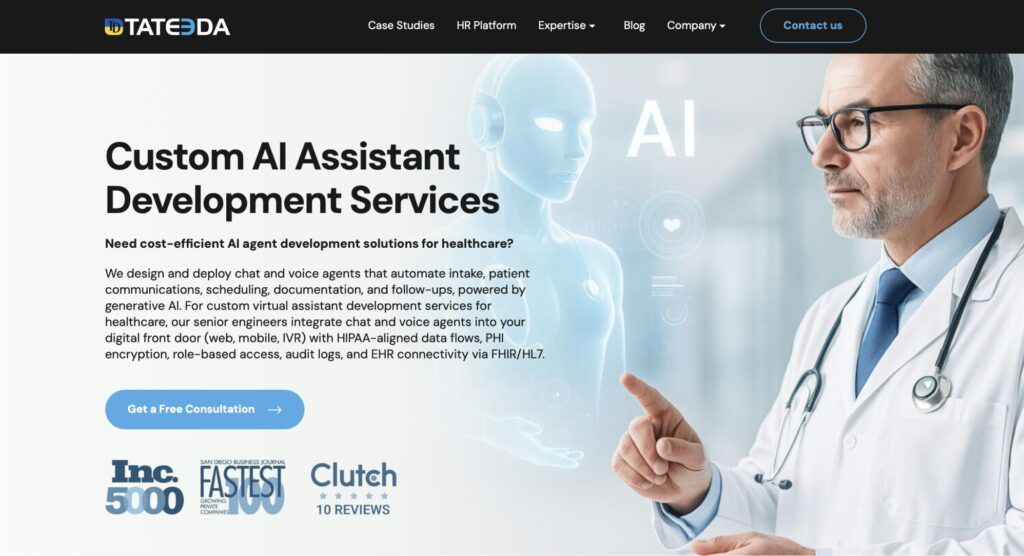
TATEEDA GLOBAL comes first in this list of top AI integration companies because it combines senior software engineering depth with a strong track record in regulated, data-heavy industries. Headquartered in San Diego and supported by engineering centers in Odesa (UA) and across Eastern Europe and LATAM, the company builds and modernizes custom healthcare software, then embeds AI agents, copilots, and analytics into those systems so they work with real clinical, financial, or operational data. TATEEDA’s resources are used to integrate AI with EHR/EMR platforms, medical billing and RCM tools, CRMs, ERPs, and IoT pipelines, while keeping PHI and other sensitive records under strict HIPAA and CCPA rules.
TATEEDA is often engaged when a client wants AI to live inside existing products rather than start from a blank slate: for example, upgrading legacy healthcare systems with AI triage or summarization, adding AI-enhanced patient portals, or wiring intelligent automation into biotech, logistics, and financial applications. A time-and-materials / time-and-expenses model, combined with .NET, JavaScript, and cloud-native microservices expertise, lets clients scale multi-agent AI systems, chatbots, and virtual assistants without losing control over architecture or compliance.
| Office locations | San Diego, CA, USA (HQ); Odesa, Ukraine; engineering presence across various Eastern European locations and LATAM |
| Preferred industries | Healthcare and life sciences; biotech; medical device and diagnostics; financial services; logistics and IoT-driven businesses; other custom B2B products |
| Types of AI solutions | AI agents and copilots; chatbots and virtual assistants; multi-agent AI systems; predictive analytics; AI integration into EHR/EMR, RCM, patient portals, legacy enterprise and IoT systems |
| Year of establishment | 2013 |
| Technology profile | .NET/C# and JavaScript (React, Angular, Vue); Node.js and Python; cloud-native applications on AWS and Azure; microservices architecture; HL7/FHIR and healthcare integrations; AI/ML using major cloud and LLM providers |
| Website | tateeda.com |
| Team size | Around 100+ engineers, QA specialists, architects, and PMs |
| Clutch rating | 5.0 / 5 based on published client reviews |
| Brands/clients | Aya Healthcare (long-term travel nurse platform partner), VisionTree, Abbott, and numerous healthcare and tech brands under NDA |

#2. eSparkBiz
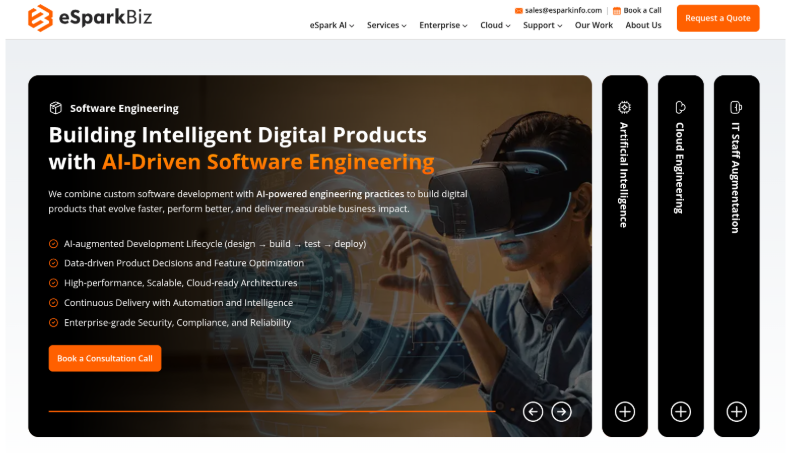
eSparkBiz is a product engineering and AI integration company that has spent 15+ years helping startups and mid-market businesses in North America build intelligent software. Headquartered in San Francisco with a primary delivery center in Ahmedabad, the company combines AI/ML engineering, custom web and mobile development, and cloud-native architecture to embed AI capabilities, agents, chatbots, recommendation systems, and generative AI features directly into clients’ existing workflows and products, operating as a full-cycle partner from discovery through production and beyond.
The company’s AI integration work connects LLMs and ML models with CRMs, ERPs, SaaS platforms, and custom backends, then layers agentic automation, conversational interfaces, and predictive analytics on top of live business data. Industries served include fintech, healthcare technology, ecommerce, real estate, logistics, and on-demand platforms. For growth-stage and mid-market companies that want AI-powered features inside existing products without building a large internal team, eSparkBiz delivers a cost-competitive, integration-oriented approach backed by 400+ engineers.
| Office locations | Ahmedabad, Gujarat, India (HQ); US and UK client presence |
| Preferred industries | Healthcare; fintech and financial services; retail and e-commerce; logistics and supply chain; SaaS products; real estate; education |
| Types of AI solutions | Generative AI apps and LLM integration; multi-agent AI systems; AI chatbots and virtual assistants; AI copilots for business workflows; predictive analytics and recommendation engines; OpenAI/GPT and Claude integrations; AI-powered process automation |
| Year of establishment | 2010 |
| Technology profile | Python, Node.js, React, Angular, Laravel, Flutter; AI/ML stacks (TensorFlow, PyTorch, OpenAI APIs, LangChain); cloud platforms (AWS, Azure, GCP); REST/GraphQL integrations; CRM and ERP connectors |
| Website | esparkinfo.com |
| Team size | 400+ engineers, AI specialists, designers and PMs |
| Clutch rating | 4.9 / 5 based on verified client reviews |
| Brands/clients | 1000+ projects across the US, UK, and global clients in healthcare, retail, logistics, and fintech; such as Cision, Atlantis, Radefy, Trane, etc. |
#3. LeewayHertz
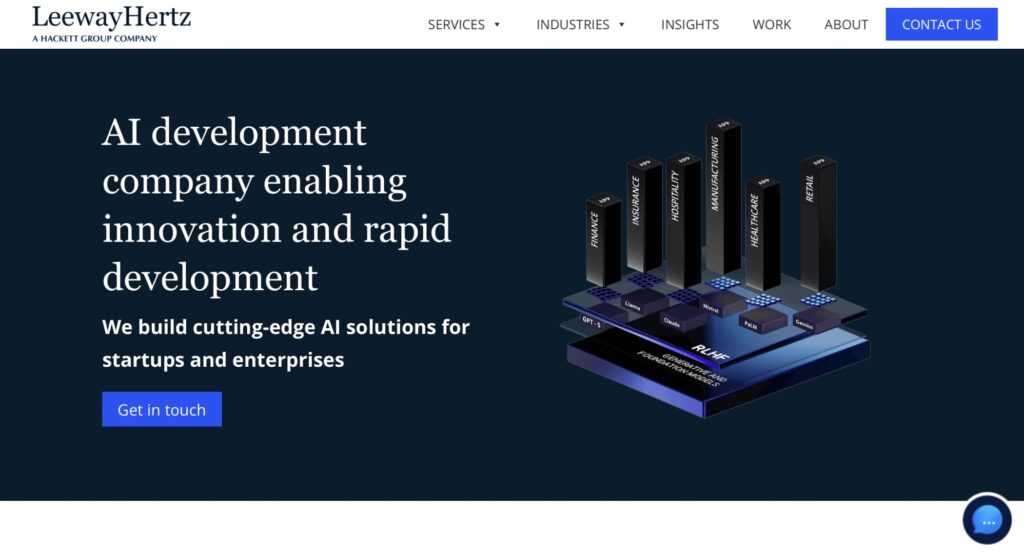
LeewayHertz frequently appears among the best AI integration companies because it combines strategic advisory work with very practical engineering. Headquartered in San Francisco and backed by a large delivery center in Gurugram, the company runs a few hundred specialists who fold generative AI, LLMs, and classic ML into CRMs, ERPs, data platforms, and custom products so copilots and chatbots live inside tools people already use. Their projects usually touch both the intelligence layer and the foundations around it: integrations with core systems, access control, observability, and MLOps pipelines that keep models reliable over time.
With more than a decade of delivery history, LeewayHertz has repeatedly worked in finance, insurance, manufacturing, logistics, healthcare, and retail, where latency, auditability, and uptime matter as much as new features. For buyers, this combination means one vendor that can define an AI roadmap, ship production-grade solutions from mixed US–India teams, and stay engaged as the organization’s AI footprint becomes a normal part of daily operations.
| Office locations | San Francisco, CA, USA (HQ); Gurugram, India (major delivery center); additional presence in the UAE |
| Preferred industries | Finance and insurance; manufacturing and logistics; retail and eCommerce; healthcare; startups and tech-driven enterprises |
| Types of AI solutions | Generative AI and LLM apps; AI chatbots and virtual assistants; recommendation and personalization engines; predictive analytics; LLM consulting and fine-tuning; generative AI integration into existing workflows |
| Year of establishment | 2007 |
| Technology profile | AI/ML and data engineering; Python-centric ML stacks; LLMs (GPT, Llama, Mistral and others); cloud platforms (AWS, Azure, GCP); web and mobile development; IoT and blockchain integrations where needed |
| Website | leewayhertz.com |
| Team size | Approximately 250–300 professionals across engineering, data, and consulting roles |
| Clutch rating | Around 4.7 / 5 based on recent client reviews |
| Brands/clients | ESPN, Hershey’s, NASCAR, and multiple enterprises across logistics, retail, healthcare, and automotive, plus many clients under NDA |
#3. Teneo (Teneo.ai)
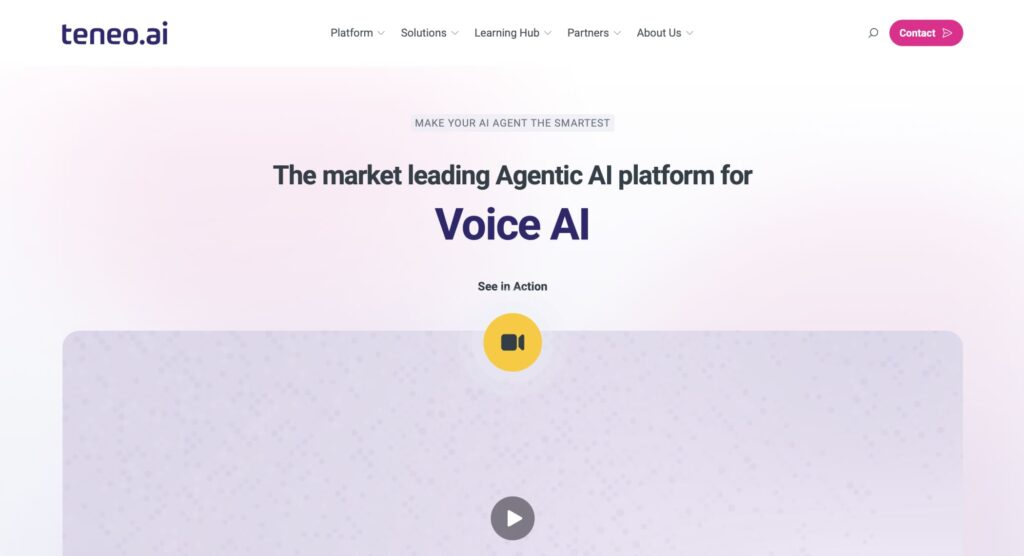
Teneo sits in a slightly different category from classic agencies: it is an agentic AI platform company that many enterprises use instead of building their own orchestration layer, which still makes it relevant among top AI integration service providers. From its base in Stockholm, with additional offices in Barcelona and Chicago, the team focuses on voice AI, contact center automation, and large fleets of AI agents that talk to customers, act on data, and trigger downstream systems. Their platform can orchestrate thousands of agents, connect to CCaaS platforms and CRMs, and layer generative AI on top of existing IVR setups, so enterprises extend what they already have rather than rip and replace everything.
For organizations with heavy call volumes and strict governance needs, Teneo effectively becomes a specialized integration hub: voice bots, chat agents, and AI copilots route calls, surface knowledge, and escalate to human agents while respecting security and compliance rules. That combination makes it interesting for buyers who want a mature, productized base for conversational and voice AI, plus advisory and implementation support, instead of fully bespoke code.
| Office locations | Stockholm, Sweden (HQ); Barcelona, Spain; Chicago, IL, USA |
| Preferred industries | Telecommunications; banking and financial services; utilities; retail; travel and hospitality; large customer service organizations |
| Types of AI solutions | Agentic AI platform for contact centers; voice AI agents; digital chat agents; AI agent copilot for human agents; conversational IVR; knowledge AI for contact centers |
| Year of establishment | 2001 (as Artificial Solutions; rebranded to Teneo.ai in 2024) |
| Technology profile | Agentic AI orchestration platform; proprietary NLU and dialogue management; LLM orchestration; integrations with CCaaS, telephony, CRM, ITSM, and Azure-based infrastructure |
| Website | teneo.ai |
| Team size | Approximately 70–80 employees |
| Clutch rating | Not a typical Clutch-rated agency; reputation built mainly through enterprise deployments and analyst/press coverage |
| Brands/clients | AT&T, Circle K, Medtronic, Vodafone, Co-operative Bank, and other large enterprises using Teneo for contact center automation |
#4. Pragmatic Coders
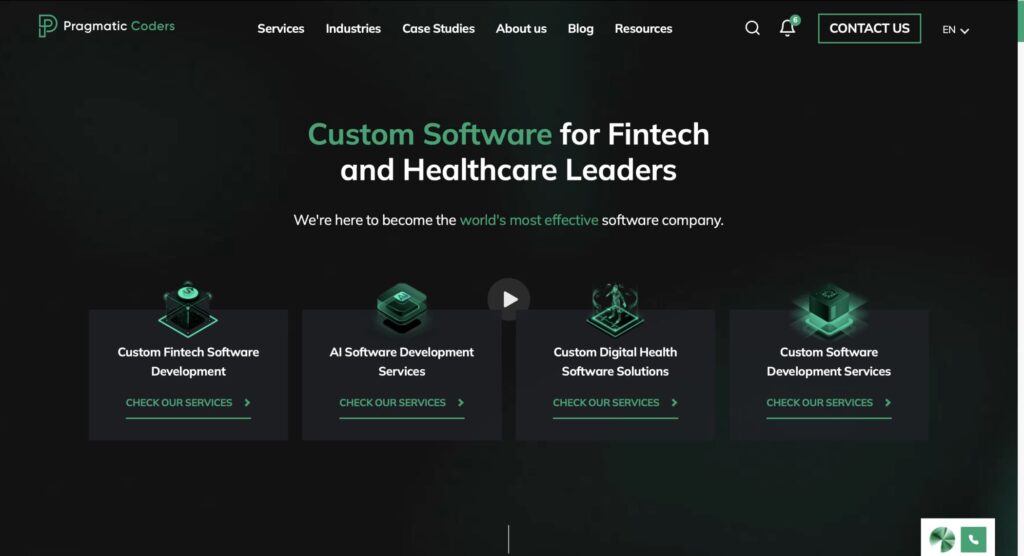
Pragmatic Coders is a Kraków-based product and engineering partner that often shows up among top AI integration service providers for fintech and digital health teams. Since 2014, they have grown into a ~100-person organization that pairs product managers, designers, and engineers who can shape a roadmap and then wire AI into the workflows that matter. The team builds autonomous AI agents, decision-support services, and AI-powered features on top of existing systems, while also using no-code and low-code platforms to assemble automations quickly when speed is a priority.
Because they work with banks, healthtech firms, and venture-backed startups, their AI projects typically sit close to regulation, risk, and real revenue. For many buyers, the value is straightforward: a single vendor based in Central Europe that can run discovery workshops, build AI-enabled products, and integrate those solutions with financial, clinical, or operational platforms already in use.
| Office locations | Kraków, Poland (HQ); remote delivery for clients in Europe and North America |
| Preferred industries | Fintech, digital health, insurtech, SaaS products, eCommerce, and tech-driven scaleups |
| Types of AI solutions | Autonomous AI agents for business processes; AI automation workflows; AI-enabled SaaS products; analytics and decision-support tools; AI advisory and PoC builds |
| Year of establishment | 2014 |
| Technology profile | Modern web and backend stacks (Python, Java, JS); cloud-native architectures; no-code/low-code automation (Power Automate, Zapier, Make) combined with external AI/LLM services |
| Website | pragmaticcoders.com |
| Team size | Around 100–120 experts across product, design, and engineering roles |
| Clutch rating | High 4.x / 5 band on Clutch, with positive feedback on product focus and collaboration |
| Brands/clients | Atom Bank, Kitopi, WithHealth, Frost, and 100+ other startup and enterprise projects over the years |
#5. Addepto

Addepto positions itself firmly in the data and AI camp, which is why it often appears among top AI software integration companies instead of generalist development vendors. Based in Warsaw and built around a compact team of several dozen specialists, the company spends its time turning raw, scattered data into prediction engines, risk scores, and recommendation layers that plug cleanly into CRMs, core banking systems, ecommerce platforms, and BI dashboards. Their engagements usually begin with discovery workshops and PoCs, then move into full-scale model deployment, monitoring, and iteration once there is enough evidence that an idea actually pays off.
Addepto usually steps in where data is both plentiful and central to the business: finance, insurance, retail, manufacturing, and telecom. In these settings, they act like one of the top AI integration service providers, with a clear focus on model accuracy, monitoring for drift, explainability, and smooth handover to non-technical teams. For companies that already have data warehouses and BI in place but want a stronger AI layer, Addepto often functions more like an internal data team than an outside vendor.
| Office locations | Warsaw, Poland (HQ); remote delivery for clients across Europe and North America |
| Preferred industries | Finance and insurance; eCommerce and retail; manufacturing; telecom; other data-intensive enterprises |
| Types of AI solutions | Machine learning models; predictive analytics; recommendation engines; fraud and risk scoring; AI PoC services; generative AI and LLM-based solutions |
| Year of establishment | Mid-2010s (AI and data consultancy origin) |
| Technology profile | Python-based ML stacks (TensorFlow, PyTorch, scikit-learn); data engineering and big data tools; cloud analytics on AWS, Azure, and GCP; BI and warehouse integrations |
| Website | addepto.com |
| Team size | Roughly 50–80 AI and data experts |
| Clutch rating | High 4.x / 5 range, with clients praising technical depth and business focus |
| Brands/clients | Financial, insurance, retail, and manufacturing companies in Europe and North America, with named case studies plus additional clients under NDA |
#6. Scopic
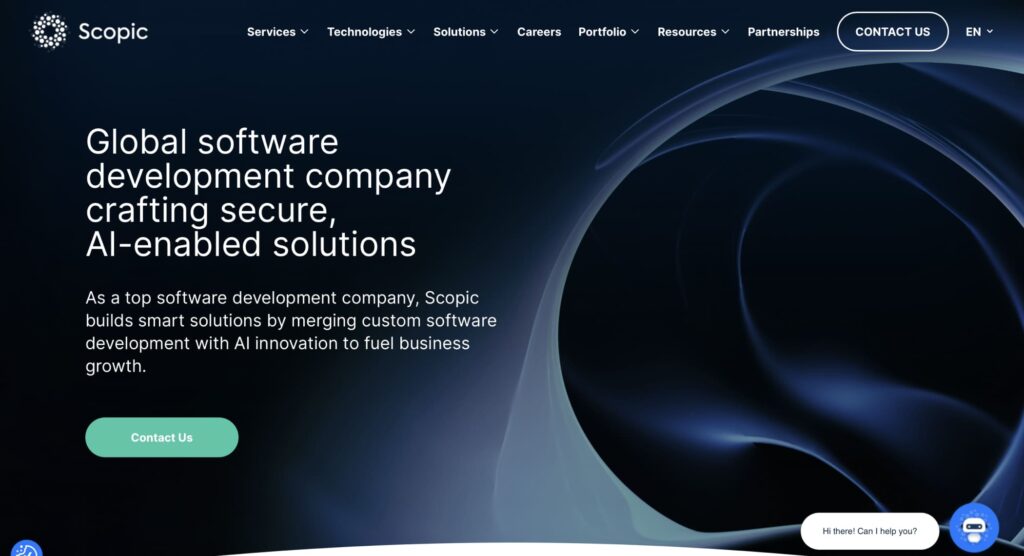
Scopic is a remote-first development company that many buyers classify among the top AI software integration firms rather than a generic engineering vendor. Headquartered in Marlborough, Massachusetts, and supported by a few hundred specialists across multiple regions, the company builds and extends web, desktop, and mobile products, then adds AI capabilities such as copilots, recommendation components, anomaly detection, and decision-support dashboards. Typical engagements involve clarifying business objectives, mapping data flows, selecting or implementing models and external AI services, and integrating those capabilities into existing user interfaces and workflows so that AI features operate within established products and processes.
Scopic works with healthcare vendors, edtech companies, media platforms, real estate applications, manufacturing systems, ecommerce solutions, and B2B SaaS products, which means its teams routinely account for performance, security, and compliance requirements alongside functional scope. For organizations seeking an offshore partner to modernize legacy systems with AI or launch new AI-enabled products without building a large internal team, this profile is attractive and aligns well with how top AI integration service providers usually operate. In many cases, Scopic serves as a long-term product partner: progressing from proof-of-concept to integrated release and then iterating as both the software and its AI capabilities mature.
| Office locations | Marlborough, MA, USA (HQ); distributed remote teams across North America, Europe, Latin America, and Asia |
| Preferred industries | Healthcare, education, media & entertainment, real estate, manufacturing, ecommerce, blockchain, and B2B SaaS products |
| Types of AI solutions | AI consulting and readiness; custom AI development; generative AI features; ML and predictive analytics; computer vision; ChatGPT and LLM integrations; AI-powered assistants and dashboards |
| Year of establishment | 2006 |
| Technology profile | Web, desktop, and mobile stacks (.NET, C++/Qt, JavaScript frameworks, native and cross-platform mobile); Python-based ML; major cloud platforms; integrations with third-party APIs and data systems |
| Website | scopicsoftware.com |
| Team size | Roughly 250–500 professionals across engineering, design, data, and PM roles |
| Clutch rating | Around 4.9 / 5 on Clutch across dozens of verified reviews |
| Brands/clients | 1,000+ projects for startups and SMEs worldwide, including healthcare vendors like Mediphany and numerous mid-market clients in ecommerce and manufacturing |
#7. Scandiweb
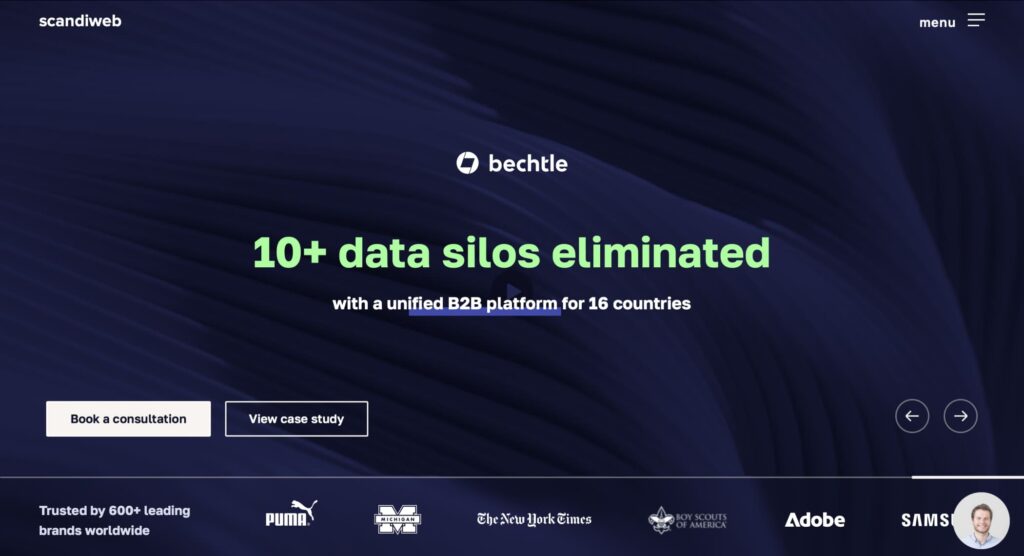
Scandiweb started as a Magento-focused ecommerce agency and has grown into a large digital partner that treats AI as a core part of online retail, not an afterthought. From its base in Riga and offices across Europe and North America, the company builds and extends storefronts, then layers on AI for product discovery, search relevance, and merchandising decisions. Their own tools, like scandiwebAI and scandilytics, connect behavioral and transactional data with ML models so teams can adjust offers, content, and campaigns based on how customers actually shop. This mix puts Scandiweb on many shortlists of top AI integration service providers for brands that live in Adobe Commerce, Shopify, or headless architectures.
For retail and D2C leaders under pressure to grow conversion and lifetime value, Scandiweb effectively acts as both an e-commerce agency and an AI partner. The same teams that handle catalog structure, UX, and performance also work on AI-driven recommendations, marketing automation, and analytics assistants, which reduces handoff friction between “commerce” and “AI” projects. That setup is especially useful for companies that want to test and scale AI use cases inside their main ecommerce stack rather than spin up separate experimental sites.
| Office locations | Riga, Latvia (HQ); offices and presence in the United States, Sweden, United Kingdom, Canada, Georgia; distributed teams across Europe and North America |
| Preferred industries | Ecommerce and retail; fashion; automotive; furniture and home; media and publishing; B2B and D2C brands selling online |
| Types of AI solutions | AI-powered personalization and product recommendations; AI search and AEO; AI content strategy and generation; marketing automation; analytics assistants (e.g., scandilytics); custom AI tools for ecommerce operations |
| Year of establishment | 2003 |
| Technology profile | Adobe Commerce/Magento, Shopify, BigCommerce, headless and PWA (ScandiPWA); JavaScript and PHP stacks; data and analytics platforms; AI and ML tools integrated with major ecommerce and marketing systems |
| Website | scandiweb.com |
| Team size | Approximately 400–600 employees across engineering, marketing, data, and consulting roles |
| Clutch rating | Around 4.7–4.8 / 5 based on dozens of verified reviews |
| Brands/clients | The New York Times, Lego, Jaguar Land Rover, L’Oréal, JYSK, and 600+ ecommerce and retail brands worldwide |
#8. Intuz
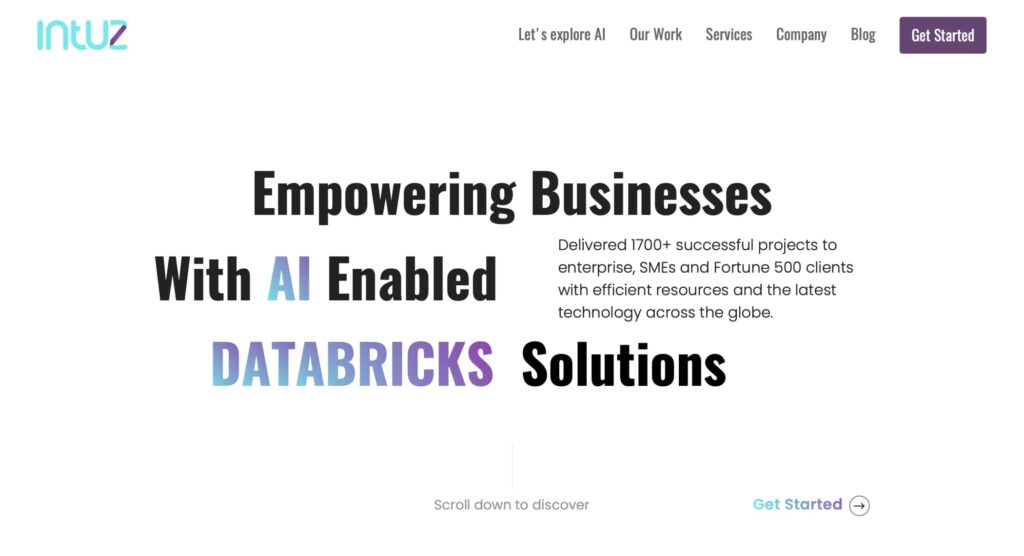
Intuz positions itself as an AI-first software partner, combining AI/ML, mobile, web, and IoT capabilities in one organization. Headquartered in the United States with a major delivery center in Ahmedabad, India, the company supports clients from early concept to production deployments of AI-powered systems. Its teams focus on turning ideas into working applications that blend AI models, data pipelines, and cloud infrastructure rather than treating AI as a standalone experiment. This makes Intuz a realistic option for buyers who shortlist top AI solution integration companies for long-term digital transformation work.
Intuz works with organizations in healthcare, finance and fintech, logistics, ecommerce, manufacturing, smart cities, and other sectors where connected devices and transactional systems already generate significant data. Its AI services span custom AI applications, generative AI development, chatbots, AI agents, and MLOps deployment, often combined with IoT and cloud projects, so the intelligence layer sits close to real-world operations. For companies that want one provider to handle application UX, backend engineering, AI models, and ongoing optimization, Intuz offers a coherent, integration-oriented approach.
| Office locations | San Francisco, CA, USA; San Ramon, CA, USA; Ahmedabad, India (main development center) |
| Preferred industries | Healthcare, finance and fintech, logistics and transportation, ecommerce and retail, manufacturing, smart cities, and other IoT-driven or data-intensive sectors |
| Types of AI solutions | Custom AI applications; generative AI solutions; AI/ML models and analytics; chatbots and virtual assistants; AI agents for back-office automation; AI for IoT and edge scenarios; MLOps deployment |
| Year of establishment | 2008 |
| Technology profile | AI/ML and data engineering; cloud platforms (AWS, Azure, others); mobile (Android, iOS), web, and IoT stacks; workflow automation; blockchain and AR/VR where relevant |
| Website | intuz.com |
| Team size | Approximately 80–150 professionals across engineering, design, and consulting roles (50–249 band on Clutch) |
| Clutch rating | Around 4.7 / 5 based on 50+ published reviews |
| Brands/clients | Startups through Fortune-level enterprises across healthcare, logistics, retail, finance, and other sectors; case studies highlight IoT healthcare, fintech, and smart-operations projects |
#9. Grape Up
Grape Up focuses on cloud-native and AI engineering for enterprises that already run large digital platforms. From Santa Clara and several engineering hubs in Poland, a roughly 120–150-person team supports automotive, insurance, and financial organizations that need AI aligned with strict uptime and regulatory expectations. They standardize data flows, define MLOps practices, and build AI-ready architectures, which is why many buyers treat Grape Up as one of the top AI integration companies for complex, long-lived systems.
On the AI side, their work spans telematics-based insurance scoring, connected-vehicle services, AI-supported claims and pricing workflows, and decision-support components for banking and financial products. Delivery teams implement these services on Kubernetes and major cloud providers, then connect them with policy administration systems, telematics platforms, and customer portals. For enterprises that prefer one vendor to manage both the platform and the AI layer instead of coordinating separate data science and infrastructure partners, Grape Up offers a unified approach.
| Office locations | Santa Clara, CA, USA (HQ); Kraków, Wrocław, Bielsko-Biała, Poland; Zurich, Switzerland |
| Preferred industries | Automotive and mobility; car rental and fleet; insurance; banking and financial services; manufacturing and other data-intensive enterprises |
| Types of AI solutions | AI consulting and implementation; AI and data infrastructure engineering; MLOps and model lifecycle management; generative AI; AI for connected cars and telematics; AI for insurance pricing and claims |
| Year of establishment | 2006 |
| Technology profile | Cloud-native architectures (Kubernetes, microservices); data platforms; AI/ML stacks; MLOps tooling; major cloud providers (AWS, Azure, GCP); integration with core enterprise systems |
| Website | grapeup.com |
| Team size | Approximately 120–150 employees (51–200 band publicly reported) |
| Clutch rating | Around 5.0 / 5 based on a small set of published reviews |
| Brands/clients | Large automotive OEMs, global insurance groups, and financial enterprises in the US and Europe, plus multiple unnamed customers in mobility and manufacturing |
#10. Lindy
Lindy takes a product-led route to AI integration, giving companies a platform where “AI employees” are configured rather than custom-built from scratch. Instead of engaging a large consulting team, customers describe tasks in natural language, connect Lindy to their CRMs, email, calendars, and support tools, and then let agents handle outreach, ticket responses, meeting prep, or routine operations. This self-serve approach puts Lindy on many shortlists of top AI integration vendors for teams that care more about wiring agents into existing SaaS stacks quickly than running a heavy bespoke development project.
Because it targets sales, customer support, and operations teams across industries, Lindy optimizes for practical integrations and repeatable workflows rather than one-off prototypes. Organizations that want to experiment with AI agents, refine how they interact with live systems, and then scale successful use cases across departments can use Lindy as a central orchestration layer, while still having the option to involve engineers where custom logic is needed.
| Office locations | United States (HQ, remote-first footprint) |
| Preferred industries | Horizontal focus: B2B SaaS, professional services, sales organizations, support teams, and operations groups using modern SaaS tools |
| Types of AI solutions | Configurable AI agents (“AI employees”) for sales outreach, customer support, lead qualification, scheduling assistance, meeting notes, and internal process automation |
| Year of establishment | 2020s (modern agentic AI startup) |
| Technology profile | LLM-based agents; orchestration and memory layer; connectors to email, calendars, CRMs, helpdesks, and other SaaS systems; web-based configuration interface |
| Website | lindy.ai |
| Team size | Small startup team (dozens of people rather than hundreds) |
| Clutch rating | Not primarily represented on Clutch; adoption tracked via product usage and case references |
| Brands/clients | Early adopters across tech, consulting, and services organizations using Lindy for outreach, support, and operational automation (exact names often under NDA) |
#11. Entrans
Entrans is an AI-first consulting and product engineering firm that many enterprises group with the best AI integration companies for large, regulated environments. Headquartered in Branchburg, New Jersey, and operating with a hybrid onshore / nearshore / offshore delivery model, the company brings a few hundred consultants, engineers, and data specialists to AI-driven digital transformation programs. Their teams combine generative AI, agentic AI frameworks, and cloud/data engineering so that models, automations, and applications end up in production systems rather than stalled PoCs.
Service lines span generative AI consulting, agentic AI framework integration, AI-driven automation, data engineering, cloud modernization, MLOps, and managed services. This combination makes Entrans relevant for enterprises that want one partner to shape an AI roadmap, modernize legacy platforms, and integrate agents with ERP, CRM, ITSM, and analytics ecosystems at scale.
| Office locations | Branchburg, New Jersey, USA (HQ); hybrid global delivery with onshore, nearshore, and offshore teams |
| Preferred industries | Enterprise customers in healthcare, financial services, lending, education, and multi-location retail/QSR, plus other data-intensive sectors |
| Types of AI solutions | Generative AI consulting; agentic AI framework integration; AI-driven automation (including IDP and workflow automation); enterprise AI apps; DataOps and MLOps; AI-enabled modernization |
| Year of establishment | Not clearly disclosed in public sources (positioned as a modern AI-first consulting and engineering firm) |
| Technology profile | Enterprise AI and agentic frameworks; LLM and GenAI stacks; CI/CD for ML and MLOps; cloud and data platforms (modern data lakes/warehouses, ETL/ELT, analytics); application modernization and DevSecOps |
| Website | entrans.ai |
| Team size | Approximately 200–500 employees (201–500 band reported) |
| Clutch rating | Not strongly represented on Clutch; reputation driven mainly by enterprise case work and thought-leadership content |
| Brands/clients | Fortune-scale and mid-market enterprises in healthcare, lending, education, and QSR, with named case studies and many client names under NDA |
The Final Word
The companies in this comparison cover a wide spectrum of AI work: multi-agent systems and copilots, e-commerce personalization, automotive and insurance platforms, data-centric ML, and AI integration in digital health. Each vendor brings its own mix of strengths, limitations, price bands, and preferred industries, so the “right” choice depends on where your systems, budget, and risk profile currently stand. Taken together, the list is meant to function as a short, opinionated map of the market rather than an exhaustive directory, giving you enough signal to narrow options and then go deeper into specific case studies and references.
Within that context, TATEEDA GLOBAL stands out as a well-balanced option for organizations that want custom AI software development plus serious integration work in regulated and data-heavy environments. A San Diego headquarters combined with Eastern European and LATAM engineering, experience with PHI, HIPAA, and CCPA, and long-term healthcare and biotech collaborations makes TATEEDA competitive among the best AI integration companies for US-focused clients. For buyers who care about solid architecture, compliance-aware delivery, and the ability to evolve AI features inside existing products over time, TATEEDA offers a pragmatic middle ground between small boutiques and very large, high-overhead consultancies.




![8 Medical Billing Automation Developers in California [2026]](https://tateeda.com/wp-content/uploads/2026/10/Cover.png)
