HIPAA-Compliant Software Development: Complete Guide & Checklist (2026)

Slava Khristich



Vlad Nazarov

| In this article we’ll cover what HIPAA-compliant software development actually requires in 2026: ✅ Why “HIPAA-certified software” doesn’t exist — and what regulators look for instead ✅ The proposed 2026 HIPAA Security Rule changes: mandatory encryption, MFA, continuous monitoring — plus an honest read on the rule’s legal status that most guides get wrong ✅ A complete HIPAA technical safeguards checklist your engineers can build from ✅ The five compliance mistakes we see most often in healthcare software projects ✅ How to evaluate a HIPAA-compliant software development company — including whether nearshore teams add HIPAA risk |
Every healthcare software project eventually arrives at the same question, usually in a planning meeting and usually later than it should: is this thing going to be HIPAA compliant?
It’s the wrong question — or at least the wrong framing. HIPAA compliance isn’t a feature you add before launch or a certificate you buy from a vendor. It’s a set of architecture decisions, engineering practices, and contractual obligations that either get built into your software from the first sprint or get retrofitted later at several times the cost.
This guide covers what HIPAA-compliant software development actually requires in 2026: the proposed Security Rule modernization that is reshaping how teams build (and why you should build to it now, even before it’s final), a complete technical safeguards checklist your engineering team can work from, the administrative decisions that quietly determine whether your architecture holds up, the mistakes we see most often in healthcare software projects, and — because roughly half the people searching this phrase are deciding whether to build in-house or bring in help — how to evaluate a HIPAA-compliant software development company without getting burned.
TATEEDA has been building software for HIPAA-regulated environments since 2013 — patient portals, EHR integrations, billing systems, telehealth platforms, and remote monitoring applications for U.S. healthcare providers, payers, and digital health companies. What follows is the guide we wish every client had read before their first discovery call.
Table of Contents
What “HIPAA-Compliant Software” Actually Means
Start with the misconception that derails more vendor conversations than any other: there is no such thing as HIPAA-certified software.
The U.S. Department of Health and Human Services does not certify software products. No government body issues a HIPAA badge, seal, or certificate. Any vendor telling you their product is “HIPAA-certified” is either confused about the regulation they claim to specialize in or hoping you are. Neither is a good sign.
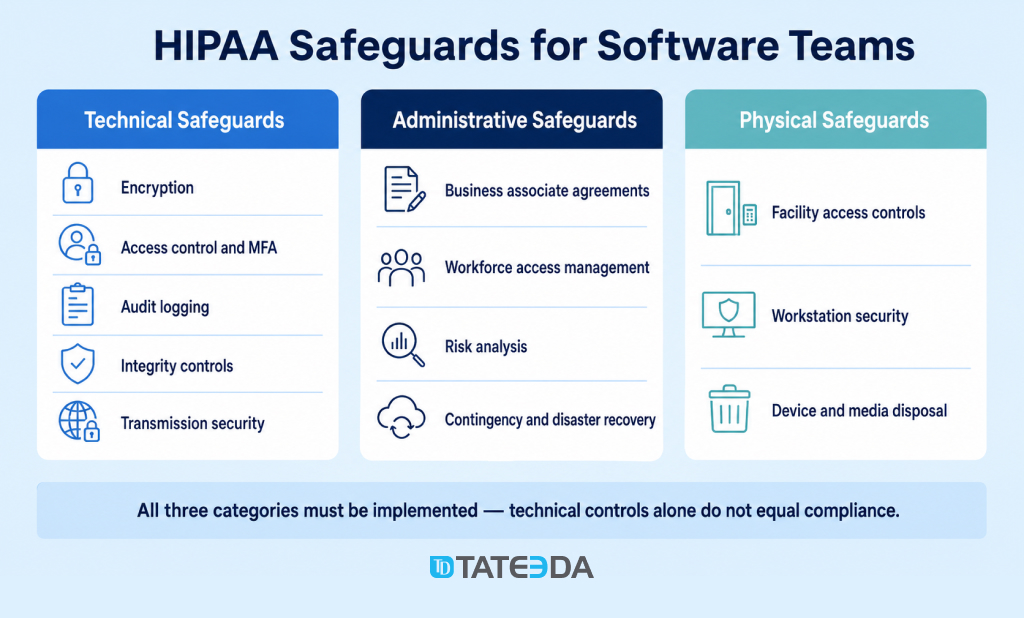
What HIPAA actually regulates is organizations and their handling of protected health information (PHI). The HIPAA Security Rule requires covered entities and their business associates to implement administrative, physical, and technical safeguards for electronic PHI (ePHI). Software can be built and operated in a way that supports those safeguards — encrypted storage, access controls, audit logging, secure transmission — or in a way that undermines them. “HIPAA-compliant software,” used precisely, means software engineered so that the organization deploying it can meet its obligations under the Security Rule.
That distinction matters because it changes what you’re actually evaluating when you assess a development partner. The question isn’t “is your code HIPAA compliant?” It’s “do you understand the safeguards my organization is legally required to implement, and can you build software that implements them?”
Covered entities, business associates, and where your dev partner sits
HIPAA’s obligations flow down a chain:
- Covered entities — health plans, healthcare clearinghouses, and providers who transmit health information electronically. Hospitals, medical groups, payers.
- Business associates — organizations that create, receive, maintain, or transmit PHI on behalf of a covered entity. This includes SaaS platforms hosting patient data, billing services — and yes, software development companies whose engineers touch ePHI during a project.
- Subcontractors of business associates — who inherit the same obligations. A business associate that hands PHI-touching work to a subcontractor without a business associate agreement (BAA) in place has created a compliance gap that OCR treats as the covered entity’s problem too.
If a development partner will have access to systems containing real patient data — production databases, live integrations, support environments — they are functioning as a business associate or subcontractor, and a signed BAA is not optional. If the engagement is structured so the dev team only ever works with synthetic or de-identified data, the BAA question changes, but the architecture they build still has to support your compliance. A partner who can’t explain which of those two situations your project falls into shouldn’t be building your healthcare software.
What happens when you get it wrong
The enforcement environment has hardened considerably. OCR closed 2025 with 21 settlements and civil monetary penalties — its second-highest annual total on record — driven largely by a targeted enforcement initiative focused on the risk analysis provision of the Security Rule. Civil penalties now range from $145 per violation for unknowing infractions to an annual cap of $2,190,294 for willful neglect, following the inflation adjustment that took effect in January 2026.
The pattern behind those settlements should worry anyone shipping healthcare software: nearly every recent settlement turns on a missing or inadequate security risk analysis, usually surfaced after a ransomware or phishing breach. In one representative case, a ransomware attack affecting 14,273 patients led to a $90,000 settlement — not because the organization was attacked, but because it had never conducted a risk analysis. And the OCR penalty is rarely the largest line item. Breach notification, forensics, legal defense, state attorney general actions, and patient attrition stack on top; healthcare data breaches cost an average of $10.93 million per incident, the highest of any industry for the thirteenth consecutive year, according to the Ponemon Institute’s most recent Cost of a Data Breach research.
The takeaway for anyone commissioning software: regulators don’t ask whether you bought a compliant product. They ask whether you can demonstrate — through documentation, architecture, and logs — that safeguards were assessed, implemented, and maintained. Your software either produces that evidence or it doesn’t.
The 2026 HIPAA Security Rule Changes Developers Need to Know
The Security Rule your software must satisfy today was written in 2003 and last meaningfully updated in 2013 — before ubiquitous cloud hosting, before ransomware became the dominant healthcare threat, and before most of the systems now holding ePHI existed. That’s changing.
In January 2025, HHS published a Notice of Proposed Rulemaking in the Federal Register — the most substantial proposed revision to the Security Rule since its adoption. OCR received roughly 4,700 public comments before the comment period closed in March 2025. The agency’s regulatory agenda targeted May 2026 for a final rule, but as of mid-2026 that date has passed without one being issued.
Here’s the part most competing guides get wrong, and it matters: the 2026 Security Rule update is not yet law. Several widely-shared articles describe mandatory encryption and MFA as if they’re already in force. They aren’t. But treating that as a reason to wait would be a serious strategic error, for three reasons:
- The direction of travel is unambiguous. The proposed requirements codify what OCR already treats as the de facto standard in enforcement. When OCR investigates a breach today, unencrypted ePHI and password-only access are findings, whatever the “addressable” language technically permits.
- The compliance window will be short. Once finalized, the rule is expected to take effect 60 days after publication, with compliance required 180 days after that — roughly 240 days in total — and business associate agreements updated within one year. That’s not enough time to re-architect a system built on the assumption that encryption was optional.
- Retrofitting costs multiples of building it right. Adding database-level encryption, MFA, and continuous monitoring to a live production system holding patient data is a migration project with real integrity risk. Building them in from sprint one is mostly just… building normally, with the right defaults.
Software with a multi-year lifespan that enters development in 2026 should be built to the proposed rule. Here’s what that means concretely.
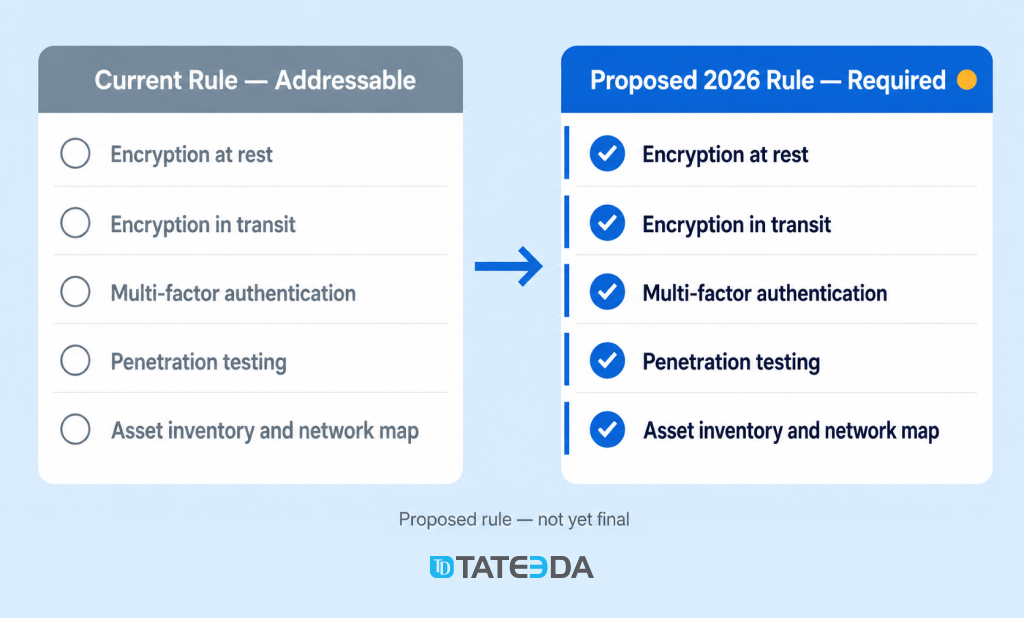
Encryption: from “addressable” to mandatory
Since 2003, encryption has been an “addressable” implementation specification — organizations could document why it wasn’t reasonable and implement an alternative. In practice, “addressable” became “optional”: teams documented that encryption was too expensive or MFA too disruptive, and auditors accepted those justifications.
The proposed rule ends that. Encryption becomes mandatory for all ePHI, with limited exceptions — data at rest (stored patient records, databases, backups) and data in transit (emails, APIs, data exchange between systems). The risk-assessment opt-out disappears. For engineering teams, the mental model shift is simple: there is no longer a compliant architecture in which ePHI sits unencrypted anywhere, at any layer, for any documented reason.
MFA for every ePHI access path
The proposed rule requires multi-factor authentication across systems accessing ePHI, with limited exceptions — clinicians, administrators, support staff, service accounts, everyone. If your application authenticates users who can see patient data with a password alone, it’s built to a standard that’s being written out of existence. This has real product implications: MFA flows, session management, and identity federation through SSO, OIDC, and OAuth 2.0 stop being enterprise nice-to-haves and become baseline requirements even for small-practice deployments. If you are modernizing an existing product, this is often the first place legacy architecture breaks — something we see constantly in EHR and EMR software development projects where the identity layer predates the security expectations now attached to it.
Continuous monitoring, testing, and knowing what you have
The annual risk assessment survives, but it’s no longer sufficient on its own. The proposed rule adds annual penetration testing, vulnerability scanning every six months, and enhanced documentation requirements, plus a written technology asset inventory and an up-to-date network map showing how ePHI moves through every relevant system. The revisions also introduce stricter audit requirements, mandated network segmentation, and expanded incident response obligations.
For developers, the asset-inventory and network-map requirements are the sleeper items. They effectively mandate the data flow mapping that good healthcare engineering teams already do first (more on that below) — and they mean architectures that can’t clearly answer “where does ePHI live and travel?” will fail audits regardless of how strong individual controls are.
What this means if your team is still on the old mental model
If your current system — or your current vendor’s proposal — treats encryption as a cost-benefit decision, allows any password-only path to ePHI, or handles security review as an annual event, you’re building against a standard that regulators have already moved past in practice and are about to move past in law. The organizations that treat the proposed rule as today’s build spec will spend the 240-day compliance window verifying. Everyone else will spend it migrating.
HIPAA Technical Safeguards Checklist for Software Development
The Security Rule’s technical safeguards (45 CFR § 164.312) define five control areas. Here is what each one means as an engineering requirement — the checklist our teams build against on every ePHI-scope project, updated for where the proposed rule is taking the baseline.
Encryption
At rest — AES-256 or equivalent, everywhere ePHI lands:
- Primary databases holding patient records (transparent data encryption at minimum; field-level encryption for the most sensitive elements)
- File and object storage — documents, images, exports
- Backups. The most commonly forgotten location. An encrypted database with unencrypted backups is not an encrypted system.
- Logs. Application and audit logs routinely capture ePHI — names in error messages, identifiers in request payloads. They need the same encryption as the data they describe.
- Key management: keys stored separately from data (KMS or HSM), rotated on schedule, access-controlled and logged. Encryption with sloppy key handling is theater.
In transit — TLS 1.2 or higher, with no exceptions:
- All client-to-server traffic — web, mobile, API
- All service-to-service traffic inside your own infrastructure. The “it’s internal, it’s fine” exception does not exist. East-west traffic between microservices, app-to-database connections, and message queues carrying ePHI all need TLS.
- Third-party integrations — EHR interfaces, clearinghouse connections, payment gateways
- Certificate management with automated renewal, so encryption doesn’t silently lapse
When citing standards, anchor to NIST guidance rather than folklore — the proposed rule aligns encryption expectations with recognized NIST cryptographic standards, including key management.
Access controls and authentication
- Role-based access control (RBAC) designed around least privilege: every role sees the minimum ePHI its function requires, enforced in the application and the data layer, not just hidden in the UI
- Unique user identification — no shared accounts, ever, including for support and admin staff, since shared credentials make audit trails meaningless
- MFA for all ePHI access, built to the proposed rule’s standard: every user, every role, including administrators and service accounts where technically feasible
- Automatic logoff and session timeout tuned to the clinical context — aggressive enough to protect unattended workstations, forgiving enough that clinicians don’t disable it through workarounds
- Emergency access (“break-glass”) procedures that grant access during an emergency while logging everything for after-the-fact review
Access design gets harder the more roles a system serves. A hospital management platform spanning admissions, nursing, pharmacy, billing, and administration may need a dozen distinct permission sets, each with a defensible clinical or operational justification. Map those roles before writing the authorization layer, not after.
Audit controls and logging
This is the safeguard that decides how bad your worst day gets. When OCR investigates, the first question is effectively “show me who accessed what, when, and from where.”
- Log every ePHI access event: user identity, timestamp, source, records touched, action taken (view, create, modify, export, delete)
- Tamper-evident storage — append-only or write-once log architecture, so an attacker or an insider who gains access can’t rewrite history
- Retention aligned with HIPAA’s six-year documentation requirement — and remember that logs containing ePHI need the full protection stack themselves: encryption, access control, and their own audit trail
- Centralized log aggregation, using ELK or OpenSearch or an equivalent, with alerting on anomalous access patterns — the building block for the continuous monitoring the proposed rule expects
- Logs reviewable by compliance staff without engineering intervention. If reading the audit trail requires a developer and a database query, it will not be reviewed.
Integrity controls
ePHI must be protected from improper alteration or destruction — a safeguard that gets less airtime than encryption but shows up hard in clinical-safety conversations, because a silently corrupted medication list is worse than an unavailable one.
- Database-level integrity constraints and transactional writes for clinical data
- Checksums and hashing to detect unauthorized modification of stored records and documents
- Versioning on clinical records, so corrections create new versions rather than overwriting history
- Soft-delete patterns with restore paths, so “destruction” is deliberate, logged, and reversible within policy
Transmission security
- API security beyond TLS: OAuth 2.0 and OIDC authorization, scoped tokens, rate limiting, and input validation on every endpoint that touches ePHI
- Webhook security — signed payloads and verification, because webhooks are the integration surface teams most often leave open
- HL7 and FHIR interface hardening. Healthcare interoperability is where transmission security gets tested in practice: HL7 v2 feeds, FHIR R4 APIs, and X12 EDI transactions each have their own authentication and transport patterns, and a misconfigured interface engine can leak ePHI at volume. Our teams build these integrations against Epic, Oracle Health (Cerner), and athenahealth environments using HAPI FHIR, Mirth Connect, and SMART on FHIR authentication flows — the mechanics are covered in depth in our complete guide to custom EHR/EMR software development.
- Third-party integration risk review: every external system that receives ePHI from yours extends your compliance boundary. Inventory them, verify their controls, and cover them with BAAs where required.
Administrative and Physical Safeguards That Affect Engineering Decisions
The technical safeguards get the attention, but several administrative and physical requirements reach directly into how a software project is staffed, contracted, and architected. Three matter most for engineering decisions.
Business Associate Agreements (BAAs). A BAA is the contract that makes a vendor’s HIPAA obligations legally enforceable — it defines permitted uses of PHI, required safeguards, breach notification duties, and what happens at contract end. Two things every buyer should know. First, the chain has to be complete: covered entity to business associate to every subcontractor who touches PHI. One missing link — say, a dev shop’s subcontractor working in a production support environment without a BAA — is a compliance gap that surfaces in exactly the audits and breach investigations you least want it to. Second, counterintuitively, “we’ll sign whatever” is a red flag, not a green light. A partner who signs a BAA without asking what data they’ll access, in which environments, under what controls, is telling you they don’t understand what they just agreed to. The right response to a BAA is questions.
Workforce access management. The Security Rule requires that workforce access to ePHI be authorized, provisioned, and — critically — revoked. For a software project, that means engineering onboarding and offboarding are compliance events: access granted per role and environment, reviewed periodically, and terminated the day someone rolls off the project. Your development partner’s answer to “what happens to repository, cloud, and database access when a developer leaves the team?” should be a documented process, not a shrug. It’s also why production ePHI access should be the exception in a well-run project — most development and QA work belongs in environments with synthetic or de-identified data. Provisioning discipline is a product problem too, not just an internal one: credentialing, scheduling, and healthcare HR and staffing software sit directly on top of the same authorize-review-revoke cycle for clinical users.
Contingency planning and disaster recovery. HIPAA requires a data backup plan, a disaster recovery plan, and an emergency mode of operation for systems holding ePHI. Those aren’t documents someone writes after launch — they’re architecture inputs. Recovery point and recovery time objectives determine your backup strategy, replication design, and failover topology, and the proposed rule tightens expectations around restoring critical systems quickly after an incident. If your system design conversation never mentioned RPO or RTO, the contingency plan is going to be fiction.
Common HIPAA Compliance Mistakes in Healthcare Software Projects
After a decade-plus of building and rescuing healthcare software, the failure patterns are remarkably consistent. Five account for most of the damage.
1. Treating HIPAA as a launch-day checklist instead of a build-time constraint. The most expensive mistake, because it compounds. Teams build the product, then schedule a “compliance review” before release — and discover that unencrypted fields, shared service accounts, and missing audit hooks aren’t findings to fix but architecture to redo. Safeguards bolted on late cost multiples of safeguards designed in, and some — tamper-evident audit logging, field-level encryption — are genuinely painful to retrofit against live data.
2. Third-party SDKs that silently move ePHI. Analytics libraries, crash reporters, session-replay tools, ad SDKs: mobile and web apps routinely embed a dozen third-party components, and several of them transmit request payloads, screen contents, or identifiers to external servers by default. In a healthcare app, that can mean ePHI flowing to a vendor with no BAA, no encryption guarantee, and no idea they’re receiving it. Every third-party dependency in an ePHI-scope application needs a data-flow review before it ships, and your architecture should assume analytics and monitoring must be configured — or replaced — to exclude PHI. The same discipline applies to AI components, which is why our approach to adding AI assistants to healthcare products uses a broker pattern that redacts PHI before anything reaches a model provider.
3. Assuming cloud provider HIPAA-eligibility makes the application compliant. AWS, Azure, and Google Cloud will sign BAAs and offer HIPAA-eligible services — and none of that protects you if your application misconfigures them. The shared responsibility model means the cloud provider secures the infrastructure; encrypting the data, restricting the storage bucket, enforcing MFA, and logging access are your application’s job. A large share of reported healthcare breaches trace to misconfiguration on HIPAA-eligible infrastructure, and OCR settlements have specifically cited cloud misconfigurations rooted in incomplete risk assessments.
4. Skipping the BAA with a subcontractor or nearshore development partner. Covered above, but it earns its place on this list because it’s the mistake buyers make about their vendors rather than in their own code. If any member of the extended development team can reach systems containing real patient data, the BAA chain has to reach them too — regardless of geography, and regardless of how the staffing arrangement is labeled.
5. No incident response plan for a breach involving ePHI. HIPAA’s Breach Notification Rule imposes deadlines the moment unsecured PHI is compromised, and the proposed rule expands incident response obligations further. An organization that discovers a breach and then starts deciding who does what will blow those deadlines. Software has a role here: your system should be able to answer “which patients’ records were accessed, by whom, during what window?” within hours — which is an audit-logging architecture decision made years before the incident.
How to Build HIPAA-Compliant Software: A Practical Development Approach
Knowing the safeguards is necessary but not sufficient. The difference between teams that ship compliant software and teams that ship findings is process. Here’s the approach that works, drawn from how TATEEDA runs ePHI-scope projects.
Start with data flow mapping — before any code. The first engineering artifact on a HIPAA-scope project isn’t a wireframe or a schema; it’s a data flow map. Every place ePHI enters the system, every store where it rests, every channel it moves through, every system and vendor that receives it, and every point where it’s displayed, exported, or deleted. This map drives everything downstream: which stores need which encryption, where the audit points sit, which integrations need BAAs, what the network segmentation looks like. It’s also, conveniently, most of the technology asset inventory and network map the proposed rule will require you to maintain anyway. Doing it first turns a future audit obligation into your design document.
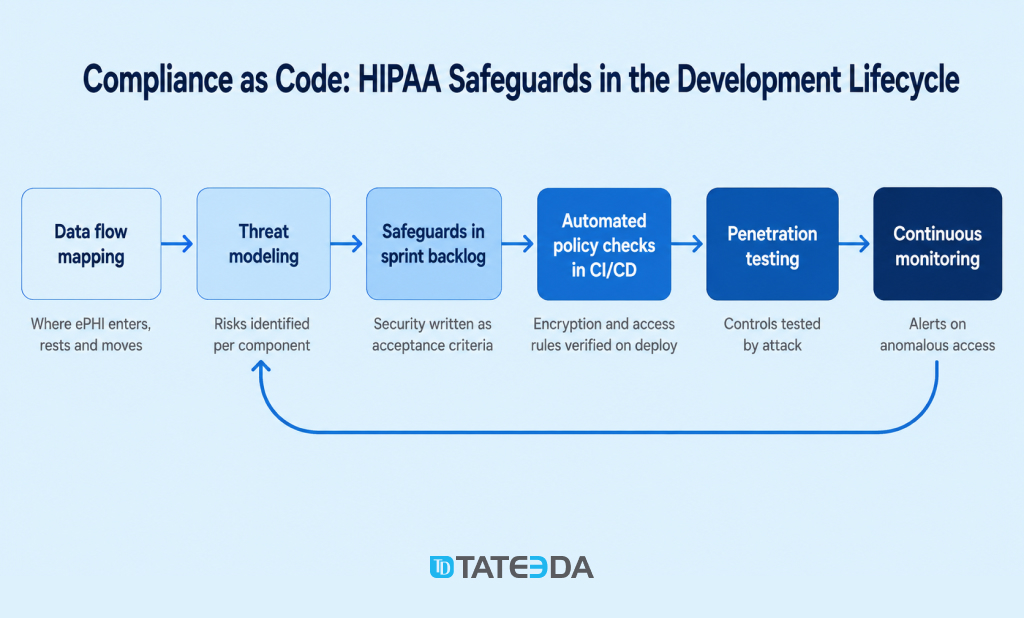
Treat compliance as code, not as an audit. The safeguards live in the same lifecycle as the features:
- Security requirements written into user stories and acceptance criteria — “all access to this endpoint appears in the audit log with user, timestamp, and record ID” — so compliance is testable sprint by sprint
- Infrastructure as code with policy checks in the CI/CD pipeline: encryption settings, network rules, and access policies verified automatically on every deployment, so a compliant configuration can’t silently drift
- Threat modeling at design time for each new ePHI-touching component, not a single review at the end
- Code review checklists that include PHI handling: no identifiers in logs, no ePHI in error messages, no test data drawn from production
Staff the project for its risk profile. A HIPAA-scope build needs a few roles a generic web project doesn’t: a security-minded architect who owns the data flow map and threat model; backend and DevOps engineers fluent in encryption, key management, and cloud security configuration; and QA engineers who test safeguards as features — attempting unauthorized access, verifying audit completeness, checking session behavior — rather than treating security as someone else’s regression suite. This is where an experienced partner changes the economics: TATEEDA’s custom healthcare software development teams pair those roles with engineers who have shipped against these requirements repeatedly, so your project isn’t paying for anyone’s first encounter with a BAA or an HL7 feed.
Test like an adversary, then keep watching. Pre-launch: penetration testing by people trying to reach ePHI they shouldn’t, plus a compliance-focused test pass against the safeguards checklist above. Post-launch: the era of “assess annually, hope quietly” is ending. Vulnerability scanning on a regular cadence, monitoring with alerts on anomalous access patterns, and periodic re-testing are the operating model the proposed rule formalizes and OCR already rewards. Build the monitoring hooks during development; they’re an architecture feature, not an ops afterthought.
Choosing a HIPAA-Compliant Software Development Partner
If you’ve read this far, you can already see the shape of the evaluation: a qualified partner is one whose answers to the questions below are specific, unprompted, and consistent with everything above. Here’s what to ask, and what the good answers sound like.
“Will you sign a BAA — and what will you ask us before you do?” The right partner says yes, then immediately starts scoping: which environments will we access, will we work with production data or synthetic data, who on our side needs access to what. At TATEEDA, ePHI-scope engagements begin with exactly that scoping conversation, and a signed BAA precedes any access to systems containing real patient data.
“Show me a delivered HIPAA-scope project.” Not a capabilities slide — a real system, with the compliance decisions explained. Ask what data was involved, which safeguards were implemented, and what trade-offs came up. We can point to named, published work: a patient payment portal built to HIPAA, PCI-DSS, and NACHA requirements, where healthcare privacy rules and payment card security had to hold simultaneously and tokenized payment flows kept card data out of the ePHI environment; a patient portal and mobile app for La Maestra Community Health Centers, built as part of our patient portal development practice; and platform work for AYA Healthcare, one of the largest U.S. travel nurse agencies, spanning FHIR and HL7 exchanges, X12 eligibility and claims flows, and SSO and OAuth2 identity services. Vendors who gesture at “case studies” without naming any are asking you to take delivery history on faith.
“What’s your incident response process?” A partner functioning as your business associate has breach notification obligations of their own. They should be able to describe, without looking it up, how an incident gets detected, escalated, contained, and reported to you — and how their engineers’ access is structured so the blast radius of any single compromised credential is small.
“Where does your team sit, and how does that affect compliance?” Here’s the question behind the question, because it’s the objection buyers actually carry into these calls: does a nearshore or offshore team introduce HIPAA risk?
The honest answer is that geography is not the risk variable. HIPAA doesn’t prohibit development work outside the U.S., and nothing about a U.S. zip code confers compliance. What matters is whether the process discipline travels: signed BAAs covering every person who can touch ePHI, environment separation so most development happens against synthetic data, role-based access provisioning and same-day revocation, encrypted communications, and audit trails covering the development infrastructure itself. A San Diego team without those controls is a bigger risk than a distributed team with them. TATEEDA’s model is built on exactly this premise — U.S.-based leadership and client interface in San Diego, senior engineers across global delivery hubs, and one compliance standard across all of it. If distributed delivery is part of your build-versus-buy math, our nearshore development team model shows how the economics and the controls coexist.
“What will this cost?” Wrong guide for that question, but the honest framing is that HIPAA-scope work adds engineering effort in specific, predictable places — encryption and key management, audit infrastructure, security testing — rather than a vague “compliance premium.” For real numbers by project type, our healthcare software development cost breakdowns are a better basis for budgeting than any vendor’s one-size estimate.
The pattern across all five questions: you’re not testing whether a vendor can say “HIPAA.” You’re testing whether compliance is a practiced discipline or a proposal keyword. Specific answers, named projects, and unprompted precision about BAAs and data scoping are the tells that it’s the former.
FAQ
Does my healthcare app need to be HIPAA compliant?
It depends on the data and who handles it, not on the word “health” in your app store listing. If your software creates, receives, stores, or transmits identifiable health information on behalf of a covered entity or business associate, HIPAA applies. A consumer wellness app collecting self-reported data directly from users, with no covered-entity relationship, generally isn’t governed by HIPAA — though FTC health data rules and state privacy laws including CCPA likely still apply. The dangerous zone is the middle: apps that start consumer-only and then add a provider integration, at which point HIPAA obligations attach to an architecture that wasn’t built for them. If there’s any chance your roadmap includes provider, payer, or EHR connectivity, build to HIPAA standards from the start.
Is there such a thing as “HIPAA-certified” software?
No. HHS certifies neither software nor organizations, and no third-party certificate confers HIPAA compliance. Private companies sell “HIPAA certification” assessments, which can be useful internal exercises but carry no regulatory weight. What exists in practice: software engineered to support the Security Rule’s safeguards, organizations that implement and document them, and contracts — BAAs — that bind the parties. A vendor leading with a “HIPAA-certified” badge has told you something about their sophistication, just not what they intended.
What’s the difference between HIPAA compliance and SOC 2 for healthcare software?
Different instruments answering different questions. HIPAA is federal law: mandatory if you handle PHI in scope, enforced by OCR, with civil and criminal penalties. SOC 2 is a voluntary attestation framework — an independent auditor’s report on a service organization’s controls, commonly requested in B2B sales as evidence of security maturity. Neither substitutes for the other. A SOC 2 report doesn’t make you HIPAA compliant, and HIPAA compliance doesn’t produce a SOC 2 report. Healthcare SaaS companies selling to enterprises frequently need both: HIPAA because the law requires it, SOC 2 because procurement teams ask for it.
How much does it cost to build HIPAA-compliant software?
Compliance-driven cost shows up in specific line items — encryption and key management infrastructure, audit logging architecture, MFA and identity integration, security testing, and the senior engineering time to design them — rather than as a flat percentage. Total project cost then varies by scope the same way any custom build does. We’ve published detailed cost breakdowns by project type, including our patient portal development cost guide, which are a better basis for budgeting than a generic range repeated here.
Do nearshore or offshore development teams introduce HIPAA risk?
Not inherently. Undisciplined teams introduce HIPAA risk, wherever they sit. HIPAA doesn’t restrict development geography; it requires that everyone who touches ePHI be covered by the BAA chain and bound to the safeguards. The evaluation is the same for a distributed team as a domestic one: BAAs in place, environment separation from production data, access provisioning and revocation, encrypted tooling, auditability. Held to that standard, a distributed senior team frequently delivers stronger compliance outcomes than a local team learning healthcare on your budget, at meaningfully better economics.
What happens if my software has a HIPAA violation after launch?
Sequence and evidence determine the outcome. If the violation involves a breach of unsecured PHI, the Breach Notification Rule’s clock starts: affected individuals and HHS must be notified within deadlines, with media notification for large breaches. OCR may investigate, and its findings turn on demonstrable diligence — risk analyses conducted, safeguards implemented, logs available, response executed. Penalties scale with culpability, from $145 per violation to an annual cap above $2.19 million, and recent enforcement shows OCR settling with organizations less for being breached than for being unable to show they’d done the work beforehand. This is why audit logging and incident response are build-time decisions: the software you shipped years earlier determines what you can prove on the worst week of your company’s life.
Compliance Is an Architecture Decision, Not a Certification You Buy
Everything in this guide reduces to one principle: HIPAA-compliant software development is a way of building, not a stamp applied afterward. Encryption everywhere ePHI lives and moves. Access controlled, authenticated, and logged so completely that the audit trail answers investigators’ questions in hours. Safeguards written into sprints, verified in pipelines, and tested by people trying to break them. Contracts — BAAs, all the way down the chain — that make the obligations real. And, in 2026, a proposed Security Rule about to turn the practices above into the legal floor, with a compliance window too short for teams that haven’t started.
You can build this capability in-house, and this guide is designed to help you do it. Or you can bring in a team that has already made these decisions across patient portals, medical billing and claims platforms, EHR integrations, and telemedicine systems — and spent the last decade being asked exactly the hard questions listed above.
TATEEDA builds custom software for HIPAA-regulated environments from San Diego, with 100+ senior engineers across global delivery hubs and delivered, published healthcare work to show for it, including a patient payment portal engineered to HIPAA, PCI-DSS, and NACHA requirements for a U.S. medical service provider.

Planning software that will touch ePHI?
We’ll walk through your data flows, flag the compliance decisions your architecture needs to make early, and give you an honest read on scope before you commit to anything.




![8 Medical Billing Automation Developers in California [2026]](https://tateeda.com/wp-content/uploads/2026/10/Cover.png)
