10 Custom AI Development Companies for Small Healthcare Providers in California

Slava Khristich


Vlad Nazarov

This guide compares healthcare AI development companies in California by services, starting engagements, and budget considerations to help small medical practices, clinics, dental offices, and behavioral health providers choose a development partner.
A small medical practice can have a very specific AI problem: too many intake documents to review, repeated appointment questions, or hours spent moving information between patient records and billing systems. Solving it should begin with a clear scope and an affordable first commitment.
Finding the right development partner takes more than comparing hourly rates. A three-provider clinic needs a manageable engagement, clear responsibilities, and software that fits its daily work. A low advertised project minimum may cover a prototype while leaving electronic health record (EHR) access, security work, and ongoing support outside the initial scope.
For a small healthcare provider, a suitable AI development partner should be able to scope one useful workflow, connect it to existing software, define how staff review its output, and explain the initial and ongoing costs. A phased engagement gives the practice a decision point before committing to a larger build.
The numbering is for reference, not a best-to-worst ranking. TATEEDA publishes this research to examine the market, identify opportunities for growth, and clarify how our services differ. We are included in the list, so this is a vendor-authored guide. The list remains open: companies can suggest an addition or correction with details of their services, California presence, and engagement terms.
Table of Contents
How we selected these healthcare AI development companies
The selection draws on company websites, service descriptions, public engagement offers, and business directories, including Clutch. Directory profiles provide background and general budget indicators; company service pages and direct offers inform the discussion of what each team can provide. We focused on specialist development firms with a California location, healthcare and AI services, and engagement options worth discussing for a smaller project.
These 10 companies offer different combinations of consulting, development, integration, and ongoing engineering support. Suitability depends on the workflow, the available budget, and what the first engagement includes. For example, discovery may produce a development plan, while a prototype engagement may include working software.
The comparison focuses on three practical questions:
- Service fit: does the company’s offering cover the AI functionality, healthcare workflow, and system connections the practice needs?
- Entry point: can the discussion begin with discovery, a prototype, a proof of concept, or another limited engagement?
- Budget fit: what do published prices and project minimums tell a smaller provider, and what needs a separate quote?
Service descriptions reflect the companies’ published offerings. The suitability assessments are our editorial interpretation, and each provider should confirm scope and availability directly. A proof of concept (PoC) tests feasibility; permission to process protected health information (PHI) requires its own review. Published security statements also need to be assessed against the proposed deployment.
Compare healthcare AI development companies in California
All prices are in US dollars. The engagement description comes first; minimum project sizes and hourly ranges are secondary budget indicators. General listings cover different services and may exclude integrations, cloud usage, testing, and support. They are not quotes for a healthcare AI deployment. TATEEDA’s project minimum is supplied by the company; its healthcare PoC scope still requires a proposal. Confirm all prices and package inclusions before contracting.
The location column identifies a publicly listed California location; it does not mean every engineer works there. The profiles explain where each company may fit and add details about its team, engagement options, or technical offering. Published credentials describe the company or its processes; they do not establish compliance for a particular clinic deployment.
| Company | California location | Relevant healthcare and AI services | Starting engagement and budget indicators | Suitability for a smaller provider |
|---|---|---|---|---|
| TATEEDA | San Diego headquarters | Custom AI assistants, RAG systems, one-workflow healthcare AI PoCs, and EHR integration | Healthcare PoC price by proposal. Company-stated project minimum: $20,000; indicative hourly range: $50-$99. | Consider for adding one AI workflow to existing clinical or administrative software. |
| Bitcot | San Diego | Healthcare agents, patient intake, scheduling, clinical documentation, and EHR development | Discovery and MVP scope by proposal; no fixed clinic AI package verified. General listed minimum: $10,000+; indicative hourly range: $25-$49. | Relevant to patient access and administrative automation; request the cost of one workflow. |
| Softermii | Los Angeles | AI agents and chatbots, telehealth applications, and EHR integration | APEX Proof supports initial validation; regulated deployments require separately agreed scope. Published Proof package: $2,995. | A candidate for early validation using approved content; confirm healthcare data and integration requirements. |
| Binariks | Torrance | AI engineering, EHR/EMR integration, HL7/FHIR interoperability, and cloud infrastructure | Integration scope or engineering allocation by proposal; no fixed healthcare pilot price verified. General listed minimum: $10,000+; indicative hourly range: $50-$99. | Useful when connecting systems is the main obstacle and the provider has a technical owner. |
| EffectiveSoft | San Diego and San Francisco locations | Healthcare AI integration, document processing, patient data management, and analytics | Discovery priced separately by scope. General listed minimum: $25,000+; indicative hourly range: $50-$99. | Consider for document-heavy workflows with fragmented patient data. |
| Topflight Apps | Irvine | Coding and documentation assistance, EHR integration, and healthcare prototyping | A one-month healthcare prototype is available as a separate engagement. Published package: $25,000; general listed minimum: $50,000+; indicative hourly range: $100-$149. | A concrete prototype option for a practice or group with a defined development budget. |
| Dogtown Media | Los Angeles area and San Francisco presence | Healthcare AI features, mobile applications, EHR connections, and product discovery | Discovery and modular AI work priced by scope. General listed minimum: $25,000+; indicative hourly range: $100-$149. | Consider when the project centers on a patient or clinician mobile application. |
| Sidebench | Los Angeles | Healthcare product strategy, EHR integration, patient interfaces, AI, and process automation | Discovery scope by proposal; no separate paid discovery price verified. General listed minimum: $50,000+; indicative hourly range: $50-$99. | More plausible for a funded clinic group or substantial workflow redesign. |
| Waverley Software | Palo Alto headquarters | Healthcare NLP/ML development; healthcare integrations and AI discovery | AI discovery price by proposal. General listed minimum: $50,000+; indicative hourly range: $50-$99. | Consider for a technically demanding project requiring feasibility work first. |
| Markovate | San Francisco | Medical coding assistance, document processing, healthcare AI agents, and PoCs | Healthcare PoC available; price not published in reviewed sources. General listed minimum: $50,000+; indicative hourly range: $50-$99. | Potential fit for a funded coding or document-processing project with measurable volume. |
When comparing healthcare AI development services in California, request the same deliverable from two or three companies: one workflow, one integration, a named staff reviewer, and a price covering both implementation and operation. That makes the proposals easier to compare.
Which companies should a small clinic shortlist?
Choose the initial shortlist around the work you need done. Based on the services and engagement options compared here:
- Adding AI to existing workflows: consider TATEEDA or Bitcot for a focused assistant or administrative automation discussion.
- Defining a prototype purchase: compare Softermii’s general validation offer with Topflight Apps’ healthcare prototype engagement, accounting for their different deliverables.
- Resolving integration or data problems: discuss Binariks, EffectiveSoft, or Waverley when system access, document quality, or technical feasibility needs attention first.
- Building an app or redesigning a workflow: consider Dogtown Media for mobile features, Sidebench for product and workflow design, or Markovate for coding and document-processing scope.
These are starting points for vendor discussions. Ask each shortlisted company to price the same workflow and state what must be in place before staff can use it.
1. TATEEDA
Relevant for: a focused AI addition that must work with existing healthcare software.
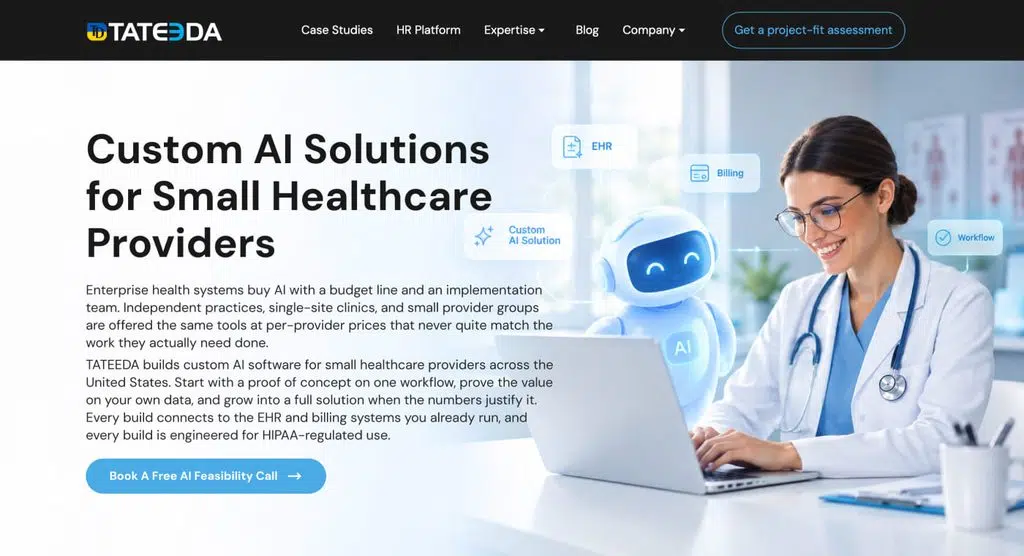
TATEEDA is a San Diego-based healthcare software development company offering senior engineering teams, custom AI development, and EHR integration. Its custom healthcare software development services cover patient portals, billing systems, medical applications, and connections between clinical and administrative tools.
The systems TATEEDA can build include internal AI assistants, intake document-processing tools, billing review support, and retrieval-augmented generation (RAG) systems. A RAG assistant retrieves relevant material from approved information sources before drafting a response. For a practice, a possible starting use is helping staff find answers in internal procedures or approved patient preparation instructions. TATEEDA includes RAG-based functionality and connections to EHR, CRM, and billing applications within its AI engineering offering.
For a smaller provider, the discussion can begin with one task and bring together the AI feature, its system connections, staff review, and data access rules. With a RAG system, that also means deciding which documents it can search, who may access them, how updates are handled, and when the assistant should return the question to a person.
| Detail | TATEEDA |
|---|---|
| Homepage | https://tateeda.com/ |
| Headquarters and delivery | San Diego headquarters with engineering resources in Eastern Europe and LATAM |
| Team structure | A company-reported pool of 100+ senior IT engineers, with dedicated-team and staff-augmentation options. |
| Integration standards | HL7/FHIR integration is available for connecting healthcare applications, subject to the target system’s interfaces and permissions. |
| Initial engagement | A healthcare AI PoC focused on one workflow, with staff review of AI output; scope and price are set by proposal. |
The practical starting point is to describe the workflow, its monthly volume, and the systems involved. Request an estimate that includes integration, testing, and support so the initial commitment reflects the work needed to make the feature useful.
2. Bitcot
Relevant for: patient access and administrative automation.
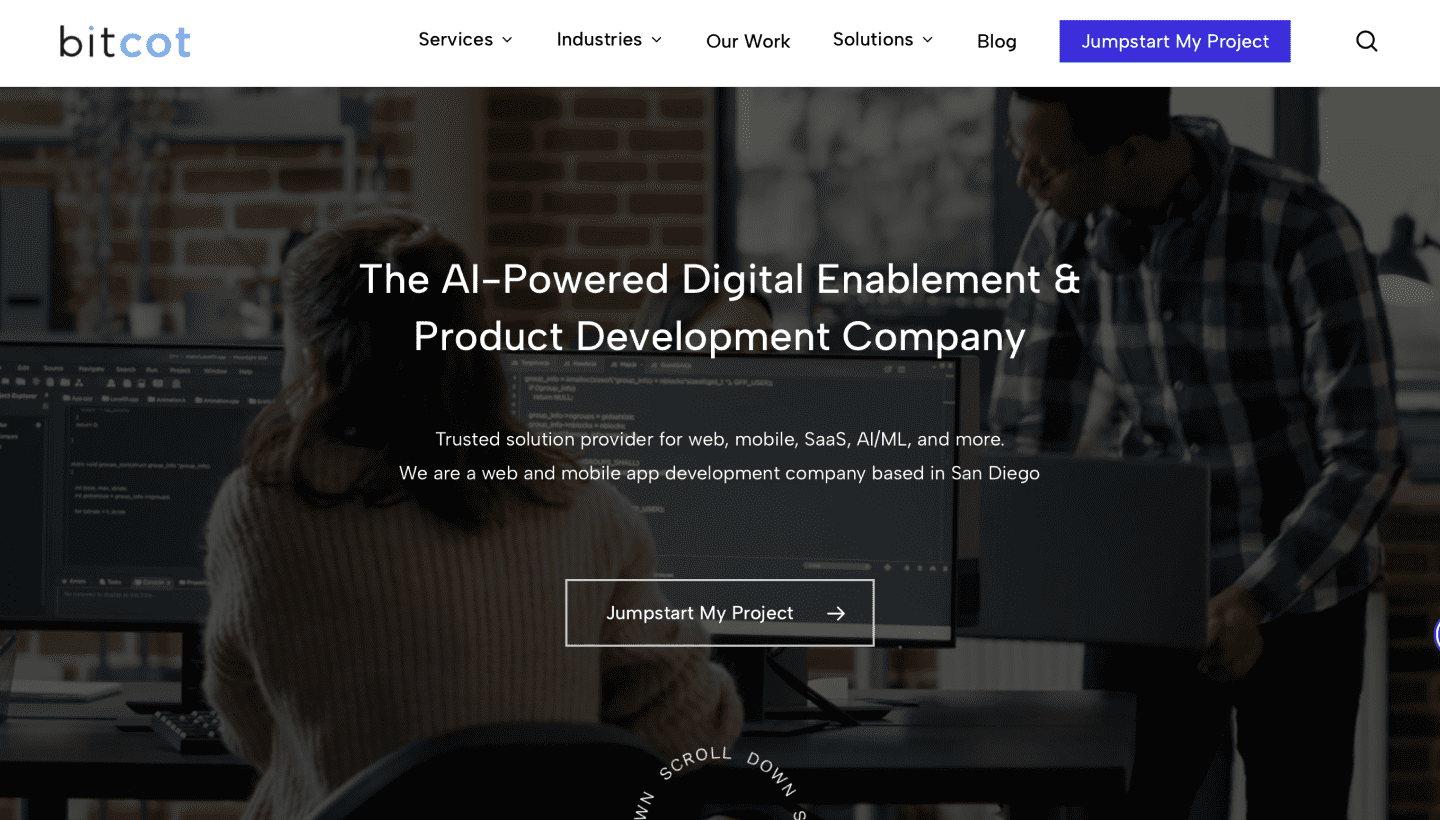
Bitcot combines healthcare AI development with web and mobile engineering. Its healthcare agents and automation services cover tasks such as intake, appointment scheduling, claims processing, and document handling. This combination is relevant to practices that want an AI-assisted task connected to the software staff already use.
For a small clinic, an administrative workflow is a sensible first conversation. A scheduling assistant, for example, needs clear rules about the questions it can answer and how it passes exceptions to staff. If the proposal includes symptom assessment or other clinical functionality, discuss validation, escalation, and oversight as a separate part of the scope.
| Detail | Bitcot |
|---|---|
| Homepage | https://www.bitcot.com/ |
| Established | Founded in 2014 |
| California base | San Diego |
| Delivery resources | Bitcot reports 200+ in-house engineers. The size and roles of the assigned project team need a separate agreement. |
| Implementation options | Its offering includes reusable healthcare components and low-code workflow tools alongside custom development. |
| Initial engagement | Discovery and MVP development are advertised; a fixed-price healthcare AI pilot was not verified. |
Ask which existing components can support your workflow and what still needs custom engineering. The general budget indicator in the comparison table is a starting point for that discussion; the proposal should identify the actual implementation and operating costs.
3. Softermii
Relevant for: testing a patient communication assistant before a broader build.
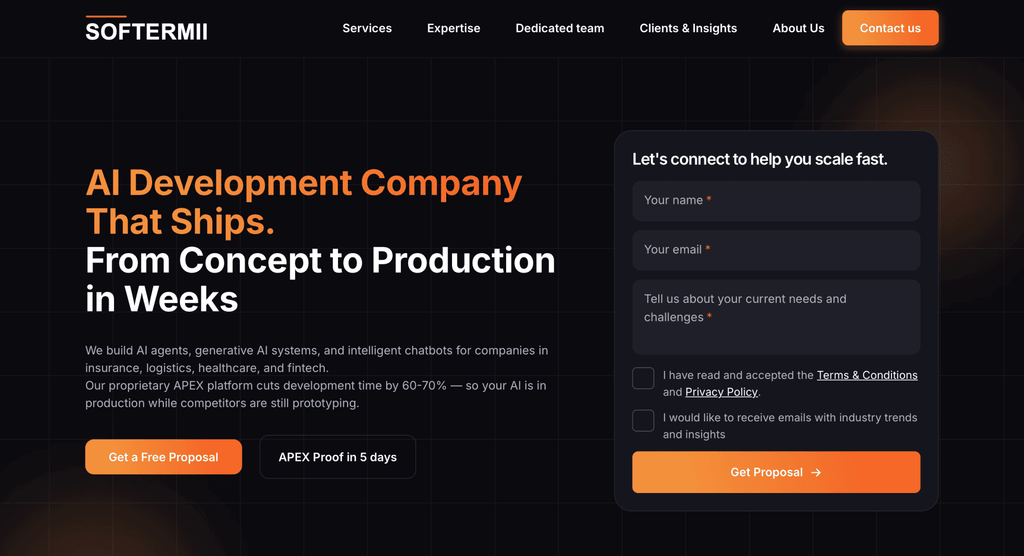
Softermii offers AI agents, chatbots, generative AI integration, and healthcare application development. For a smaller practice, a useful brief would define the information an assistant can use, how staff control its responses, and which systems it needs to access.
Its APEX engagement model uses an agreed feature list and fixed price. This can make an initial purchase easier to define, provided the practice distinguishes a demonstration using approved content from a deployment that handles patient information. The pricing page places HIPAA and other regulated-environment requirements within a custom-scoped Enterprise option, so the entry package should not be treated as an all-inclusive healthcare implementation.
| Detail | Softermii |
|---|---|
| Homepage | https://www.softermii.com/ |
| Established | Founded in 2014 |
| Selected office locations | Los Angeles/Studio City, Austin, London, Warsaw, and Kyiv are among its listed locations. |
| Entry package terms | APEX Proof lists five working days and a 15-day defect warranty; its price appears in the comparison table. |
| Ownership and operating costs | Published terms provide code ownership on payment and an upfront estimate of model and infrastructure costs. Third-party fees and licenses are excluded. |
| Relevant platform option | Its VidRTC offering supports real-time communication and telehealth applications. |
Before choosing a package, ask whether the proposed workflow fits its feature allowance and how EHR access, patient data handling, and post-warranty support will be priced.
4. Binariks
Relevant for: connecting an AI application to healthcare systems.
Binariks offers AI engineering alongside EHR/EMR modernization, interoperability, and cloud development. Its combination of software development and dedicated engineering support is relevant when information needs to move between an AI application and existing healthcare systems.
A focused brief could start with a defined data exchange: receiving a referral document, extracting selected fields, and presenting them for review before they enter the practice’s system. The first discussion should establish what the destination software permits and who will manage the connection when its interface changes.
| Detail | Binariks |
|---|---|
| Homepage | https://binariks.com/ |
| California location | Torrance |
| Delivery model | European engineering resources with dedicated-team and software development engagements. |
| Integration capabilities | The published offering includes EHR/EMR integration, HL7/FHIR interoperability, data pipelines, and cloud infrastructure. |
| Initial scope to request | A limited integration engagement or defined engineering allocation, with a documented handover. A fixed-price healthcare pilot was not verified. |
When discussing a project with Binariks, clarify whether product planning and project management are included alongside engineering. A clinic without an internal technical lead should also request clear ownership of architecture, testing, and ongoing support.
5. EffectiveSoft
Relevant for: extracting useful information from fragmented healthcare documents.
EffectiveSoft’s healthcare AI services cover document management, patient data processing, analytics, and integration. Natural language processing (NLP) is part of its offering for working with unstructured text and extracting information from medical documentation.
A useful small-provider brief would limit the first phase to one document type and one destination system. For example, staff might need to locate selected information across referral packets without manually reading every page. The development discussion should cover missing fields, contradictory information, and the review required before extracted data is used.
| Detail | EffectiveSoft |
|---|---|
| Homepage | https://www.effectivesoft.com/ |
| California offices | The company lists San Diego and San Francisco locations. |
| Additional delivery location | San José, Costa Rica is among its listed locations, providing an option to discuss for time-zone overlap. |
| Published credentials | Its certification page lists ISO/IEC 27001:2022 certificates for EffectiveSoft Corp. and EffectiveSoft Poland, plus Microsoft Solutions Partner designations in Data & AI and Digital & App Innovation. |
| Initial engagement | A separate product discovery service is available, with pricing based on scope. |
Ask what discovery will establish about data quality and integration costs before authorizing development. The implementation estimate should separate data preparation, system connections, evaluation, and support.
6. Topflight Apps
Relevant for: a healthcare prototype with a published price and defined deliverables.
Topflight Apps focuses on healthcare application development, data integration, and AI-assisted workflows. Its healthcare software offering includes patient and provider applications, EHR connections, and support for bringing a product from initial design into use.
The company publishes a separate healthcare prototype engagement, making it easier to discuss a defined first purchase. For a small provider, the question is whether the prototype will resolve an operational uncertainty: can staff review the output quickly, can the proposed interface support their work, and is the required data accessible?
| Detail | Topflight Apps |
|---|---|
| Homepage | https://topflightapps.com/ |
| California location | Irvine, with a listed address on Kettering Street. |
| Prototype schedule | The healthcare prototype package specifies one month. |
| Included handover | A deployed prototype, source code, strategy report, user-flow maps, design system, and next-phase roadmap. |
| Security scope | The offer describes a HIPAA-compliant setup; confirm the actual hosting, data permissions, agreements, and release requirements for your project. |
| Follow-on work | MVP development and ongoing support are separate phases in the published development path. |
The prototype package and the general project minimum in the comparison table refer to different engagements. Ask for the included integrations, testing, and next-phase cost in writing before treating the prototype as a step toward live clinical use.
7. Dogtown Media
Relevant for: adding an AI feature to a patient or clinician mobile app.
Dogtown Media offers healthcare mobile applications with AI functionality. Its services cover discovery, EHR connections, and modular additions to existing applications. This makes it relevant when the intended improvement belongs within a patient or clinician mobile experience.
A practice could discuss a limited feature for patient communication or connected care. The proposed app should have a clear operational purpose: who uses it, what it helps them complete, and why the existing portal or website cannot already support that task.
| Detail | Dogtown Media |
|---|---|
| Homepage | https://www.dogtownmedia.com/ |
| Established | Founded in 2011 |
| Geographic presence | Its company page describes a Venice Beach headquarters and presence in San Francisco, New York City, and London. |
| Product platforms | Mobile application development spans iOS and Android. |
| Initial engagement | Discovery and modular AI work are described; a fixed-price healthcare AI pilot was not verified. |
| Budget item to request | A separate estimate for app maintenance, operating-system updates, and support after release. |
Confirm that the team will accept the proposed limited scope. For a back-office document assistant, first establish whether a mobile application would add useful functionality or simply add screens and maintenance costs.
8. Sidebench
Relevant for: a clinic group whose AI plans also require workflow redesign.
Sidebench combines product strategy, design, and engineering. Its healthcare services bring workflow planning and patient or staff interfaces into the same discussion as system integration and data management.
This can be relevant when inconsistent processes are part of the problem. Before adding AI, a clinic group may need to agree on how a referral is routed, who reviews it, and which system holds its current status. Ask the team to identify what can be improved through ordinary software or integration, then explain where AI would add value.
| Detail | Sidebench |
|---|---|
| Homepage | https://sidebench.com/ |
| California base | Los Angeles |
| Relevant platforms | The published offering names Salesforce Health Cloud and CentralReach alongside healthcare system integration. |
| Interoperability tools | HL7, FHIR APIs, middleware, and data mapping are included in its healthcare capabilities. |
| Team disciplines | The company team includes product management, user research, technical architecture, and machine learning roles. |
| Initial engagement | A free discovery call is offered. A paid discovery project has a separate scope and no verified published price. |
Given its general project minimum, Sidebench is a more plausible candidate for a funded clinic group or substantial redesign than a very small automation experiment. Ask for a phased proposal with an explicit decision point after discovery.
9. Waverley Software
Relevant for: checking whether a more technical AI idea is feasible.
Waverley’s healthcare offering includes AI and machine learning, NLP, data engineering, EHR/EMR integration, and patient applications. It also offers a separate AI discovery service for organizations deciding where AI belongs in their operations.
For a smaller provider, this route is most relevant when the uncertainty is technical. Perhaps the documents vary substantially, the data sits in several systems, or the proposed model needs to work within strict operating limits. The value of discovery is a clear recommendation about whether to proceed and what the build would require.
| Detail | Waverley Software |
|---|---|
| Homepage | https://waverleysoftware.com/ |
| Established | Founded in 1992 |
| Headquarters | Palo Alto, California |
| Other listed locations | Wrocław, Poland; Cochabamba, Bolivia; and Lviv, Ukraine. |
| Discovery deliverables | Its AI discovery service assesses opportunities and feasibility; a working PoC is a potential next step rather than an included deliverable. |
| Initial pricing | Discovery requires a separate quote; the general development minimum appears in the comparison table. |
Ask for data requirements, integration assumptions, and expected next-phase costs in writing. The engagement should leave the practice able to make a build-or-stop decision without committing to further development.
10. Markovate
Relevant for: medical coding and document-processing projects with a funded business case.
Markovate offers healthcare AI consulting, development, and integration, including medical coding assistance, document processing, patient support, and claims workflows. A practice considering these services should define the intended output and the staff review required before it enters a clinical or billing system.
The strongest reason to consider this option is a repeatable workflow with enough volume to support a development budget. For coding or document extraction, assess correction rates and exception handling alongside processing speed. Faster output has limited value if staff must spend just as long checking it.
| Detail | Markovate |
|---|---|
| Homepage | https://markovate.com/ |
| California location | San Francisco |
| Published credentials | The company reports ISO 9001:2015 and ISO/IEC 27001:2022 certification. Request the current certificates and their scope during procurement. |
| Initial engagement | Its healthcare page offers a proof of concept delivered in weeks, without a published healthcare PoC price. |
| Integration scope to define | The exact EHR or billing product, permitted data access, and the point at which a staff member approves the output. |
A small clinic should establish whether a separately priced PoC is available before considering a broader build. Request a demonstration using representative documents and agree on how errors will be measured.
What makes custom healthcare AI development affordable?
Affordable healthcare AI development has three practical characteristics: the first commitment is limited, operating costs are visible, and the result can be measured against the practice’s workload.
A low hourly rate does not establish any of those conditions. Nor does a prototype price tell you what a deployed system will cost.
Compare the full first-year cost
Ask vendors to separate the following items in their proposals:
| Cost item | What the proposal should explain |
|---|---|
| Discovery | Workflow analysis, data review, integration checks, and the decision it will support |
| Development | Included features, interfaces, integrations, and acceptance criteria |
| Data preparation | Document cleanup, sample selection, labeling, and access arrangements |
| Security and evaluation | Access controls, logs, testing, staff review, and release approval |
| Third-party services | Model usage, hosting, storage, messaging, and EHR vendor charges |
| Operation | Monitoring, maintenance, support, staff review time, and changes after launch |
The comparison should include the cost of handling mistakes. If an assistant saves time on routine documents but creates a long exception queue, the apparent benefit may disappear.
For example, imagine a workflow falls from six minutes to three minutes per document across 600 documents a month. That represents 30 hours of released capacity. It is an illustrative calculation, not a savings forecast. The practice still needs to subtract additional review time and operating costs, and decide how it will use those hours.
Buy a decision before buying a platform
A useful initial engagement can answer whether the data is usable, whether the EHR permits the required connection, and whether the workflow benefits from AI at all.
For cost-effective healthcare AI solutions, define an explicit stopping point. A pilot that reveals an unsuitable use case can prevent a much larger expense. The contract should allow that outcome without obligating the practice to purchase the next phase.
When does a small provider need custom AI instead of a subscription tool?
Start by checking what your existing EHR or practice-management vendor already offers. A subscription product may be sufficient for a common task if its functionality, integration, data handling, and contract meet your needs.
Custom development becomes more relevant when the workflow depends on several systems, practice-specific approvals, or access to approved internal information that existing products cannot support.
| Your situation | Route to evaluate first |
|---|---|
| A standard documentation or reminder tool meets the practice’s requirements | An existing product and its available configuration |
| A suitable AI product exists, but information must move between systems | A limited integration engagement |
| Staff must review unusual referral documents and route them through practice-specific approvals | A focused custom workflow |
| The task consists of predictable rules, such as checking required fields | Conventional automation, with AI only where needed |
| The proposal involves diagnosis or treatment recommendations | A separate clinical validation and regulatory assessment before development |
AI development for small medical practices does not necessarily mean training a proprietary model. A custom application may combine an existing model with approved data sources, business rules, staff review, and secure system connections.
When comparing custom healthcare AI development in California, ask each company to explain why a custom component is needed and which existing tools it would reuse.
How can a small clinic start with one AI-assisted workflow?
Start with one repetitive task, one defined output, and a staff member responsible for reviewing the result. Useful AI solutions for small clinics often address intake documents, referral completeness, or routine administrative questions before expanding into more complex workflows.
1. Choose a bounded task
The following workflow ideas can help define an initial discussion with a development partner:
| Provider setting | Possible first workflow | Staff responsibility |
|---|---|---|
| Independent medical practice | Extract selected fields from intake documents and flag missing information | Verify the extracted information before saving it |
| Dental practice | Sort referral documents and prepare a checklist of missing attachments | Confirm the patient match and document completeness |
| Behavioral health provider | Classify administrative intake requests and draft routine replies | Review replies and route clinical or urgent content to qualified staff |
| Ambulatory care center | Check incoming referral packets against an approved document checklist | Decide whether the packet is ready for the next step |
| Small multispecialty clinic | Draft answers to scheduling and preparation questions from approved content | Approve content and take over questions outside the allowed scope |
2. Define the pilot before development begins
Write down the input, the permitted output, the systems involved, and the person who accepts or rejects the result. Include what the AI must do when information is missing or contradictory.
Use synthetic data for an early demonstration where possible. Introducing patient information requires an approved data-handling arrangement. Under HHS guidance on cloud computing and electronic PHI, cloud providers processing or maintaining electronic PHI on behalf of a regulated organization generally require a business associate agreement, alongside applicable safeguards and risk analysis.
3. Measure the work staff actually performs
Track time per completed task, correction frequency, cases needing manual handling, and cost per task. Test difficult examples as well as clean ones: incomplete forms, conflicting fields, duplicate records, and unfamiliar wording.
Agree on acceptance thresholds before testing. Expand only after the clinic can explain what improved, what still needs review, and what the next phase will cost.
Questions to ask before hiring a healthcare AI development company
Before hiring a healthcare AI software development company in California, ask shortlisted vendors the same questions so differences in their answers are visible.
- Which part of our workflow should we address first? Ask the vendor to identify a useful initial scope, explain where AI adds value, and describe what staff will need to review.
- Will you accept a standalone discovery or pilot? Ask for its price, deliverables, exclusions, and whether further development is optional.
- How will you connect to our exact systems? Establish API availability, read and write permissions, vendor approvals, and third-party charges.
- Which organizations will handle patient information? Request the data flow, subcontractor list, hosting details, model providers, retention settings, and applicable BAAs.
- How will staff check AI output? Ask how source information is displayed, how errors are corrected, and when the system hands a task back to a person.
- What does the first-year estimate include? Look beyond development to usage, support, staff training, monitoring, and future changes.
- Who owns the code and accounts? Clarify access to source code, configurations, documentation, cloud accounts, and data export.
- Who supports the system after launch? Request named responsibilities for integration failures, model changes, security incidents, and routine maintenance.
For California projects involving patient communications, also ask how the workflow addresses relevant state requirements. California Health and Safety Code section 1339.75 requires disclosures and human-contact instructions for specified generative-AI patient communications concerning clinical information. It contains an exception for communications read and reviewed by a licensed or certified healthcare provider, and excludes administrative matters such as scheduling and billing from its definition of patient clinical information.
Discuss one healthcare AI workflow with TATEEDA
Bring one workflow, the systems it touches, an approximate monthly task volume, and the problem staff encounter today. TATEEDA’s custom AI assistant development services and healthcare AI PoC services provide starting points for that discussion. Ask for an assessment of the smallest useful scope, its integration requirements, and a written estimate before deciding how to proceed.
FAQ: Healthcare AI development for small California providers
1. How should a small California clinic choose an AI development company?
Choose a company that can define a limited first engagement, connect to your existing systems, explain patient data handling, and assign responsibility for support. Compare proposals for the same workflow, including deliverables, exclusions, staff review, and first-year costs. A California office may help with coordination, but the assigned team’s availability and responsibilities matter more than the address alone.
2. How much does custom healthcare AI development cost for a small provider?
The cost depends on the workflow, integrations, data preparation, security requirements, and support. TATEEDA’s minimum project size is $20,000, with healthcare PoC pricing determined by proposal. Published entry offers in this comparison include Softermii’s $2,995 general validation package and Topflight Apps’ $25,000 healthcare prototype. These engagements have different deliverables and do not establish the cost of an equivalent production system. Request a scoped estimate and separate operating-cost forecast.
3. When is a subscription AI tool enough for a medical practice?
A subscription tool may be enough when it supports the required task, connects to the practice’s systems, and meets its data-handling and contract requirements. Custom development is worth considering when staff need a workflow that spans several applications, practice-specific approvals, or an assistant using approved internal content. Sometimes a limited integration project is sufficient, without building a new application.
4. Can custom healthcare AI work with an existing EHR or billing system?
Yes, when the system permits the required data access and integration. The developer should confirm the exact product, version, available APIs, read and write permissions, vendor approvals, and fees before pricing the build. HL7 and FHIR capabilities can support healthcare data exchange, but they do not guarantee access to every installation. Define what staff must review before AI-generated information enters the record or billing workflow.
5. What should HIPAA-compliant healthcare AI development include?
Healthcare AI development should address the actual data flow, risk analysis, access controls, logging, retention, and responsibilities of every organization handling protected health information. The HHS guidance on cloud computing explains relevant safeguards and business associate agreement requirements. A vendor’s general compliance statement does not establish compliance for your deployment; those requirements must be reflected in the architecture, agreements, and operating procedures.

![The 11 Best Offshore Software Development Companies Suitable for the U.S. Market [2026]](https://tateeda.com/wp-content/uploads/2024/04/The-Best-Offshore-Software-Development-Companies-e1731060509127.jpg)



![8 Medical Billing Automation Developers in California [2026]](https://tateeda.com/wp-content/uploads/2026/10/Cover.png)
