From Healthcare App Prototype to HIPAA-Ready Product Development
Your AI-generated, vibe-coded, or no-code software prototype proved
the concept. Upgrading it into production-ready healthcare software takes more: secure architecture, controlled AI behavior, HIPAA-compliant PHI handling, EHR integration, testing, and a clear release path.
TATEEDA is a custom healthcare software development company that helps healthtech founders, providers, pharma teams, biotech companies, and healthcare SaaS vendors move from an early demo to a HIPAA-ready PoC, MVP, or full commercial product.
What can we help you with?

Healthcare SaaS MVP
Launch a first sellable version with multi-tenancy, PHI handling, and billing designed in from day one.

Multi-tenant re-architecture
Turn a single-customer application into a platform that onboards new organizations without a code fork.

Scale and compliance hardening
Prepare an existing product for larger tenants, enterprise buyers, and the security questionnaires that come with them.
Healthcare SaaS Deals End at the Security Questionnaire
Making the product work is the visible part. Selling it is where the real requirements land: tenant data isolation, single sign-on against the customer’s staff directory, roles that match clinical workflow, audit logs a compliance officer can export, an uptime commitment, a signed BAA, and a straight answer about where PHI travels. Products that can’t answer stall in procurement — months after the demo went well.
Build the Platform Layer Before You Need It

and goals
work to us
ready-to-go product
Plan your healthcare SaaS build with us
Drop us a line, and our medical software development services advisor will get back to you shortly


 7220 Trade Street, Suite 103
San Diego, CA 92121
7220 Trade Street, Suite 103
San Diego, CA 92121
We reply within 24 hours, and the first call is with the CTO, not a salesperson.
What Makes Healthcare SaaS Different
A healthcare SaaS product carries obligations a one-off build never faces. Every customer brings its own users, its own EHR, its own retention rules, and its own security review — and every release ships to all of them at once.


Choose the Right Healthcare SaaS Service
Healthcare SaaS MVP Development
Ship a first commercial version in months, not years. We scope the smallest product that a real customer will pay for, then build it on architecture that survives customers two through fifty — tenant model, PHI boundaries, roles, and release pipeline included.
Multi-Tenant Architecture & Re-Platforming
Convert a single-customer application, internal tool, or pilot build into a true platform. We separate tenant data, rework identity and permissions, move configuration out of code, and remove the per-customer branches that make every release a manual exercise.
EHR, Payer, and Billing Integrations
Build the integration layer as a product feature. We implement FHIR and HL7 v2 interfaces, SMART on FHIR launches, payer and clearinghouse connections, and per-tenant credential management — with monitoring and retries instead of silent failures.
Subscription, Billing, and Payment Workflows
Handle plans, seats, usage metering, invoicing, and patient-facing payments. Where card data is in scope, we design payment flows around PCI DSS requirements and keep cardholder data out of your application wherever a provider can hold it instead.
Healthcare AI and Analytics Features
Add AI and reporting that your customers’ compliance teams will accept: defined data boundaries for what may reach an LLM, traceable outputs, permission-aware retrieval, human review steps, and tenant-scoped analytics.
Compliance & Security Hardening
Prepare the product for the reviews that decide deals. We add encryption, RBAC and MFA, audit logging, PHI data-flow mapping, environment separation, and the technical documentation your buyers’ questionnaires and your own SOC 2 or HITRUST assessment will ask for.
What HIPAA-Ready SaaS Engineering Includes
HIPAA-ready software supports regulated healthcare use through technical safeguards and clear documentation, aligned with the HIPAA Security Rule. Organizational compliance also depends on contracts (including Business Associate Agreements), policies, staff training, legal review, and daily operating procedures.


Tenant isolation and PHI data-flow mapping
Map where Protected Health Information enters, moves, is stored, and leaves the platform — and prove that one tenant’s data cannot surface in another’s queries, exports, caches, or logs.

Access control
Role-based permissions, minimum-necessary access, multi-factor authentication, SSO against customer identity providers, session rules, and separated support and administrative access.

Audit logging
Record data access, permission changes, exports, and relevant system events per tenant, in a form your customers can review during their own HIPAA audits and incident investigations.

Audit-readiness documentation
Architecture notes, data-flow diagrams, access-control descriptions, and prepared answers for buyer security questionnaires and SOC 2 or HITRUST assessments.

Subprocessor and BAA review support
Identify every third party that may receive PHI — including LLM providers, analytics, messaging, and hosting vendors — and supply the technical input your BAAs and vendor reviews require.

Secure cloud infrastructure
Encryption at rest and in transit, environment separation, backups, disaster recovery, retention and deletion, and monitoring on HIPAA-eligible AWS or Azure services under a signed BAA.
One Integration Layer,
Every Customer’s EHR
SaaS vendors can’t rebuild connectivity for each new customer. In a platform, the integration layer is a product feature — configurable, monitored, versioned, and owned by the same team that ships the rest of the roadmap.

FHIR and HL7 v2 interfaces
Read and write clinical data through FHIR REST APIs and HL7 v2 messaging, with mapping that survives differences between customer environments.

SMART on FHIR and OAuth2 launches
Launch inside the EHR where the vendor supports it, with OAuth2/OpenID Connect authentication and scoped access to the right patient context.

Per-tenant credentials and endpoints
Store, rotate, and manage each customer’s integration credentials, sandbox and production endpoints, and go-live approvals without redeploying the application.

Payer, clearinghouse, and payment connections
Connect eligibility, claims, remittance, and patient payment workflows to the platforms your customers already run.

Monitoring, retries, and error surfacing
Detect failed messages, retry safely, and show tenant admins what went wrong — instead of discovering a broken interface through a support ticket.
What Belongs in Version One?
Non-negotiable at launch
- Tenant isolation and defined PHI boundaries
- Role-based access control and MFA
- Audit logging of sensitive actions
- Encrypted storage, backups, and recovery
- Signed BAAs across PHI-touching vendors
Can wait until customer three
- Self-serve onboarding and provisioning
- SSO against every identity provider
- White-label branding per tenant
- Usage analytics dashboards
- A public partner API
Often built too early
- Custom machine learning models
- A microservice split before the load exists
- Multi-region infrastructure
- An in-house billing engine
- Native mobile apps for every user role
Healthcare SaaS Products We Build
-

Telehealth and virtual care platforms
Video and audio visits, scheduling, intake, e-prescribing, secure messaging, and post-visit follow-up, connected to the EHRs your provider customers already use.Video and audio visits, scheduling, intake, e-prescribing, secure messaging, and post-visit follow-up, connected to the EHRs your provider customers already use.
-
Billing, claims, and payer workflow SaaS
Eligibility verification, claim submission and status, denial worklists, patient payment portals, and revenue reporting for RCM vendors and payer-adjacent teams.
-
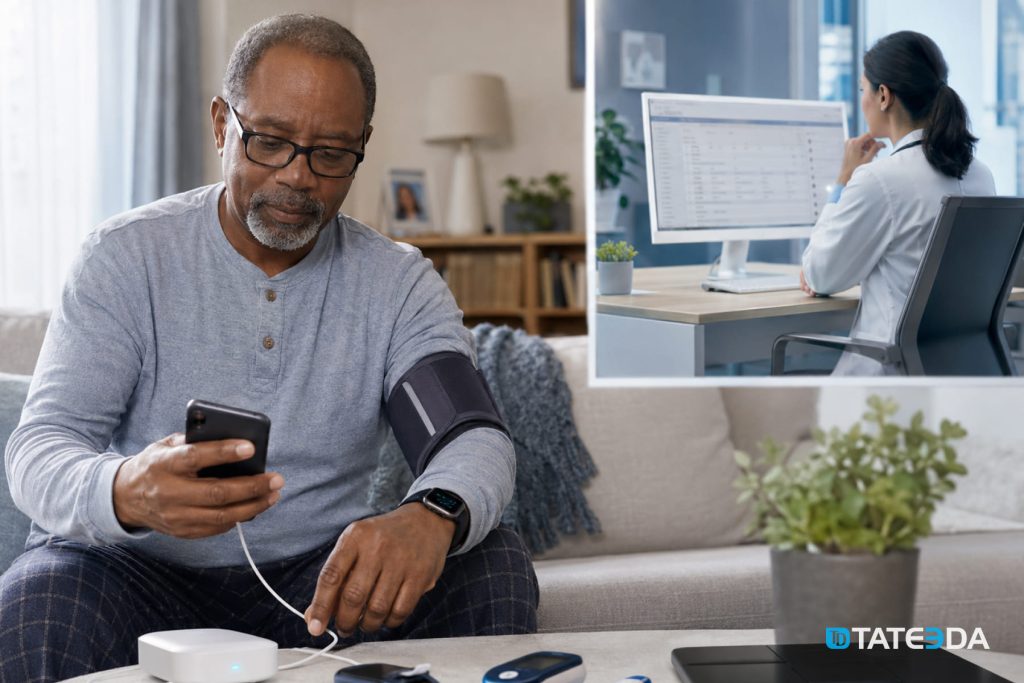
Remote patient monitoring platforms
Device and wearable data collection, thresholds and alerting, care-team dashboards, and the reporting that supports RPM billing workflows.


-
Patient engagement and portal SaaS
Multi-organization patient portals with appointments, records access, forms, reminders, secure messaging, and payments under each tenant’s own branding and rules.
-
Lab, pharma, and biotech platforms
LIMS and laboratory workflow tools, sample and inventory tracking, document processing, instrument and device integrations, and study or trial operations dashboards.
-
Practice, clinic, and hospital operations software
Scheduling, staffing, credentialing, task queues, inventory, documentation, and operational analytics for organizations running multiple sites.


Why Choose TATEEDA GLOBAL as Your Telehealth App Development Company?
-
Healthcare software experience since 2013
Our teams have delivered products for healthcare providers, pharmaceutical and biotech companies, medical staffing, billing, patient portals, and medical IoT.
-
San Diego headquarters
U.S. clients get direct communication with a San Diego-based company, with engineering delivery across Eastern Europe and LATAM.

-
Flexible engagement models
Start with an architecture review, an MVP build, a re-platforming project, or a dedicated development team, and change the model as the product grows.
-
100+ technical specialists
Developers, QA engineers, DevOps specialists, designers, architects, and project managers — one accountable delivery team.
-
Senior in-house engineers
Core delivery never depends on freelancers or temporary gig workers.
Frequently Asked Questions
articles
New in Healthcare App Development Services

Who Can Help California Practices Connect Referrals Across EHR Systems? 5 Companies to Consider

EHR Medication Management Module: eRx, Refill Requests, Drug Database Integration, and Patient Safety Logic