8 Healthcare RAG Development Companies in California [2026]

Slava Khristich


Vlad Nazarov

This guide helps California healthcare providers and healthtech teams compare developers of source-grounded AI assistants by their RAG services, data permissions, answer evaluation, EHR connections, and starting scope.
A staff member asks an assistant for the current referral requirements for a procedure. A useful answer identifies the approved policy, its effective date, and the passage supporting the response. If the policy is missing, outdated, or unavailable to that staff member, the assistant should say so. That is the practical promise—and the engineering challenge—of retrieval-augmented generation (RAG) in healthcare.
Which California-connected companies develop healthcare RAG systems? TATEEDA, ThirdEye Data, Intuz, Xicom, BlueLabel, Closeloop, Simform, and LeewayHertz each describe both RAG-related and healthcare software capabilities, along with a California headquarters, office, or service presence. The right shortlist depends on whether you need a focused provider workflow, data engineering, a research library, a patient-facing product, or a wider platform. Their published material does not establish that each has delivered a permission-aware, clinically evaluated RAG system for your EHR.
The numbers make the profiles easy to reference; they do not rank the companies from best to worst. TATEEDA publishes this vendor-authored research to understand the California market and improve its own offering. We include ourselves and welcome suggestions or corrections from other qualified developers.
Table of Contents
What makes a healthcare RAG partner worth shortlisting?
RAG retrieves information from selected sources before a model drafts an answer. We shortlisted companies with a California connection, a stated RAG or grounded-retrieval capability, and healthcare software services. We also reviewed published material on data engineering, integration, privacy, evaluation, and starting engagements. Sources included official service and contact pages and business directories, including Clutch. The company profiles rely primarily on the vendors’ own descriptions; a published capability is not independent proof of a particular deployment.
We kept the list at eight rather than adding companies with weaker evidence of RAG or California presence. “California connection” may mean headquarters, an office, or explicitly marketed local service; it does not mean every engineer works in the state. No competitor’s RAG-specific project minimum was verified in the reviewed public material.
For a healthcare buyer, five requirements matter more than a vendor’s preferred model:
- Approved and current sources: document owner, effective date, version, refresh schedule, and a way to withdraw obsolete content.
- Permissions at retrieval time: role, organization, patient, and other applicable boundaries must carry through from the original systems into search and results.
- Answers that can be checked: citations should point to the exact passage and version, while unsupported questions should produce a refusal or a handoff.
- Measured performance: test the retrieval step, the final answer, citations, access failures, latency, and cost with representative questions.
- Workflow integration: specify which EHR, portal, document store, or payer system is involved, what the vendor can read or write, and who approves any action.
Healthcare RAG companies in California: a comparison
The suggested first scope is an editorial starting point, not a published package or price. Where a company describes RAG and healthcare in separate service lines, ask how the two would come together for your project.
| Company and California connection | Published capabilities | Suggested first scope | Price and minimum |
|---|---|---|---|
| TATEEDA · San Diego headquarters | Dedicated healthcare RAG service covers permissions, evaluation, citations, PHI boundaries, and EHR connections | One approved source collection and question set; scored retrieval PoC | PoC by proposal; company-stated general project minimum $20,000 |
| ThirdEye Data · San Jose head office | RAG development, healthcare data/AI, and enterprise knowledge engineering | Inventory one source collection and test a limited question set | By proposal; RAG-specific minimum not verified |
| Intuz · San Francisco and San Ramon offices | RAG engineering, healthcare AI, and document/research retrieval | Define one corpus and its privacy boundary | By proposal; RAG-specific minimum not verified |
| Xicom · San Francisco office | RAG development offering names healthcare retrieval explicitly | Test guideline or patient-education search | By proposal; RAG-specific minimum not verified |
| BlueLabel · San Francisco office | RAG applications, healthcare product design, and EMR/EHR integration | Prototype a user experience with traceable answers | By proposal; RAG-specific minimum not verified |
| Closeloop · Mountain View headquarters | RAG and permission-aware retrieval; healthcare software and FHIR/HL7 services | Map permissions and data flow for an existing app | By proposal; RAG-specific minimum not verified |
| Simform · published California service presence | ThoughtMesh corrective RAG and namespace controls; healthcare/EHR development | Test the accelerator against one corpus and access model | By proposal; RAG-specific minimum not verified |
| LeewayHertz · San Francisco-based company | Custom agentic RAG and healthcare AI/EHR services | Compare a read-only assistant with multi-step agent work | By proposal; RAG-specific minimum not verified |
The price column does not compare equivalent packages. TATEEDA’s $20,000 figure is a general project minimum, not a quoted healthcare RAG PoC price. “Not verified” means the reviewed material did not establish a RAG-specific minimum, not that a vendor has none.
Which companies fit different healthcare RAG needs?
For a focused internal provider workflow, start with TATEEDA’s dedicated healthcare RAG scope and compare Xicom’s healthcare retrieval offering. For a messy knowledge collection, consider ThirdEye Data’s data engineering and Intuz’s document-oriented RAG work. For a designed patient or clinician interface, BlueLabel is worth a conversation. Closeloop and Simform are relevant when existing systems or access models drive the architecture; LeewayHertz is an option for a broader agentic system. These are fit hypotheses based on published services, not judgments about delivery quality or price.
1. TATEEDA — a healthcare RAG workflow with explicit evaluation
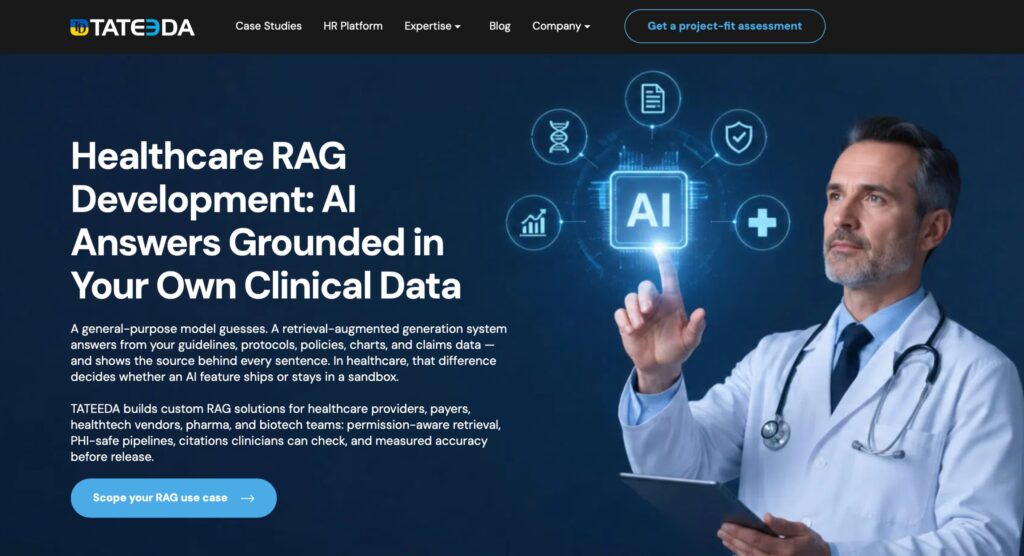
TATEEDA is based in San Diego. Its healthcare RAG development service describes source preparation, permission-aware indexing and retrieval, passage citations, scored question sets, refusal behavior, and connections to EHR, document, and claims systems. That specificity makes it a useful conversation for a provider whose first goal is one reliable internal knowledge workflow rather than an entirely new platform.
A pilot could begin with current practice policies or payer instructions and questions written by the people who use them. TATEEDA’s published approach measures retrieval before adding generated answers, then tests citation quality and access boundaries. Its healthcare software engineering can put the assistant in an existing portal or staff workflow. Delivery through engineering resources in Eastern Europe and LATAM gives a buyer a staffing option to discuss alongside a California point of contact; the total scope still determines cost.
| Detail | Buyer-relevant information |
|---|---|
| Homepage | https://tateeda.com/ |
| Base | San Diego, California |
| Published first step | Healthcare RAG PoC on one question set, with a working retrieval pipeline and scored evaluation |
| Distinct question to ask | Which existing source permissions will be carried into both the index and each query? |
| Pricing | PoC by proposal; company-stated general project minimum: $20,000 |
Ask for the proposed source list, evaluation dataset, EHR interface assumptions, and operating costs in the same estimate. A PoC on approved content should not be confused with permission to process live protected health information (PHI).
2. ThirdEye Data — knowledge engineering and healthcare data
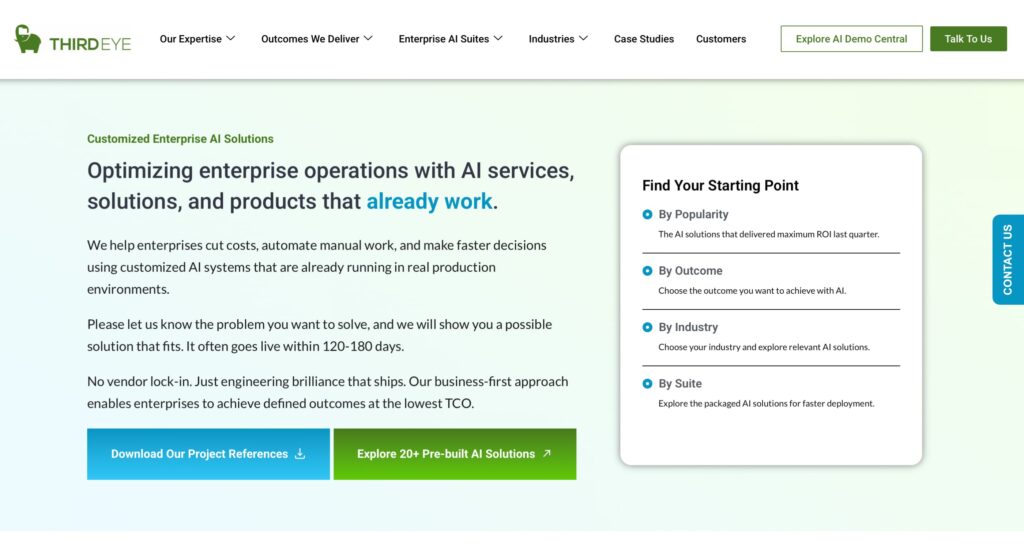
ThirdEye Data lists a San Jose head office, RAG application development, data engineering, AI governance, and healthcare-focused data/AI solutions. It is a candidate when the principal obstacle is collecting and governing information from multiple systems before an assistant can answer questions.
A first engagement could inventory document sources, identify owners and update cycles, and test retrieval on a limited set of operational questions. Ask the team to show how its data pipeline would handle duplicate documents, conflicting versions, and access controls inherited from the original systems.
| Detail | Buyer-relevant information |
|---|---|
| Homepage | https://thirdeyedata.ai/ |
| California base | San Jose head office |
| Delivery footprint | Company lists delivery centers in India and Canada |
| Other stated services | Data engineering and analytics, governance, and enterprise knowledge intelligence |
| First-scope question | Can the team deliver a source inventory and a retrieval test before a full application build? |
Its healthcare and RAG offerings are both published; the exact combination, permissions, and EHR connection should be demonstrated in the proposed scope.
3. Intuz — research and document-heavy retrieval
Intuz reports offices in San Francisco and San Ramon and an engineering center in India. Its RAG material discusses private data, a vector store, redaction, and audit trails; its published work also addresses retrieval from medical research and other complex documents. This makes it worth considering for a healthtech or life-sciences team whose first problem is finding support in a changing knowledge library.
The first decision is what belongs in the index. A research literature assistant and a patient-record assistant have very different data rights and review requirements. Specify the document classes, whether PHI is present, the citation granularity, and who decides that a source is authoritative.
| Detail | Buyer-relevant information |
|---|---|
| Homepage | https://www.intuz.com/ |
| California locations | San Francisco and San Ramon, as listed by the company |
| Document focus | RAG-powered search and synthesis across large research collections |
| Architecture claim to validate | Private-cloud deployment and PHI handling described in its RAG guidance |
| First-scope question | How will a reviewer trace each answer to a specific document version and passage? |
If the intended system will touch patient charts, request a separate explanation of identity, patient scoping, EHR access, and who can see the retrieved material.
4. Xicom — healthcare retrieval in a defined application

Xicom lists a San Francisco office. Its RAG development offering explicitly names clinical guideline retrieval, patient-record question answering, medical literature search, and grounded responses in healthcare. It also offers software and AI integration services.
For a smaller provider, begin with a constrained use such as finding the current approved patient-preparation instruction. The proposal should define source ownership, how the assistant refuses unsupported questions, and how staff correct an answer. Patient-record search would require a much more demanding permissions design.
| Detail | Buyer-relevant information |
|---|---|
| Homepage | https://www.xicom.biz/ |
| California office | San Francisco; development office also listed in New Delhi |
| Explicit RAG use | Healthcare guideline, record, and literature retrieval are named in its service description |
| Source formats | The RAG offering discusses PDFs, databases, wikis, and other structured or unstructured material |
| First-scope question | Can an initial build stay within approved, non-PHI content while access testing is designed? |
Discuss the difference between a general RAG demonstration and a live healthcare deployment before setting a delivery date.
5. BlueLabel — a grounded assistant inside a designed product
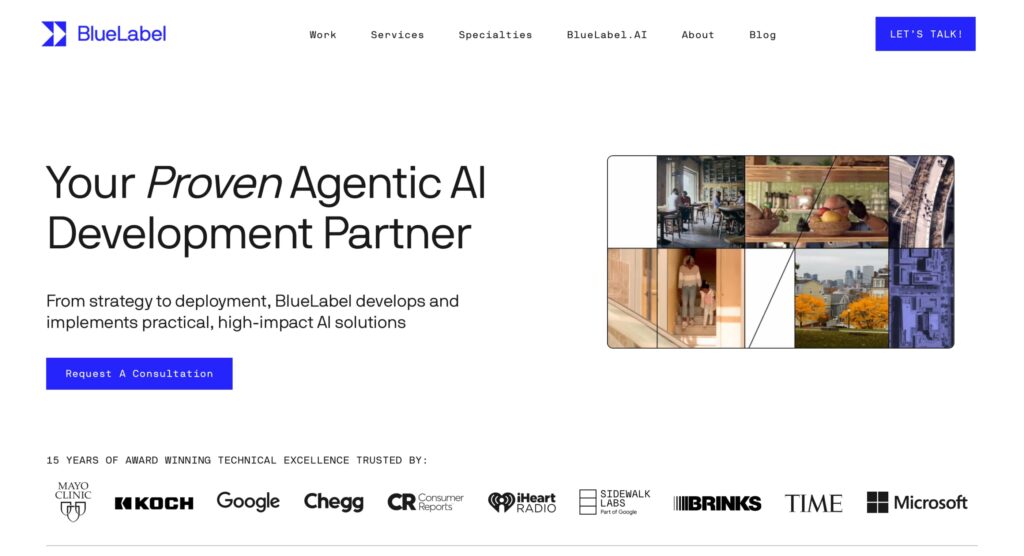
BlueLabel has a San Francisco office and describes RAG-powered applications, healthcare product development, and EMR/EHR-connected software. Its combination of product strategy, interface design, and engineering may appeal to teams building a clinician or patient-facing experience, where the presentation of a source and the handoff to a person matter as much as retrieval.
Ask for a prototype in which a user can open the cited passage, see its date, and report a misleading answer. That tests the interface and review process before broadening the knowledge base or connecting live records.
| Detail | Buyer-relevant information |
|---|---|
| Homepage | https://www.bluelabellabs.com/ |
| California office | San Francisco; headquarters in New York |
| Relevant disciplines | Product strategy, design, RAG applications, and healthcare software |
| Healthcare integration | Company describes EMR/EHR-connected applications |
| First-scope question | What will users see when a source is stale, contradictory, or outside the assistant’s scope? |
Clarify whether the first quote covers a design prototype, a functioning retrieval system, EHR integration, or all three.
6. Closeloop — permissions and system integration
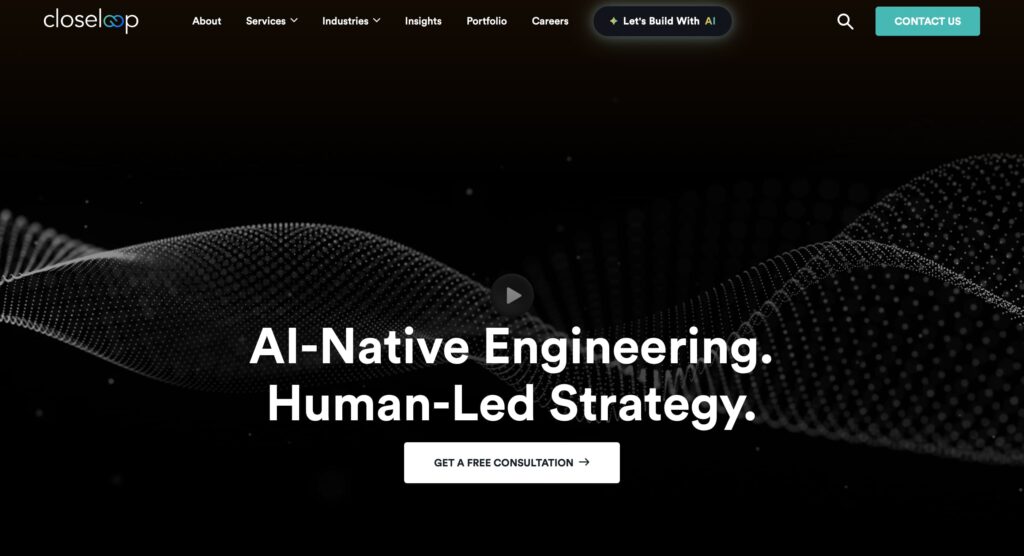
Closeloop lists its headquarters in Mountain View. It describes RAG within its software engineering offering, permission-aware retrieval for enterprise knowledge, and healthcare software integration using FHIR and HL7. This is relevant if the assistant must fit a preexisting application and its data-flow rules.
An appropriate first task is a permissions map: which user may search which source, how rights change, and how the index is updated when access is revoked. Ask the team to show the enforcement point rather than relying only on instructions given to the language model.
| Detail | Buyer-relevant information |
|---|---|
| Homepage | https://closeloop.com/ |
| Headquarters | Mountain View, California |
| Delivery | California-managed engagements with engineering centers in India |
| Relevant integration | Healthcare service describes FHIR and HL7 interoperability |
| First-scope question | How are document-level permissions tested when a user’s role changes? |
Its separate RAG and healthcare descriptions make it a plausible candidate. Require a proposal showing how those capabilities meet in your actual systems.
7. Simform — a RAG accelerator and healthcare engineering
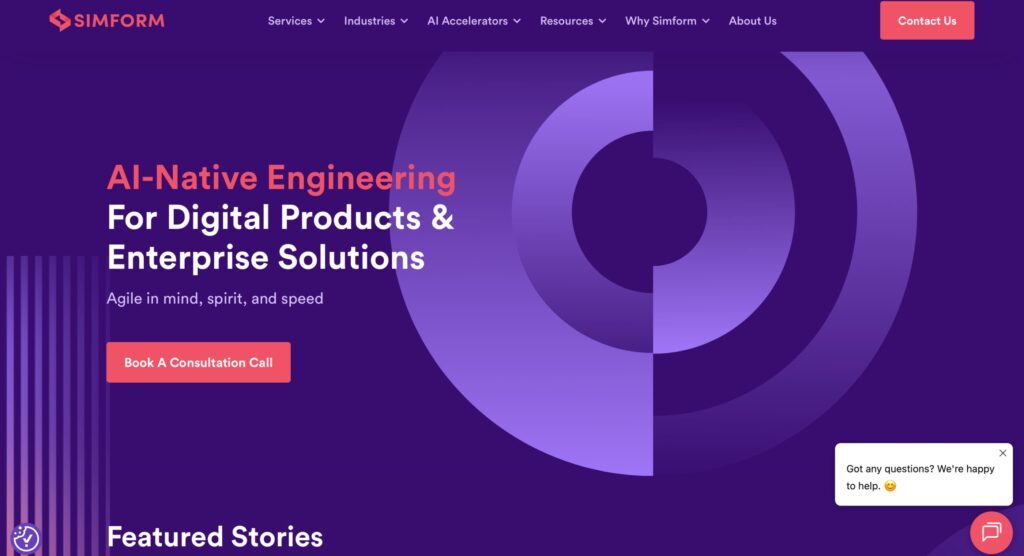
Simform advertises California and San Francisco service. Its ThoughtMesh offering grounds language models in enterprise data using vector retrieval, corrective RAG validation, and namespace-based controls; its healthcare practice discusses EHR/EMR development and integration.
An accelerator can reduce setup work, but the buyer should still test its fit against real documents and access policies. Request a small evaluation set that includes obsolete content, ambiguous questions, and a user who must not retrieve a given document. Confirm what is reusable and what will be custom for the EHR connection.
| Detail | Buyer-relevant information |
|---|---|
| Homepage | https://www.simform.com/ |
| California connection | Published San Francisco and California service presence; verify the project team’s location |
| RAG component | ThoughtMesh describes corrective RAG and namespace-secured retrieval |
| Healthcare component | EHR/EMR, data analysis, and cloud development |
| First-scope question | What can the accelerator demonstrate with our source versions and user permissions? |
This is a service-presence entry; the reviewed company pages do not establish a California headquarters or the geography of a specific delivery team.
8. LeewayHertz — broader healthcare AI and agentic RAG
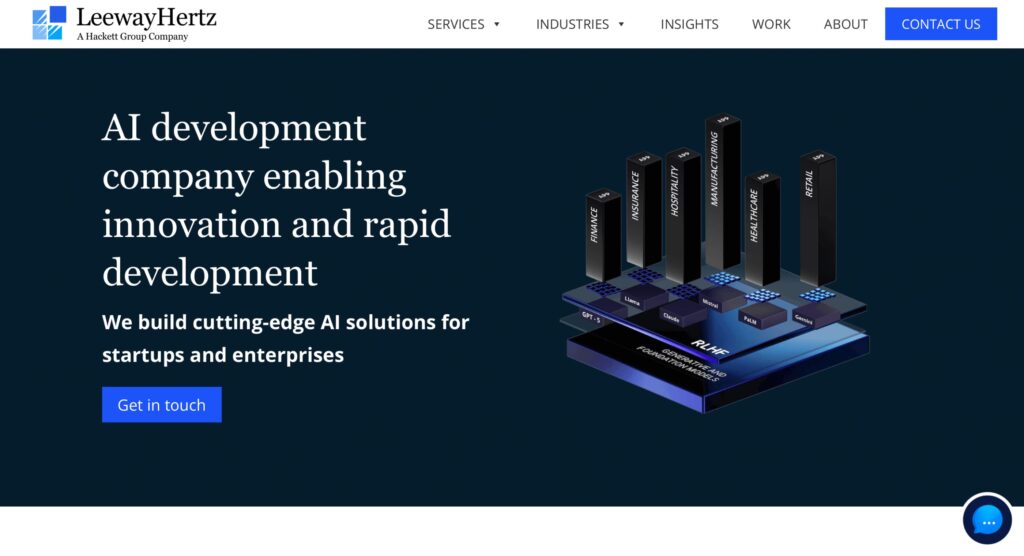
LeewayHertz describes itself as based in San Francisco. It offers custom agentic RAG development and healthcare AI software, including EHR/EMR systems. It is a candidate when a healthtech buyer needs a wider application or multiple connected actions around a knowledge system.
More autonomy is not automatically useful. For a first healthcare deployment, request a plain read-only RAG option alongside any multi-step agent proposal. Compare the additional permissions, evaluation, human approvals, and support needed before the system can take action.
| Detail | Buyer-relevant information |
|---|---|
| Homepage | https://www.leewayhertz.com/ |
| California connection | San Francisco, according to its healthcare consulting material |
| Published capability | Custom agentic RAG design, deployment, and maintenance |
| Related healthcare work | AI software and EHR/EMR development services |
| First-scope question | Which parts require an agent, and which can remain a read-only cited answer? |
Ask for a healthcare-specific architecture and a contained pilot. The general agentic RAG and healthcare service descriptions alone do not settle its suitability for a small practice budget.
How to test a healthcare RAG vendor before a larger build
Send the same one-page brief to two or three vendors. Name one user group, one question set, one approved source collection, one existing system, and a person responsible for reviewing output. Ask each vendor to price the same first phase and state its exclusions.
| Test | What to ask the vendor to deliver | What a buyer should inspect |
|---|---|---|
| Source control | Inventory with owners, effective dates, and a withdrawal process | Can an obsolete policy be removed from results promptly? |
| Retrieval permissions | Role and patient/organization access model with negative tests | Can a user ever see a document they cannot open in the source system? |
| Evidence | Passage-level citations and a clear no-answer state | Does the cited passage actually support the wording of the answer? |
| Evaluation | Representative questions, expected sources, failure categories, and rerun plan | Are access failures, unsupported answers, and wrong citations measured separately? |
| Integration | Named EHR or document-system interface, authorization method, and write limits | Does the vendor know what the specific system and contract permit? |
| Operations | Monitoring, corpus refresh, incident handling, and unit costs | Who owns updates, review queues, and cost per answer after launch? |
Measure retrieval and generation separately. If the right passage is never retrieved, improving the prompt will not solve the underlying problem. A source citation also does not prove the answer is correct: a model can cite a relevant page but misstate it. A useful evaluation set includes typical questions, near misses, expired policies, conflicting sources, attempts to obtain another person’s information, and questions for which no approved answer exists.
How EHR integration changes a healthcare RAG project
A RAG system that searches approved public patient instructions may need no patient data. Searching chart notes, on the other hand, requires a defensible PHI boundary, authorization, patient matching, and a review of every system that receives data. The HHS guidance on cloud services and business associate agreements explains why the contract and actual data flow matter. “HIPAA-compliant AI” is not a product feature that can be inferred from a vendor’s service page.
FHIR is a way to exchange certain structured health information; it does not turn every EHR document into a clean, searchable, authorized source. SMART on FHIR scopes help define delegated access, while the source system’s policies still limit what the app may see. The buyer should confirm the exact EHR vendor, supported APIs, scopes, data elements, and permissions before treating integration as a routine connector task. Write-back to the chart needs a separate approval design; a read-only first phase is often easier to evaluate.
How should you price a first healthcare RAG project?
There is no useful universal per-hour price for a healthcare RAG deployment. Cost depends on source cleanup, OCR, access mapping, EHR interfaces, the evaluation set, cloud and model usage, staff review, and maintenance. The comparison table gives TATEEDA’s stated general project minimum; other firms did not present a verified RAG-specific minimum in the reviewed public material. No figure here is a quote for a live PHI workflow.
Ask for two priced stages: (1) a bounded retrieval and evaluation PoC on approved sources, and (2) the additional work to operate it with real users and data. The first should produce a scored question set, working citations, a documented failure review, and a build-or-stop decision. The second must account for security, permissions, integrations, monitoring, and ongoing content ownership. TATEEDA’s healthcare prototype-to-product offering illustrates that a prototype and a regulated product are distinct scopes.
Before commissioning custom software, compare the EHR vendor’s search features or a configurable knowledge product. Build custom RAG when the sources, permissions, interface, or evaluation requirements cannot be met adequately through those tools. A deterministic search or rules engine may be enough for a fixed checklist; not every document task needs a generative answer.
Questions to ask before signing
- Which named sources will be indexed, who owns them, and how are changes and deletions propagated?
- Are permissions checked when documents are ingested and when each user searches? Show a failed-access test.
- Can a reviewer open the exact cited passage and version, and what happens when sources disagree?
- What is the agreed evaluation set, who labels it, and which failures block release?
- What PHI reaches the model, vector store, logs, and subcontractors? Which agreements and controls cover those flows?
- Which EHR interface and authorization scopes are in the quote? Is any write-back included?
- Who maintains the corpus, monitors failures, and pays hosting, model, storage, and EHR fees?
The best proposal will answer these questions for one actual workflow and leave the buyer with an explicit decision point after the pilot.
FAQ
What is healthcare RAG development?
Healthcare RAG development builds an AI system that retrieves from approved healthcare sources before drafting an answer. The work includes preparing and updating documents or records, controlling access, showing citations, evaluating answers, and connecting the assistant to a real workflow. A model alone is not the finished system.
Does RAG prevent hallucinations or guarantee correct clinical answers?
No. Retrieval can give a model relevant evidence, but it can still fetch the wrong document, omit context, or misread a correct passage. Test retrieval, citations, refusals, and final answers separately, with qualified human review for clinical use.
Can a RAG assistant use EHR data and still meet HIPAA requirements?
It can be designed for a regulated environment, subject to the actual data flow, safeguards, authorized access, contracts, and operating practices. Confirm the EHR interface and the responsibilities of every service that may handle PHI. A vendor’s general HIPAA claim is not enough for a specific deployment.
What should a small clinic prepare before requesting a RAG proposal?
Prepare a sample of current, approved documents; the questions staff need answered; the user roles involved; and the name of the system where the assistant would appear. Identify a person who owns the source content and a reviewer for the pilot. A vendor can then estimate a bounded, read-only first phase and identify any PHI or EHR-access issues.
Does a healthcare RAG assistant need to be an AI agent?
No. A read-only RAG assistant can answer from approved sources without taking actions in other systems. An agent may be useful when a workflow genuinely requires multiple steps, but it also needs additional permissions, approval rules, testing, and monitoring. Ask the vendor to explain what the agent would do that a cited answer cannot.





![8 Medical Billing Automation Developers in California [2026]](https://tateeda.com/wp-content/uploads/2026/10/Cover.png)
