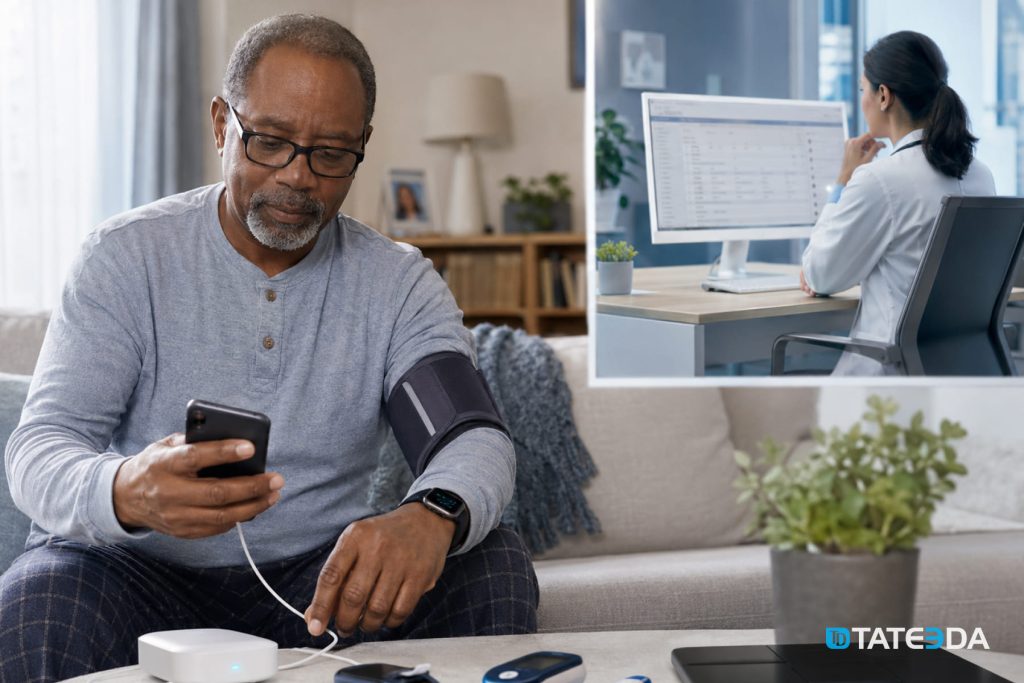
Healthcare RAG Development: AI Answers Grounded in Your Own Clinical Data
A general-purpose model guesses. A retrieval-augmented generation system answers from your guidelines, protocols, policies, charts, and claims data — and shows the source behind every sentence. In healthcare, that difference decides whether an AI feature ships or stays in a sandbox.
TATEEDA builds custom RAG solutions for healthcare providers, payers, healthtech vendors, pharma, and biotech teams: permission-aware retrieval, PHI-safe pipelines, citations clinicians can check, and measured accuracy before release.
What can we help you with?

Healthcare RAG proof of concept
Prove retrieval quality on one high-value question set before committing budget to a platform.

Production RAG pipeline
Move a working prototype onto permission-aware, monitored, auditable infrastructure.

Retrieval quality rescue
Fix a RAG system that returns confident answers from the wrong document — or the wrong patient’s document.
RAG Platforms and Technologies We Build With
Our healthcare RAG development services run on HIPAA-eligible cloud services covered by Business Associate Agreements, with model endpoints that do not retain your prompts. We select each layer of the retrieval-augmented generation stack — model provider, vector database, orchestration framework — against your data volume, latency, permission model, and cost per query, then connect it to your EHR, document, and claims systems.

IBM Watson Health

Google Cloud Healthcare API

Microsoft Azure Healthcare APIs
Nuance (Microsoft)
Prognos Health
Health Catalyst

Komodo Health
Tempus
PathAI
Aidoc
Viz.ai

Butterfly Network

Olive AI

KenSci
Intermedica
A Real Solution Finds the Right Answer and Shows It Only to the Right Person

and goals
work to us
ready-to-go product
Let’s discuss your healthcare RAG solution
Drop us a line, and our medical software development services advisor will get back to you shortly


 7220 Trade Street, Suite 103
San Diego, CA 92121
7220 Trade Street, Suite 103
San Diego, CA 92121
We reply within 24 hours, and the first call is with the CTO, not a salesperson.
Three RAG Risks We Help You Avoid
Retrieval-augmented generation solves the two problems that keep large language models out of clinical use: invented answers and outdated knowledge. Research on medical LLMs consistently points in the same direction, since grounding responses in current, retrieved sources reduces hallucinations and makes outputs traceable. The technology works. Projects still fail, almost always for one of three reasons, and all three are preventable before development starts.


What HIPAA-Ready RAG Engineering Includes
A HIPAA-compliant RAG system supports regulated healthcare use through technical safeguards and clear documentation, aligned with the HIPAA Security Rule. Organizational compliance also depends on contracts (including Business Associate Agreements), policies, staff training, legal review, and daily operating procedures.

PHI boundary definition and data-flow mapping
Decide what may reach an embedding model, a vector database, or a generation endpoint — and what must never leave your infrastructure. Then map where that data lives at every stage of the pipeline.
Permission-aware indexing and query filtering
Carry access rights from the source system into the index as metadata, and enforce them at query time so retrieval respects the same minimum-necessary rules as the record itself.
Zero-retention model access and subprocessor BAAs
Use model endpoints that do not retain or train on your prompts, or self-host open models. Every vendor that may touch PHI — model provider, vector database, hosting, monitoring — is identified and covered by an agreement.
Security-review documentation
Architecture notes, data-flow diagrams, access-control descriptions, model and vendor inventories, and prepared answers for buyer security questionnaires and SOC 2 or HITRUST-oriented assessments.
Audit logging of retrieval and generation
Record who asked what, which documents were retrieved, which model and prompt version answered, and what the user did next — the trail your compliance officer and any incident investigation will need.
Encryption and environment separation
Encryption at rest and in transit for documents, embeddings, and logs, with separate environments, key management, and backups on HIPAA-eligible AWS or Azure services.
Choose the Right Healthcare RAG Service
Healthcare RAG Proof of Concept
Pick one question set that matters — guideline lookup, payer policy search, chart abstraction — and prove it. You get a working retrieval pipeline, a scored evaluation set, and an honest verdict on whether RAG is the right tool before the roadmap grows.
Knowledge Base and Data Pipeline Engineering
Turn scattered documents into a retrievable corpus: ingestion, OCR, deduplication, chunking strategy, version and effective-date metadata, ownership, and scheduled refresh so answers reflect the current guideline rather than last year’s.
Permission-Aware Retrieval Architecture
Scope every query by role, organization, and patient relationship. We design index partitioning, metadata filtering, and query-time enforcement so a retrieval-augmented assistant can never return a document its user could not open directly.
Clinical and Patient-Facing RAG Assistants
Build the interface around the retrieval layer: cited answers, confidence and refusal behavior, escalation to a human, conversation history, and integration into the EHR, portal, or internal tool where the question actually gets asked.
RAG Evaluation and Safety Testing
Measure the system before your users do. We build golden question sets with clinical input and score retrieval accuracy, faithfulness to sources, citation correctness, refusal on out-of-scope prompts, latency, and cost per query — then re-run them on every release.
HIPAA-Ready Infrastructure and Deployment
Deploy on HIPAA-eligible AWS or Azure services under signed BAAs, with zero-retention model endpoints or self-hosted open models, encryption, environment separation, audit logging, and the documentation your buyers’ security reviews request.
Inside a Healthcare RAG Pipeline
The architecture matters more than the model choice. These are the layers we build and tune on a healthcare RAG development project.

Source ingestion and normalization
Clinical guidelines, SOPs, payer policies, EHR manuals, formularies, contracts, faxes, and scanned documents through OCR — plus structured data from FHIR resources, HL7 messages, and claims systems.

Chunking, embeddings, and vector storage
Chunk boundaries that follow document structure instead of character counts, embedding models selected by measured retrieval accuracy, and vector storage in pgvector, Pinecone, Weaviate, Qdrant, or an equivalent, partitioned per tenant.

Hybrid retrieval and reranking
Keyword and semantic search combined, then reranked — with filters for recency, guideline version, document status, and medical vocabularies such as ICD, SNOMED, and LOINC where they improve precision.

Grounded generation with citations
Prompts that instruct the model to answer only from retrieved evidence, cite it, and decline when the evidence is insufficient — with human review steps in front of any workflow that triggers an action.

Evaluation and monitoring
Golden question sets scored for retrieval accuracy, faithfulness, and citation correctness, plus production monitoring of latency, cost per query, refusal rate, and answer quality drift as the corpus changes.
Healthcare RAG Systems We Build
-

Clinical guideline and protocol assistants
Answer point-of-care and back-office questions from your own protocols, order sets, and formularies, with citations to the exact section and version a clinician can verify.
-
Prior authorization and payer policy search
Find the governing policy, documentation requirements, and medical necessity criteria across payer manuals — the search that currently takes a coordinator twenty minutes per case.
-
Document review and abstraction
Extract and summarize from charts, referrals, lab reports, faxes, and prior records, with source links on every extracted field and a human review step before anything is committed.


-
Patient-facing answer assistants
Respond to portal and pre-visit questions from approved patient education content, with clear scope limits, refusal behavior, and escalation to staff when a question needs a person.
-
Medical coding and billing support
Surface coding rules, payer edits, denial reasons, and internal billing policy for revenue cycle teams, grounded in the current rule set rather than a model’s training data.
-
Internal knowledge and support copilots
Answer staff questions from EHR manuals, IT runbooks, HR policy, and clinic SOPs — one of the fastest paths to measurable time savings without touching patient data.


Why Choose TATEEDA?
-
Healthcare software experience since 2013
Our teams have delivered products for healthcare providers, pharmaceutical and biotech companies, medical staffing, billing, patient portals, and medical IoT.
-
San Diego headquarters
U.S. clients get direct communication with a San Diego-based company, with engineering delivery across Eastern Europe and LATAM.
-
Senior in-house engineers
Core delivery never depends on freelancers or temporary gig workers.

-
AI that connects to real systems
We build RAG into products that already have EHR integrations, portals, billing workflows, and permission models — not as a standalone demo.
-
100+ technical specialists
Developers, QA engineers, DevOps specialists, designers, architects, and project managers — one accountable delivery team.
Frequently Asked Questions
articles
New in Healthcare App Development Services

Who Can Help California Practices Connect Referrals Across EHR Systems? 5 Companies to Consider

EHR Medication Management Module: eRx, Refill Requests, Drug Database Integration, and Patient Safety Logic