ScienceSoft Alternatives for Healthcare Development: ScienceSoft vs TATEEDA
Vlad Nazarov



Looking for ScienceSoft alternatives? Compare ScienceSoft and TATEEDA for healthcare software modernization, from patient portals and EHR integrations to pricing and support.
ScienceSoft is worth shortlisting if your modernization project spans multiple applications, infrastructure, and ongoing IT support. At TATEEDA, we’re a fit for healthcare product teams that need senior engineers to rebuild a core application, integrate it with existing systems, or take responsibility for a defined release. The choice starts with what you want the vendor to own after launch. A portfolio-wide migration needs someone accountable across applications. A single product release needs a team that can trace the systems it touches and keep the relevant workflows in use.
Take a patient portal upgrade. Replacing the portal may sound straightforward until you map where it gets appointment data, who supports logins, and what happens to intake forms submitted during cutover. If the same problems surface across several applications, it may be time for an audit across those systems. If they’re concentrated in one product, start by asking what it would take to fix and release that product without changing how the rest of the organization works.
Table of Contents
ScienceSoft vs TATEEDA at a glance
| What to compare | ScienceSoft | TATEEDA |
|---|---|---|
| Where to start | Several applications need assessment, upgrades, or support from one partner | A healthcare product, integration, or release needs a dedicated team or additional senior engineers |
| Healthcare project example | HealthPoint Plus reports that ScienceSoft refactored and modernized its telehealth portal and cross-platform patient app | Our team reworked financial reporting and integrated new time tracking for Aya Healthcare’s travel nurse staffing platform |
| Delivery options | Project delivery, IT outsourcing, managed services, and support | Full-cycle software development and staff augmentation |
| Location and staffing | US office in McKinney, Texas, and international offices. Confirm where your team would work. | San Diego headquarters with engineers in Eastern Europe and Latin America. Confirm your team’s working hours. |
| Public rate information | Clutch lists an average hourly range of $50–$99. ScienceSoft describes several pricing models on its website. | Our published rates are $45–$95 per hour by role and seniority. |
| Handling protected health information | ScienceSoft says it signs business associate agreements (BAAs) for healthcare engagements that require them. | We sign a BAA before our team accesses protected health information (PHI). |
What ScienceSoft can take on
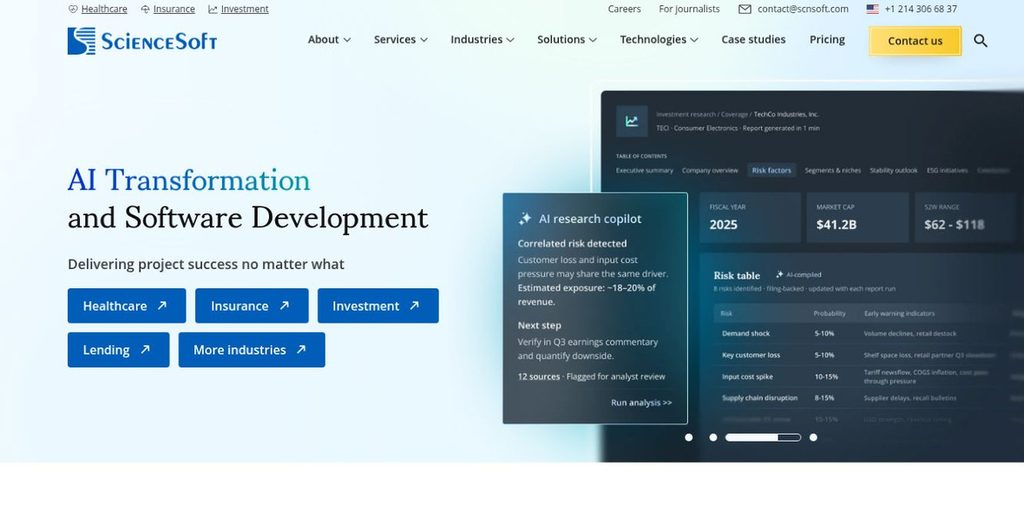
ScienceSoft is an IT consulting and software development company founded in 1989. It has worked in healthcare IT since 2005, according to its website. Its healthcare practice covers software modernization, systems integration, cloud migration, testing, and managed support. That range matters if several providers currently share responsibility for your applications and changes routinely stall while teams work out who owns a dependency.
In a testimonial hosted by ScienceSoft, HealthPoint Plus credits the firm with refactoring and modernizing its telehealth web portal and cross-platform patient app. The client highlights the team’s code analysis and knowledge of telemedicine. If you’re commissioning a similar update, ask what the team accomplished while the old system was still in use and what changed for patients and support staff after launch.
ScienceSoft also describes modernizing mental health software and its AWS environment for a US nonprofit. That example is relevant when application work and infrastructure changes share a release plan. If your proposal covers both, ask which environments have to move together and who can approve a pause if the application stops handling a key workflow.
Advantages to weigh
- You can ask one firm to assess application dependencies, plan a migration, and quote ongoing support.
- The HealthPoint Plus example shows work on a patient-facing web and mobile product that was already built.
- ScienceSoft describes time and materials, capped time and materials, and fixed-price options for suitable scopes.
Questions to settle before you sign
- Which specialists will be assigned to your project, and which will be called in as needed?
- If different teams handle discovery, development, and managed support, who stays accountable when work changes hands?
- What will a cap cover once engineers open the code and find a dependency the estimate missed?
What TATEEDA can take on
At TATEEDA, we build, modernize, and integrate healthcare software. We work with organizations that want one team to handle delivery and with in-house teams that need extra engineering capacity for a particular release, subsystem, or integration. Our healthcare software development services cover application development, APIs, cloud engineering, and QA.
For Aya Healthcare’s travel nurse staffing platform, the existing financial reporting system had slowed as the volume of employee and vendor data grew. Working with Aya’s team, we reworked the reporting software to automate calculations and added a time-tracking system that fed into those reports. The project also included a portal and mobile apps for different user groups. If you’re replacing a module such as reporting, map what feeds it and who relies on its output before you scope the rebuild.
Other ways TATEEDA has changed an existing healthcare product
For a clinical assessment product, we replaced a site-by-site installation process with a browser-based product that could capture assessments offline and synchronize them later. That work shows why deployment and workflow continuity belong in the same plan. A centrally managed release still has to account for users whose devices reconnect after the switchover.
For SCRx Pharmacy’s claims platform, our team extended an existing product with automated bulk PDF import and scanning, alongside work on medication fulfillment and claims processing. That is a useful comparison if a manual task is holding up staff and the team wants to modernize one part of the application first.
Advantages to weigh
- You can assign a defined release to one delivery team or add engineers to your existing team.
- Our published rates give you a starting point for budgeting different roles before scoping.
- Product work can include the systems it needs to connect to, including EHR integration services, as well as QA and deployment.
Questions to settle before you sign
- If you need support for several applications after launch, agree on which ones our team would cover, what hours are included, and who owns incident response.
- In an augmentation engagement, name the person on your side who will set priorities and accept the work.
- If the rebuild involves several facilities, specify which sites will be in the pilot and what must work before you expand.
Set the cutover rules before rebuilding a live patient portal
Pick a representative workflow, such as submitting a completed intake form. In a rehearsal, submit one form just before the switchover and one after. Try again with the first submission still queued. Ask who checks where each record landed, where staff see exceptions, and which version can accept new submissions if the release has to roll back.
| Cutover decision | Evidence to ask for before launch |
|---|---|
| Which system can accept changes | A plan that assigns ownership of each write during the transition, including delayed messages and data entered by staff |
| What must move with the app | A list of clinical and operational dependencies, including identity, interfaces, background jobs, and data exports |
| How to reconcile the handoff | A sample report that shows missing records, duplicates, and records the team still needs to review |
| When to pause or roll back | Agreed thresholds and a rehearsal that shows how staff will find work created after the cutover |
For a multi-system modernization, repeat the exercise for each critical interface and check which systems can move independently. For a focused rebuild, get the same agreement from the people who own the touched systems. A managed support contract can then name who receives first-line alerts, who fixes integration failures, and how the clinic reaches a decision-maker after hours.
How to compare the two proposals
Send each company the same project outline. A one-page description is enough to start if it includes who uses the system, which workflows are affected, and what deadline matters. If any application exchanges data with an EHR, name the vendor and list the interfaces you already use. Then compare the proposals on four points.
- What can change safely? Ask for a first milestone that produces an application and dependency inventory. Make that inventory useful for a decision. For instance, it should explain what would break if you retire an old login service and which systems still depend on it.
- How will both versions run during the transition? Have each team show who reconciles data, who decides that a release can go live, and who can roll it back. For a clinic rollout, ask what happens to a form that is submitted just before the system switches over.
- Where will patient information be handled? Ask who can access it, whether subcontractors are involved, and how production and test data are kept separate. Have your privacy and security team review the proposed practices and contract.
- What does the price cover after release? Ask each firm for a role-by-role estimate that includes migration rehearsals, integration testing, production monitoring, and support during the first month. Hourly rates tell you part of the cost. The hours and responsibilities are what let you compare the proposals.
Which company should you shortlist?
Consider ScienceSoft if you’re planning several upgrades together or if you want a company to quote modernization and ongoing IT support in the same brief. Ask to meet the people who would lead the handoff from delivery to operations.
Consider TATEEDA if you have a healthcare product to rebuild, an integration backlog to clear, or a release your current team needs help getting out the door. If you’re deciding where to make the first change, talk with our team about the workflow that causes the most trouble today. Bring a short description of who uses it and what can’t go offline.
Frequently asked questions
What is a good ScienceSoft alternative for healthcare software modernization?
TATEEDA is an option for rebuilding a specific healthtech product, adding EHR connectivity, or bringing senior engineers into an existing team. If you need to modernize several applications at once, ask each firm to show who would own delivery, infrastructure, and support across the whole project.
Can ScienceSoft and TATEEDA modernize a patient portal while clinics stay open?
A staged rollout can keep some functions available during modernization. Ask each vendor to map availability by workflow, since patient logins, form submission, and staff processing can depend on different systems. Review the switchover window and how each team will account for transactions in progress.
How much do ScienceSoft and TATEEDA charge per hour?
Clutch lists ScienceSoft at $50–$99 per hour on average. TATEEDA publishes rates of $45–$95 per hour by role and seniority. Request a written estimate for the same roles and deliverables from both companies, including any support you need after go-live.
Do both companies sign a business associate agreement?
ScienceSoft says it signs a BAA where required for healthcare work. TATEEDA signs a BAA before our team accesses PHI. Before sharing patient data, have your privacy team review the agreement, access arrangements, and handling of any subcontractors.
Who should maintain the application after modernization?
Decide which responsibilities your team wants to keep before you request proposals. A maintenance agreement should say who monitors the app, owns incident response, ships security updates, and maintains integrations when an external vendor changes its API. Set a date for reviewing the arrangement once the release is in use.