Healthcare Staffing and Credentialing AI Software Developers [2026]

Slava Khristich



Vlad Nazarov

This guide helps healthcare providers and staffing organizations compare custom developers for clinician scheduling, credential checks, and AI workflows that connect with their existing systems.
A clinic can have an open shift, an available nurse, and a scheduling tool that recommends the match. If the nurse’s certification has expired in a separate credentialing system, the recommendation is of little use. The same disconnect appears when an approved shift never reaches payroll or when a new provider is scheduled before enrollment is complete.
Custom healthcare staffing software works best when these handoffs are designed together. AI can help forecast demand, rank eligible clinicians, or read documents, while clear rules and authorized records determine who is qualified to work. The ten developers below offer different ways to build those connections. The list is not ranked: a medical group fixing provider enrollment needs a different partner from a hospital coordinating thousands of shifts.
TATEEDA publishes comparisons like this to understand the market and refine its own healthcare services. We welcome corrections and suggestions for future editions.
Table of Contents
What separates staffing AI from credentialing software?
Staffing and credentialing overlap, but they answer different questions. Staffing software manages demand, availability, assignments and hours. Credentialing software records whether a clinician meets the requirements for a role, facility or payer network. A useful AI feature depends on knowing which system owns each answer.
| Decision | Information the software needs | Where AI can help |
|---|---|---|
| How much coverage is needed? | Appointments, patient volume, service lines and existing schedules | Forecast likely gaps or suggest coverage options |
| Who may fill a shift? | Availability, role, current licenses, certifications, privileges and local rules | Rank eligible clinicians by fit, travel or preference |
| What happens after approval? | Final assignment, worked hours, pay rules and billing status | Flag discrepancies for a coordinator to review |
A predicted good match is still a suggestion. The system must check required qualifications against the appropriate records, show conflicts, and let an authorized person resolve them.
How we selected these developers
We reviewed the companies’ public healthcare, workforce, integration, AI and pricing materials in October 2026. Each firm offers custom development or substantial customization. The shortlist covers provider credentialing, hospital staffing, nursing agencies, home care and Workday-centered operations; it excludes subscription-only products.
The named systems below come from the companies’ own descriptions. Some appear in a specific workforce implementation; others belong to a firm’s broader electronic health record (EHR) or AI practice. The tables make that distinction where it changes the buyer’s decision. Before signing, confirm the exact interface, access permissions, model stack and support responsibilities for your workflow.
Ten healthcare staffing and credentialing AI developers at a glance
| Developer | Most relevant buyer | Sensible first project |
|---|---|---|
| TATEEDA | A California provider or healthtech team extending its existing clinical and HR tools | One credential-aware shift or onboarding workflow with a clear approval step |
| OSP Labs | A hospital coordinating Epic, UKG and Workday data | Demand-based scheduling for one unit |
| Bacancy | A nursing organization managing shifts, float pools and payroll | Open-shift filling with eligibility and time capture |
| Taction Software | A medical group, payer or hospital with provider credentialing backlogs | Application intake and renewal tracking |
| Thinkitive | A team seeking AI recommendations for coverage changes | A scheduling assistant for one recurring gap |
| SolGuruz | A staffing agency connecting placement, compliance and billing | One placement-to-timesheet process |
| Zignuts | A facility modernizing a wider workforce management system | One location’s roster connected to clinical demand |
| Staffinc | A nurse, locum or home-care agency seeking a defined custom platform | Core shift scheduling and credential-expiry tracking |
| AssistNow | A health system already running Workday | A competency or schedule workflow inside Workday |
| Empeek | A care organization joining staffing data with clinical operations | Credential-status exchange for one schedule |
1. TATEEDA
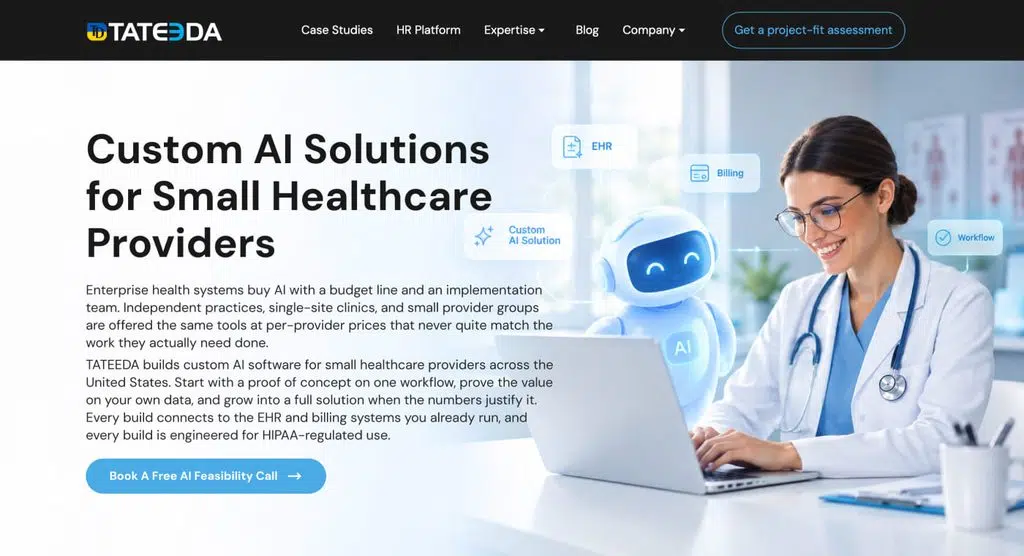
For a smaller provider, the first useful improvement may be a reliable handoff between systems it already owns. San Diego-based TATEEDA builds medical HR software for scheduling, credential tracking, float pools, mobile shift bidding, time capture and payroll connections. One starting scope is to offer an open shift only to qualified clinicians, have a coordinator approve the assignment, and pass the completed hours to payroll.
TATEEDA also develops EHR and EMR integrations. Its San Diego team can draw on engineering resources in Latin America and Eastern Europe as the workflow grows. If staff must search lengthy onboarding rules or clinical policies, TATEEDA’s healthcare retrieval-augmented generation (RAG) development can add an assistant that retrieves approved guidance with source references and access controls. Credential validity remains a separate, verified record.
| Detail | What a buyer can explore |
|---|---|
| Clinical integration | Epic, Oracle Health/Cerner, athenahealth and Allscripts/Veradigm through TATEEDA’s EHR/EMR services |
| Workforce and verification | Custom HR/ATS and payroll connections; state boards, CAQH provider data and National Practitioner Data Bank (NPDB) checks where access is authorized |
| AI capabilities | Skill matching and workforce forecasts; its wider AI assistant development includes Azure OpenAI, AWS, Google AI and LangChain |
| First scope | One credential-aware scheduling or onboarding workflow, with human approval and an agreed system of record |
| Delivery | San Diego leadership with distributed engineering resources |
| Homepage | https://tateeda.com/ |
Best fit: A provider that wants to start with one working integration and extend it into a broader clinical or HR system over time.
2. OSP Labs
OSP Labs is a relevant option when staffing decisions depend on several hospital systems at once. Its clinical scheduling work brings demand information from Epic together with staff availability and credentials from UKG and Workday. The scheduling logic combines linear programming with agentic AI to account for qualifications, rest periods, preferences and other constraints.
That is a useful starting point for a hospital whose problem is not simply publishing open shifts. The harder task is reconciling changing patient demand with workforce rules and giving managers a way to resolve exceptions.
| Detail | What a buyer can explore |
|---|---|
| Clinical system in scheduling work | Epic EHR |
| Workforce systems in the same work | UKG and Workday |
| AI and optimization | Linear programming with agentic AI; model provider to establish in the proposed architecture |
| First scope | A demand-based roster for one unit, measured against current coverage and rule violations |
| Homepage | https://www.osplabs.com/ |
Best fit: Hospitals that need scheduling logic across Epic and established workforce platforms.
3. Bacancy
Bacancy develops nursing workforce systems that bring rosters, open shifts, credential-expiry alerts, acuity-based assignments and payroll data into one process. It names Epic and Oracle Health/Cerner on the clinical side, and Workday, ADP, UKG and Kronos among workforce and payroll connections.
A nursing team could start by making open shifts visible to eligible internal staff before involving outside coverage. Predictive models may help anticipate call-outs or census changes, while scheduling rules still govern whether an assignment can be approved.
| Detail | What a buyer can explore |
|---|---|
| Clinical integration | Epic and Oracle Health/Cerner in its nursing workforce services |
| HR and payroll systems | Workday, ADP, UKG and Kronos |
| AI capabilities | Forecasting for census, call-outs and shift gaps; model platform to select for the project |
| First scope | Open-shift offers, credential checks and approved time export for one nurse group |
| Homepage | https://www.bacancytechnology.com/ |
Best fit: Nursing organizations that need shift access, workforce rules and payroll connections in the same build.
4. Taction Software
Taction focuses on a different part of the staffing journey: getting a provider’s qualifications verified, approved and kept current. It builds systems for applications, primary-source verification, payer enrollment, license-expiry alerts and renewals. These workflows matter to medical groups and hospitals where a provider record passes through several teams before the clinician can work or bill.
A practical first release could collect applications, route missing information to the right person and track renewal dates. Document extraction may help staff process uploads, but reviewers need a way to inspect the source and correct a disputed value. Access to restricted sources such as the National Practitioner Data Bank (NPDB) must follow the organization’s authorized process.
| Detail | What a buyer can explore |
|---|---|
| Clinical integration capabilities | Epic, Oracle Health/Cerner, athenahealth, NextGen, eClinicalWorks, AdvancedMD and DrChrono across Taction’s healthcare services |
| Credentialing sources | CAQH provider data, NPDB, licensing boards, DEA, SAM and OIG sources, subject to appropriate access |
| AI platforms | SageMaker, Azure Machine Learning and Vertex AI in its broader healthcare technology practice |
| First scope | Application intake, a verification queue and renewal alerts for one provider group |
| Homepage | https://www.tactionsoft.com/ |
Best fit: Organizations whose main bottleneck is provider credentialing or enrollment rather than daily shift allocation.
5. Thinkitive
Thinkitive develops an AI scheduling agent that weighs availability, qualifications, patient demand and coverage constraints. It also builds EHR integrations and custom connections to HR, timekeeping and payroll tools. That combination suits a team that wants recommendations inside its existing scheduling process rather than a separate dashboard that managers must remember to check.
For example, the first project could focus on one recurring problem: a late call-out that leaves a unit short. The agent could suggest qualified replacements and show why they were ranked, while a scheduler makes the final change.
| Detail | What a buyer can explore |
|---|---|
| Clinical integration capabilities | Epic, Cerner, Allscripts, athenahealth, eClinicalWorks and AdvancedMD through EHR services |
| Workforce connections | HR, credential, timekeeping and payroll APIs tailored to the buyer’s systems |
| AI capabilities | Scheduling recommendations and anticipated coverage gaps; model stack set during project design |
| First scope | A reviewed recommendation flow for one type of staffing change |
| Homepage | https://www.thinkitive.com/ |
Best fit: A provider that has scheduling data but needs better suggestions and a clear approval path when coverage changes.
6. SolGuruz
For a staffing agency, filling a shift is only part of the transaction. The facility’s request, clinician credentials, agreed rate, approved time and invoice all have to refer to the same placement. SolGuruz builds custom agency platforms across candidate matching, credential tracking, shift offers, timesheets and billing.
Its integration scope includes EHRs, vendor-management systems (VMS), managed service providers (MSPs), payroll and background checks. The specific products should follow the agency’s client contracts and current software. A small first build can make one placement move cleanly from request to payment before adding more specialties or facilities.
| Detail | What a buyer can explore |
|---|---|
| Clinical connection | EHR/EMR integration based on the buyer’s system |
| Agency connections | VMS/MSP, payroll, accounting, background-check and credential-verification systems |
| AI capabilities | Candidate and shift recommendations, plus demand forecasts; model platform chosen for the build |
| First scope | One worker type and one facility’s request-to-timesheet flow |
| Homepage | https://solguruz.com/ |
Best fit: Agencies that need placement, compliance and billing to share a consistent record.
7. Zignuts
Zignuts covers a broad healthcare workforce remit: scheduling, timekeeping, credential tracking, payroll analytics and forecasting. Its named clinical integration targets include Epic, Oracle Health, MEDITECH and athenahealth. HR, learning, identity and payroll connections are part of the proposed workforce architecture.
That breadth is useful for a facility replacing fragmented staffing tools. To keep the project manageable, choose one location and trace a small number of important fields, such as availability, required role and patient demand, from their source systems to the final roster.
| Detail | What a buyer can explore |
|---|---|
| Clinical integration targets | Epic, Oracle Health, MEDITECH and athenahealth |
| Workforce connections | HR, payroll, learning and identity systems selected for the client’s environment |
| AI capabilities | Workforce forecasts and analytics; model platform established with the project scope |
| First scope | One location’s schedule using approved HR roster data and one clinical demand signal |
| Homepage | https://zignuts.com/ |
Best fit: Facilities planning a wider workforce system and willing to define the first location and integrations precisely.
8. Staffinc
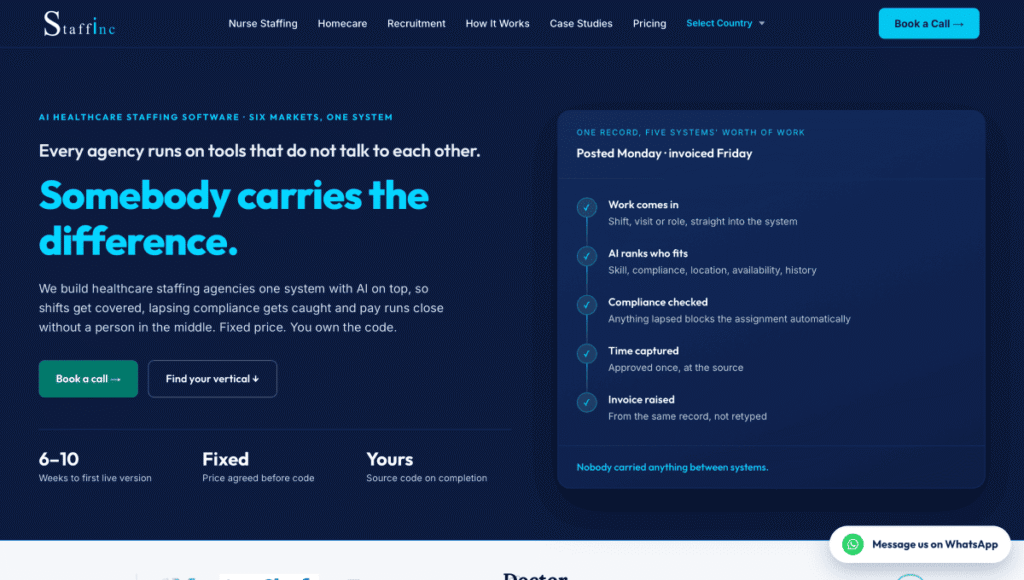
Staffinc builds custom systems for nurse staffing, locum tenens, recruitment and home care. Its core offering includes schedules, clinician apps, license-expiry records, timesheets and AI matching. A separately priced credential-intelligence module can read uploaded documents, flag date mismatches, check registries where an API is available and send uncertain results to a reviewer.
The defined modules help an agency see what it is buying. Staffinc’s Foundation tier covers shift matching and expiry alerts, while registry verification is separate. Its Complete System tier adds one finance connection, such as Xero, Sage or QuickBooks. An EHR connection should be included in the project scope if the agency’s workflow needs one.
| Detail | What a buyer can explore |
|---|---|
| Clinical connection | Specify the required EHR or practice-management interface as part of a custom scope |
| Finance systems | Xero, Sage or QuickBooks as one integration in its Complete System tier |
| AI capabilities | Shift matching and ranking; document extraction and registry checks in a separate credential-intelligence module |
| First scope | Nurse scheduling and expiry alerts, with verification added where required |
| Homepage | https://staffinc.io/ |
Best fit: Agencies that want a defined custom platform and can separate their essential first modules from later integrations.
9. AssistNow
AssistNow is a specialist choice for organizations already invested in Workday. It develops Workday HCM implementations and Workday Extend applications, including healthcare scheduling and competency workflows. Its Assistly platform supports staffing recommendations and compliance flags, with learning and patient-management information feeding the workforce process.
That approach is most useful when staff records and approvals already live in Workday. The first design decision is then what belongs inside Workday Extend and what should remain in the clinical or patient-management system.
| Detail | What a buyer can explore |
|---|---|
| Clinical connection | Patient-management data in its healthcare staffing work; the product for a new project needs to be specified |
| HR platform | Workday HCM and custom Workday Extend applications |
| AI platform | Assistly for recommendations and compliance alerts |
| First scope | One competency check or scheduling approval inside an existing Workday environment |
| Homepage | https://assistnow.com/ |
Best fit: Health systems seeking a healthcare-specific staffing workflow within their Workday setup.
10. Empeek
Empeek develops staffing integrations that exchange data among schedules, EHRs, payroll, agency tools and hospital systems. Its related home-care work uses nurse recommendations based on proximity, workload and relevant experience. Those are useful ingredients for organizations that assign staff across changing locations or patient needs.
Empeek has also connected Netsmart and AccuMedic in care-team software and offers Epic consulting. For a staffing project, ask the team to demonstrate how the proposed schedule receives credential status from the chosen system and how an exception reaches a coordinator.
| Detail | What a buyer can explore |
|---|---|
| Clinical integration experience | Netsmart and AccuMedic in care-team work; Epic consulting as a separate service |
| Workforce connections | Scheduling, payroll and staffing-agency integrations tailored to the project |
| AI capabilities | Nurse recommendation logic in home-care software; model platform set for the proposed build |
| First scope | One credential-status connection to a scheduling workflow, including exception review |
| Homepage | https://empeek.com/ |
Best fit: Care organizations that need a custom staffing handoff between clinical data and worker assignment.
What does an affordable first project actually include?
A discovery call or a low headline price does not tell a provider what it will cost to connect its systems. The initial quote should identify the workflow, the systems being connected, the authorization work, the AI function, who reviews exceptions and what support follows launch.
Only a few firms in this shortlist publish useful starting figures. They represent different scopes, so they are not a price ranking.
| Developer | Public commercial information | Scope that changes the comparison |
|---|---|---|
| TATEEDA | General project minimum of $20,000; staffing work priced by proposal | Define the first workflow and its clinical, HR and payroll connections |
| Taction Software | Typical $40,000–$80,000 estimate for a credentialing module or MVP | Verification sources, enrollment rules and number of connected systems |
| Staffinc | $500 one-week Blueprint, credited against a build within 90 days; nurse-staffing Foundation $8,000–$11,000 plus $350/month after delivery | Registry verification is separate; its credential-intelligence module is $7,000–$14,000 plus $150/month on an existing platform |
For the other developers, request a proposal tied to the same written workflow. Compare what each price includes before judging affordability: an EHR interface, an HR/payroll connection, verification-source access, testing with real exceptions, and maintenance may be separate items.
When is custom development worth considering?
An existing staffing subscription may be enough when its schedule, credential reminders and payroll export fit the organization with little adaptation. Custom development becomes more relevant when a decision crosses systems the product cannot reliably connect, or when a clinic’s approval and compliance rules need to be reflected in the workflow itself.
One useful starting example is open-shift coverage for a single clinic or nursing unit:
- Map the current handoff. Locate the shift request, staff availability, qualification record, approval and final timesheet.
- Choose the authoritative credential record. Define who can verify it, how often it updates, and what happens when a result is missing.
- Add one AI task. Rank clinicians who pass the eligibility checks or forecast likely gaps. Test suggestions against actual scheduler decisions.
- Keep approval visible. A coordinator accepts or changes the recommendation, and the system records the reason.
- Complete the connection. Send the approved assignment or hours to the current HR, payroll or practice system and reconcile errors.
This sequence gives a development partner something concrete to estimate. It also reveals whether the difficult part is the model, an unavailable interface, inconsistent credential data or an approval rule that has never been written down.
Questions to ask before hiring a development partner
- Which EHR, practice-management, HR and payroll products will the first release connect? What can each interface read and write?
- Who obtains access to a credential source, and what happens if a source query fails or produces a disputed result?
- Which decisions are governed by fixed eligibility rules, and which are AI suggestions?
- How will the team test expired licenses, overlapping shifts, changed assignments and corrected time records?
- What model or cloud platform will process staff or patient information, and who manages permissions, logs and vendor agreements?
- What exactly is included in the first price, and which integrations, verification modules or support services cost extra?
A good proposal should make the path from source record to approved action visible. That is more useful than a long list of technologies without a working example of the buyer’s own workflow.
FAQ
Is staffing software the same as provider credentialing software?
No. Staffing software manages availability, assignments and hours. Credentialing software maintains the records and review process used to establish that a clinician meets defined requirements. Provider credentialing may also cover privileges and payer enrollment. A custom system can connect these jobs while keeping their approvals distinct.
Does a small clinic need an EHR connection for staffing AI?
Only when the workflow needs EHR data or must update a clinical schedule. A clinic can begin with staff availability, qualification records and approved shifts, then add an EHR or practice-management interface when there is a clear data flow to support.
Can AI approve credentials or decide who is eligible for a shift?
AI can help extract fields, identify missing documents and suggest matches. Eligibility should depend on the organization’s rules and authorized records. A reviewer needs access to the source and a way to correct uncertain or conflicting results.
Do we need a large language model for this type of project?
Often, no. Forecasting and constrained scheduling may use predictive models or optimization methods. A language model may be useful for reading documents or answering questions from approved policies. Choose the technology after defining the task and how its output will be checked.
What should we prepare before requesting a quote?
Bring one workflow, the names of the systems involved, sample records with sensitive information removed, the relevant qualification rules, and the person who approves the final action. Ask each developer to price the same first release and identify any dependencies on vendors or verification sources.



![10 Healthcare Data Engineering Companies for AI-Ready EHR Data [2026]](https://tateeda.com/wp-content/uploads/2026/10/Cover-image-6.png)
![8 Healthcare RAG Development Companies in California [2026]](https://tateeda.com/wp-content/uploads/2026/10/Cover-img-2.jpg)
![Top 10 Healthcare AI Agent Developers in California [2026]](https://tateeda.com/wp-content/uploads/2026/09/Tateeda-illustration-2-1.png)