How we delivered a U.S. healthtech product 4x faster with AI-assisted engineering

Slava Khristich



Vlad Nazarov
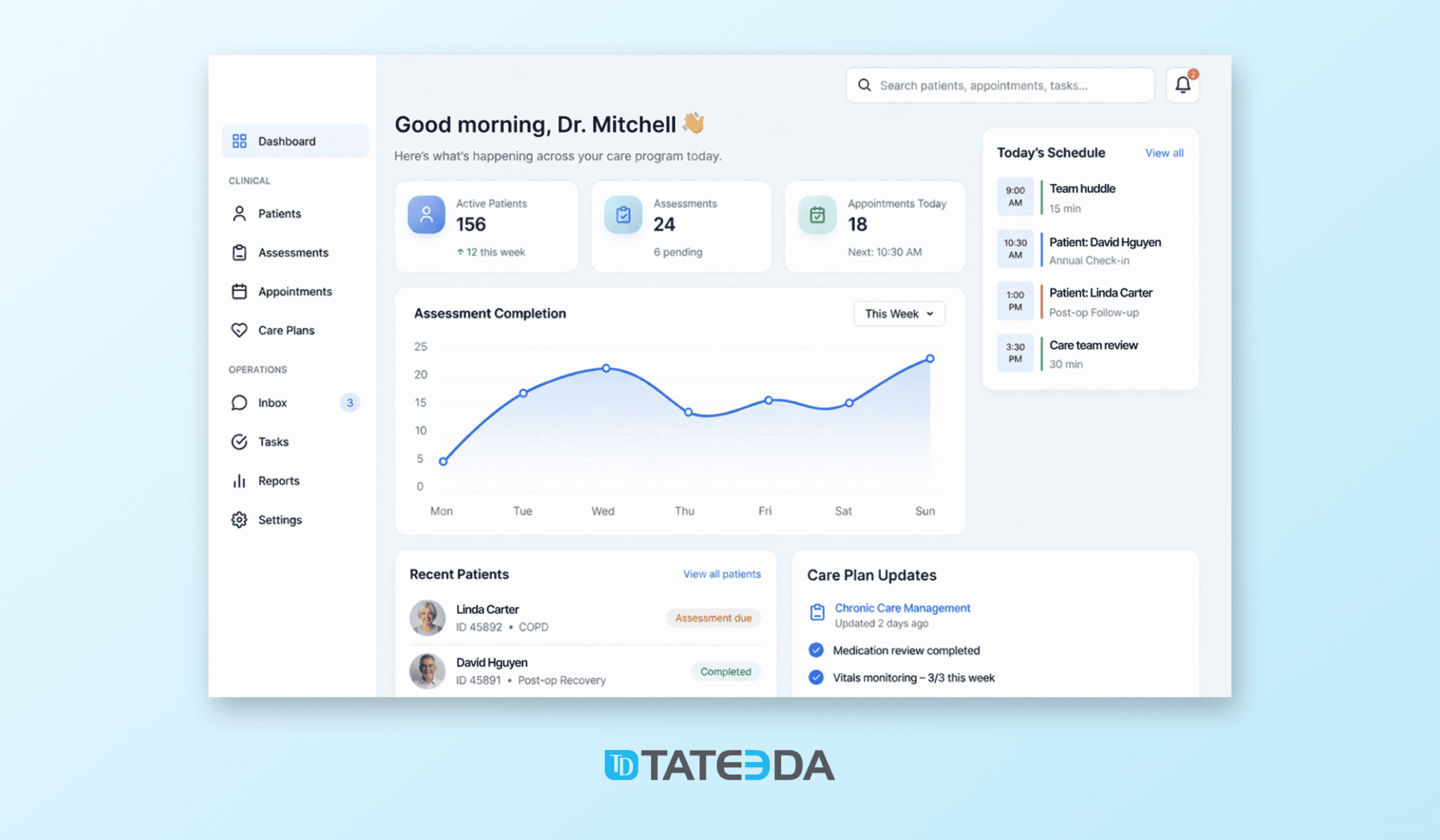
| This case study shows how TATEEDA helped an NDA-protected U.S. healthtech company update a clinical assessment product 4x faster by replacing slower manual delivery habits with a cross-platform architecture and AI-assisted engineering, while keeping senior specialists in control of review, validation, and final release quality. The result was a major compliance-driven release in 6 weeks instead of 24, about 55% lower projected delivery spend, much easier update management, and a stronger foundation for future product growth. |
- Major compliance-driven release shipped in 6 weeks instead of 24
- Projected delivery spend reduced by about 55%
- Centralized update model removed the need for repeated site-by-site rollouts
- Reporting and export workload for 15,000 patient records dropped from 38 minutes to under 3 minutes
- AI-assisted delivery helped shorten coding, QA, and debugging cycles without removing human review
An NDA-protected U.S. healthcare software company needed to update its clinical assessment product before new documentation requirements took effect. The original path was slow and conventional: more manual coding, more repetitive QA effort, more time spent tracing bugs by hand, and a delivery model that leaned too heavily on platform-specific work and local rollout overhead.
TATEEDA proposed a different approach to speed up product development with AI.
We combined cross-platform product design with AI-assisted software delivery:
- human-verified AI-generated code for well-bounded tasks
- AI copilots that helped developers move faster
- AI-supported testing and debugging workflows that reduced the drag of repetitive engineering work
That shift, combined with architectural simplification, helped the client reduce delivery time by 4x, lower projected costs, and release a product that was easier to maintain and easier to grow.
| Location | United States |
| Cooperation period | 2024, ongoing |
| Services used | Custom healthcare software development, architecture redesign, UI modernization, QA, cloud deployment support, integration engineering, AI-assisted software delivery |
| Industry | Healthcare / digital health |
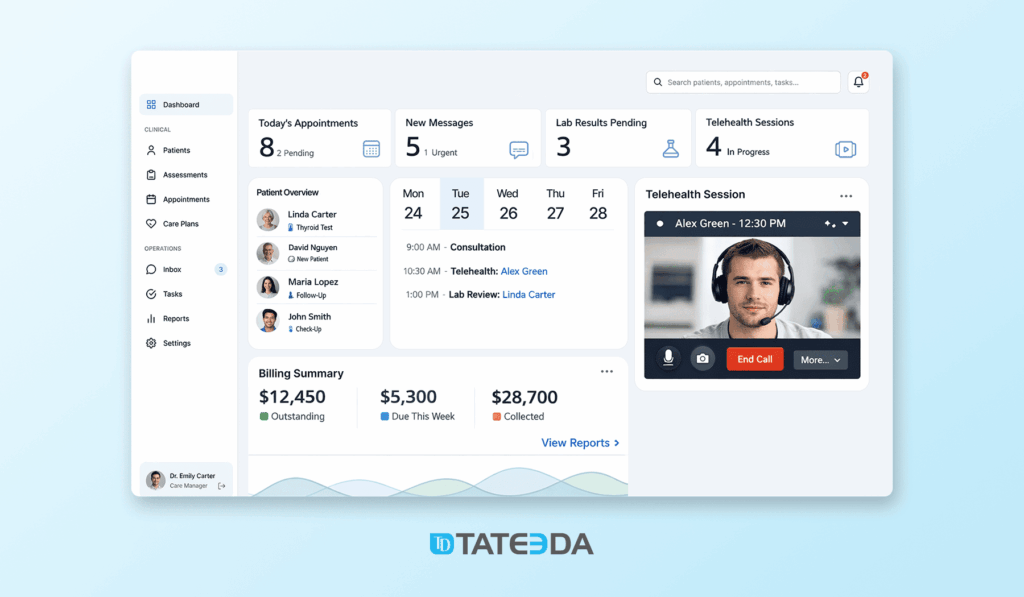
Table of Contents
The challenge: urgent compliance, slower delivery, and field-use constraints
The client, a U.S.-based healthtech vendor serving provider organizations, relied on a clinical assessment product used for patient intake, documentation, and care planning. A compliance update created immediate commercial pressure: the product had to be revised before the new documentation requirements took effect, or the client risked missing a narrow market window and falling behind competitors that moved faster.
The product itself was not the only concern. The delivery approach was also holding the project back. At the start, the client was dealing with several connected issues:
- a deadline tied to new compliance requirements;
- too much manual engineering work around repeatable features and integration logic;
- slower debugging and heavier QA cycles than the release window could comfortably support;
- a real product constraint, since many end users worked in remote or low-connectivity environments;
- a maintenance model that made updates harder to roll out across multiple customer sites;
- a broader business need to shape something durable, not just a short-term fix.
That combination made the project harder than a standard product refresh. The team needed to move quickly, but they also had to protect release quality, support disconnected workflows, and avoid creating another version of the product that would be expensive to maintain later. On top of that, the client wanted the system to remain flexible enough for expansion into an adjacent care segment, which meant architecture decisions had to support future growth from the beginning.
| Compliance-driven release window | The product had to be updated before new documentation rules took effect, which effectively compressed the practical release plan to about 12 weeks. Missing that window could delay rollout, weaken the client’s market position, and push revenue opportunities into a later cycle. |
| Manual programming of repeatable features | Routine components, form logic, and parts of the integration layer were being built largely by hand, which added an estimated 6 to 8 weeks to implementation and kept senior engineers tied up in repetitive work that did not always require fully manual treatment. |
| Long debugging and QA loops | Defects, regressions, and validation scenarios required more manual effort than the release window could comfortably absorb, extending stabilization by an estimated 4 to 6 weeks and creating significant pressure late in the release cycle. |
| Inconsistent internet access in real care settings | Because clinicians and staff often worked in field and facility environments with unstable connectivity, the product needed offline capture and later sync. Without that, assessments could stall, data entry could be repeated, and user adoption would suffer. |
| Site-by-site update model | Repeated local rollout work turned each release into a support-heavy operational task, slowing future updates, increasing maintenance effort, and making product evolution more expensive across customer environments. |
| Need to support future expansion | The client was not looking for a temporary patch. The platform had to remain adaptable for an additional care segment, which raised the architectural bar from day one and ruled out quick fixes that would trigger another rebuild later. |
The solution: AI-accelerated product build
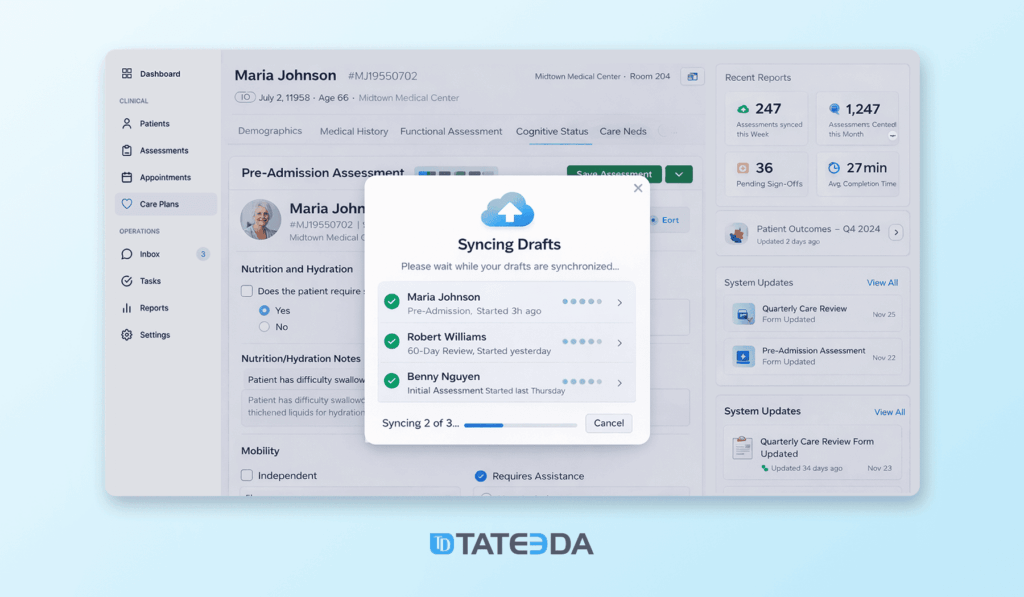
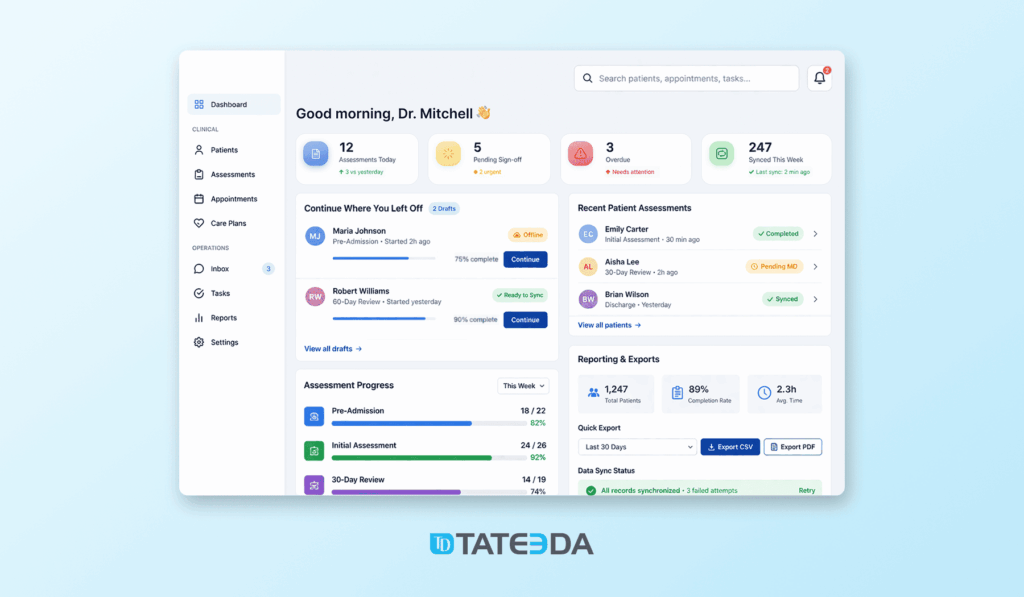
TATEEDA reviewed the client’s initial concept and recommended moving away from separate native builds. Instead, we created a browser-based assessment application that could run across devices, store data locally during disconnected sessions, and sync it once connectivity returned.
“That architectural choice mattered, but it was only part of the acceleration story. The other major shift was in how the product was delivered. Rather than relying fully on traditional manual implementation, TATEEDA introduced an AI-assisted engineering workflow to speed up software development with AI while keeping senior engineers responsible for review, correction, and final approval.”
Slava K.
TATEEDA’s CEO
This approach focused on three areas:
- Development: AI copilots helped scaffold predictable components, draft integration logic, support refactoring, and generate test-ready building blocks.
- QA and debugging: AI-assisted workflows helped inspect logs faster, highlight likely failure points, and suggest regression scenarios.
- Human verification: senior engineers finalized the code, checked business logic, and validated production readiness.
In practice, that meant AI handled more of the repetitive groundwork, while people stayed responsible for correctness, safety, and release quality. The same logic improved QA and debugging: testers and engineers were not replaced, but they started from a much faster and more informed baseline, with more time left for validation, edge cases, and final checks.
“Our team also reworked the system structure behind the product so updates could be delivered from one central point rather than through repeated site-level installations. For the client, that meant less operational friction, fewer deployment headaches, and a much simpler path for future releases.”
Slava K.
TATEEDA’s CEO
On top of that, TATEEDA rebuilt the reporting and export layer used to move assessment data into downstream systems. We improved data handling, reduced processing delays, and refreshed key parts of the interface so day-to-day usage felt clearer for care teams under time pressure.
To support the client’s expansion plans, we also prepared the product so that assessment logic and workflows could be adapted for an additional care segment without rebuilding the application from scratch.
What changed in the delivery model
Before TATEEDA’s involvement, the project leaned more heavily on slower manual processes:
- Repetitive code written from scratch
- Longer debugging loops
- Heavier dependence on manual QA effort
- More fragmented delivery across platforms
- More operational effort for updates and releases.
TATEEDA introduced a different working model:
- AI-generated code for bounded implementation tasks, always reviewed and finalized by engineers
- AI copilots for developers, helping with scaffolding, refactoring suggestions, interface logic, and routine engineering output
- AI-supported testing workflows, including faster test-case drafting and broader regression preparation
- AI-assisted debugging, helping the team inspect errors, logs, and likely causes faster
- Human verification at every final step, especially for healthcare logic, compliance-sensitive behavior, and release readiness.
This combination is what helped make the 2x delivery claim credible. The speed did not come from cutting corners. It came from reducing avoidable manual repetition and keeping experienced engineers focused on the parts of the product that truly required judgment.
Core system functions included in the scope
The updated product covered a practical set of clinical and operational functions:
- Offline assessment capture
Clinicians could complete patient assessments without a stable internet connection and sync records later when access returned. - Cross-device browser access
The system was built to work on laptops and tablets through a web interface, reducing dependency on platform-specific mobile applications. - Centralized update delivery
Product updates could be pushed from one location, which reduced local installation work and made version control easier across customer sites. - Structured intake and documentation flows
The application supported guided assessment forms, required fields, logic-based steps, and cleaner data entry for pre-admission and ongoing evaluation workflows. - Compliance-related form updates
Documentation, logic, and data fields were revised to reflect new regulatory requirements and reduce the risk of outdated assessments remaining in use. - Assessment data export and reporting
The system included improved export functions for downstream reporting, internal review, and data handoff into external systems. - User-friendly interface refresh
Key screens were updated to make everyday work more intuitive for staff dealing with patient intake, documentation, and follow-up actions. - Configurable workflow foundation for future expansion
The product was prepared for adaptation into adjacent care settings, allowing the client to introduce modified assessment logic for new facility types without starting over. - Integration-ready architecture
The new structure made it easier to connect the application with external healthcare platforms, analytics tools, and future data-processing modules.
The result
The client launched its updated healthcare product in 6 weeks instead of the 24 weeks originally projected, giving the business a much better chance to respond to regulatory pressure while the market window was still open.
By replacing a multi-build concept with one cross-platform solution, the client reduced projected delivery spend by roughly 55%. Just as important, they avoided the long-term burden of maintaining several separate codebases.
The AI system engineering model also changed the tempo of the project. Developers spent less time on repetitive boilerplate work, QA cycles moved faster, debugging became less labor-intensive, and senior specialists could focus more attention on validation, architecture, compliance-sensitive details, and final release quality.
The new centralized release model made future updates far less painful. Customer sites no longer had to rely on repeated local deployment efforts for every major change, which cut support overhead and simplified product evolution.
Performance also improved in a way that users could actually feel. Large-volume data exports that previously took 38 minutes for about 15,000 records were reduced to under 3 minutes, helping customer teams access reports faster and move data onward with less waiting.
For the client, this was more than a compliance fix. It was a faster release, a more modern engineering process, and a stronger product base for the next phase of growth.
| Release timeline | 24-week projected release cycle | Product launched in 6 weeks | Helped the client respond to compliance pressure while the market window was still open |
| Delivery cost | Higher projected spend tied to a multi-build approach | About 55% lower projected delivery spend | Reduced upfront delivery costs and avoided unnecessary engineering duplication |
| Product architecture | Multiple builds and heavier long-term maintenance burden | One cross-platform solution | Simplified support, reduced codebase fragmentation, and made future changes easier to manage |
| Engineering workflow | More manual coding, slower QA, and heavier debugging effort | AI-assisted delivery with faster coding, QA, and debugging cycles | Freed senior specialists to focus on validation, architecture, compliance-sensitive details, and release quality |
| Update management | Repeated local rollout effort across customer sites | Centralized release model | Cut support overhead and made future updates much easier to distribute |
| Reporting performance | 38 minutes to process exports for about 15,000 records | Under 3 minutes | Faster reporting, quicker downstream data movement, and less waiting for customer teams |
| Strategic outcome | Compliance fix only | Faster release plus a stronger product base | Left the client with a more modern delivery model and a better foundation for future growth |
Why this case matters
This case shows that faster healthcare delivery is not just about hiring more people or pushing harder. Sometimes the real gain comes from changing how the work gets done. In this project, TATEEDA combined architectural simplification with AI-assisted engineering, while keeping humans in control of the final code, final validation, and final release decisions.
That is what made the acceleration practical: less manual drag, more focused engineering time, and a healthier path from urgent product pressure to a release the client could actually trust.