Top 7 Nearshore Software Development Companies in 2026

Slava Khristich


Vlad Nazarov
Nearshore software development gives North American companies access to engineering talent outside their domestic market while preserving the working-day overlap that makes standups, architecture discussions, product reviews, debugging, and release coordination considerably easier.
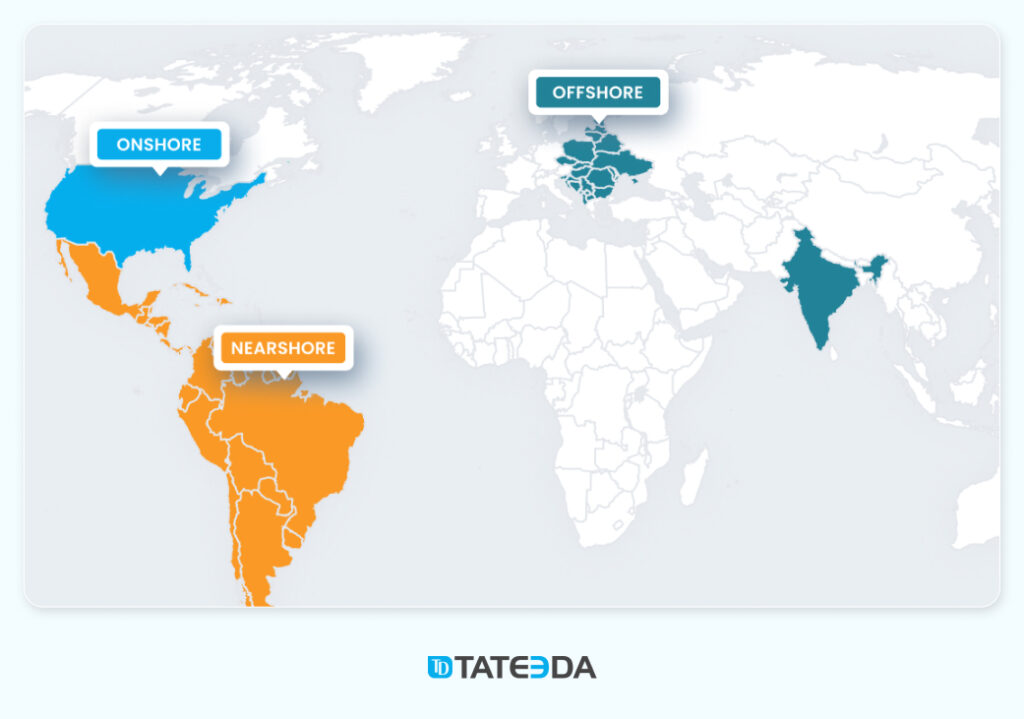
For U.S. companies, the nearshore model is most commonly associated with software engineers in Latin America (LATAM), including Mexico, Brazil, Colombia, Argentina, Costa Rica, and other countries across Latin America and the Caribbean. Some providers are headquartered directly in LATAM; others keep their headquarters in the United States or Canada and operate distributed engineering teams throughout the region.
Many of the best nearshore software development companies support several engagement models at once. A client can extend an existing development team, hire individual specialists, assemble a dedicated product squad, or outsource a complete software project.
The attraction is no longer simply lower developer rates. LATAM gives U.S. companies a combination of overlapping work hours, a substantial engineering labor market, access to specialized skills, and more flexible staffing economics than fully domestic hiring. Modern nearshore teams cover web and mobile app development, cloud engineering, DevOps, QA, data systems, AI development, cybersecurity, UX/UI, and enterprise integrations.
AI has become particularly important. Companies selecting a nearshore partner may now need Python or .NET engineers alongside specialists in generative AI, AI agents, RAG, machine learning, data engineering, and cloud AI platforms. The engineering question has also expanded: businesses need to know how vendors use AI coding assistants internally, who reviews AI-generated code, and how security, intellectual property, testing, and accountability are handled.
The seven companies below represent different versions of the nearshore model, from healthcare-focused custom software engineering to AI-first product development and pure staff augmentation.
| Please note: ✔️ This list includes nearshore software development companies serving U.S. and North American clients through engineering resources in Latin America. A provider does not have to be headquartered in LATAM; what matters is a credible regional delivery capability and a practical nearshore engagement model. ✔️ The companies appear in no particular ranking order. They were selected according to their nearshore presence, engineering capabilities, service range, public project evidence, technology expertise, and third-party business profiles. ✔️ The purpose of this list is not to formally endorse or rate these vendors against one universal standard. Different companies can be better suited to healthcare software, AI engineering, product development, IT staff augmentation, enterprise systems, UX/UI, or cloud projects. ✔️ Public hourly ranges cited from Clutch are directional marketplace figures rather than vendor quotations. Actual pricing varies by seniority, technology, project scope, team composition, and engagement duration. ✔️ If nearshore location matters to your project, confirm where your assigned engineers will actually work. A global software company may operate offices in LATAM while assigning a particular project to specialists elsewhere. ✔️ If you represent one of the companies listed here and would like to correct or add useful information, please contact us. |
Table of Contents
The 7 Best Nearshore Development Companies: Strengths, Considerations, and Hourly Rates
The right provider depends heavily on what you intend to outsource.
A company looking for two backend engineers has a different procurement problem from a healthtech organization building a HIPAA-regulated platform, an enterprise introducing AI into an established product, or a startup commissioning an entire MVP.
Here is a quick comparison of the seven top nearshore software development companies covered in this guide.
| Company | Particularly Relevant For | Nearshore Footprint | Consideration | Clutch-Listed Hourly Rate |
|---|---|---|---|---|
| TATEEDA GLOBAL | Healthcare software, regulated products, AI integration, dedicated teams, complex custom systems | LATAM engineering resources, including Brazil, Colombia, Mexico, plus additional European delivery | Strongest fit is substantial custom engineering and team extension rather than very small commodity projects | $50-99/hr |
| Alset | Product engineering, SaaS, .NET, FinTech, MedTech | Mexico, with Mexico City operations | Smaller organization with a comparatively high current Clutch rate | $100-149/hr |
| Azumo | AI, data, cloud engineering, custom applications, AI staff augmentation | Engineers distributed across LATAM, with a major Argentina presence | AI specialization may exceed the needs of a basic web project | $25-49/hr |
| DevEngine | Software, data, cloud, DevOps, SAP talent acquisition and staff augmentation | LATAM, including an operational presence in Argentina | Primarily a staffing and recruiting partner rather than a conventional full-cycle product studio | $50-99/hr |
| Teravision Technologies | Larger development teams, custom products, AI/data engineering, staff augmentation | Colombia and Mexico, with U.S. headquarters | Clutch currently lists a $50,000+ minimum project size | $25-49/hr |
| Asymm | Product development, UX/UI, Mexico-based nearshore teams | Mexico, with U.S. headquarters in San Diego County | Compact organization; large multi-team programs should confirm available capacity | $50-99/hr |
| Intuitio Labs | AI products, full-stack engineering, UX, mobile, cloud | Argentina plus U.S., European, and Asian engineering resources | Global delivery model means clients wanting exclusively LATAM staffing should confirm assigned-team geography | $50-99/hr |
Why Are Nearshore Software Development Companies in LATAM So Popular?
LATAM has become a major engineering source for companies in the United States and Canada, but it is better to think of the region as a collection of distinct technology markets rather than one uniform outsourcing destination.
Brazil, Mexico, Argentina, and Colombia have particularly substantial software communities. Smaller markets such as Uruguay and Costa Rica can also provide concentrated technical talent. For more detail on individual countries, hiring models, technologies, and engineering resources, see our guide to software development in Latin America.
Same-Day Collaboration with U.S. Teams
Time-zone compatibility remains one of the clearest advantages of nearshoring.
Engineers in Mexico, Colombia, Argentina, Brazil, and neighboring markets can participate in U.S. standups, sprint planning, architecture calls, pair-programming sessions, QA reviews, and product discussions during the same business day.
This becomes valuable whenever developers need frequent access to product managers, internal engineers, clinicians, business analysts, designers, or customer-facing teams. Azumo explicitly structures its nearshore service around North American working-hour overlap, while Asymm’s Mexico-based model targets Pacific and Central Time collaboration.
Cost Is Important, but So Is Team Structure
LATAM can reduce engineering expenditure compared with building the same team entirely in major U.S. technology centers. The difference, however, varies considerably.
The companies in this guide alone range from $25-49 to $100-149 per hour on Clutch. Rates depend on experience, specialization, management included in the engagement, QA, architecture responsibility, contract duration, and whether you are buying individual engineering capacity or complete product delivery.
A lower hourly rate does not automatically mean a lower final project cost. Rework, weak architecture, communication gaps, slow recruitment, inadequate testing, or frequent engineer turnover can quickly erase an attractive rate.
AI Has Changed Nearshore Talent Requirements
Nearshore hiring increasingly extends beyond conventional frontend, backend, and mobile roles.
Companies now seek engineers capable of integrating LLMs, building AI agents, implementing RAG, working with vector databases, developing machine-learning pipelines, connecting enterprise data, and deploying AI through AWS, Azure, or Google Cloud.
Nearshore teams may also use AI-assisted development internally. Buyers should therefore ask how generated code is reviewed, whether confidential code or data can be submitted to external AI services, and who remains accountable for architecture, security, QA, and release decisions.
This matters especially in healthcare, finance, insurance, and other data-sensitive environments.
Flexible Engagement Models
Nearshore software development can take several forms:
- Staff augmentation: individual engineers become part of your existing team.
- Dedicated team: a stable group works primarily or exclusively on your product.
- Managed project: the vendor owns defined software deliverables, usually including project management and QA.
- Product engineering: the partner participates in architecture, design, development, testing, cloud work, and ongoing releases.
- Specialist augmentation: a company adds particular skills such as AI, DevOps, cloud, cybersecurity, QA automation, or nearshore .NET engineers.
You can explore these models in more detail in our nearshore software development guide.
In-Depth Analysis of the Top Nearshore Software Development Agencies in LATAM and the U.S.
The seven vendors below serve broadly similar geographic markets, but their business models differ considerably.
That distinction matters. Some take responsibility for complete products. Others primarily supply engineers. Several emphasize AI. A few have particularly strong domain concentrations.
#1. TATEEDA GLOBAL

TATEEDA GLOBAL is a San Diego-headquartered custom software development and staff augmentation company founded in 2013. It works with U.S. and Canadian businesses through a team of 100+ senior IT professionals across 16 countries, including engineering resources in LATAM and Eastern Europe.
TATEEDA is especially concentrated in healthcare, healthtech, biotechnology, pharmaceutical software, IoT/IoMT, fintech, and other data-sensitive systems. Its nearshore engineers participate in web and mobile software development, cloud projects, APIs, EHR/EMR integrations, FHIR and HL7 interfaces, medical billing, patient portals, healthcare staffing platforms, pharmacy software, remote patient monitoring, QA, DevOps, and enterprise applications.
That healthcare concentration is an important differentiator. Nearshore development for a conventional SaaS product is primarily an engineering and management decision. Healthcare projects can also involve PHI access, Business Associate Agreements, HIPAA-related controls, interoperability standards, billing formats, cloud permissions, audit records, medical-device integrations, and other requirements that directly affect software architecture.
TATEEDA therefore describes its healthcare work as development for HIPAA-regulated environments, rather than presenting HIPAA as a generic company certification.
Nearshore AI Development
AI is part of TATEEDA’s nearshore offering rather than a separate experimental practice.
The company develops AI assistants and agents, document-processing functions, healthcare workflow automation, AI-backed analytics, and intelligent features connected with EHR/EMR, billing, CRM, pharmaceutical, insurance, and operational systems.
Its publicly listed AI technologies include OpenAI, Microsoft Azure AI services, TensorFlow, IBM watsonx, Google Cloud Vertex AI, AWS SageMaker, and Amazon Bedrock.
This approach can be particularly useful for organizations that do not need an isolated AI demo. They need AI inserted into an existing product, data flow, API layer, clinical workflow, billing application, or internal business system.
U.S. Presence Plus Distributed Engineering
TATEEDA combines a San Diego headquarters with nearshore and offshore delivery resources. LATAM teams can work during the U.S. business day, while additional engineers in Eastern Europe provide access to a wider technical pool and can extend delivery coverage beyond a LATAM-only model.
The company has also appeared on the Inc. 5000 four consecutive times, ranking No. 2,833 in 2022, No. 2,318 in 2023, No. 2,519 in 2024, and No. 3,758 in 2025. Inc. reported 100% three-year growth for its 2025 placement.
| HQ Location | San Diego, California, United States |
| Founded | 2013 |
| Team | 100+ IT professionals across 16 countries |
| Nearshore Destinations | LATAM engineering resources including Brazil, Colombia, Mexico, and broader regional sourcing |
| Additional Delivery Region | Eastern Europe, including Ukraine and Poland |
| Platforms | Web, mobile, cloud, AI, desktop, enterprise software, connected devices |
| Industries | Healthcare, healthtech, biotech, pharma, fintech, IoT/IoMT |
| Technologies | .NET/C#, JavaScript/TypeScript, Angular, React, Vue.js, Node.js, Python, Flutter, SQL databases, AWS, Azure, Google Cloud, Docker, Kubernetes |
| AI Technologies | OpenAI, Azure AI services, AWS Bedrock/SageMaker, Google Vertex AI, IBM watsonx, TensorFlow |
| Services | Custom product development, nearshore staff augmentation, dedicated teams, AI integration, cloud/DevOps, QA, software modernization |
| Clutch Rating | 4.9/5 |
| Clutch Rate | $50-99/hour |
| Website | TATEEDA Nearshore Software Development Services |
Best fit: Healthcare providers, healthtech and biotech businesses, medical SaaS companies, enterprises with difficult integration requirements, and North American companies seeking senior nearshore engineers combined with U.S.-based business leadership and additional international engineering capacity.
#2. Alset
Alset is a Mexico City software product company founded in 2016. Its core nearshore advantage comes from Mexico-based engineering and Central Time collaboration with North American clients.
The company focuses heavily on structured product delivery. Its services cover product discovery, architecture, custom software, SaaS, mobile applications, APIs, DevOps, QA, UX/UI, AI, and continuing product teams.
Alset works across FinTech, MedTech, RegTech, gaming, retail, enterprise software, and related sectors. Current technical capabilities include C#, ASP.NET, .NET, SQL, TypeScript, JavaScript, Python, Angular, React, Node.js, and related web/mobile technologies. Clutch also references work involving HIPAA-related medical record systems.
One point deserves care: old Microsoft Silver Partner and Xamarin partnership references are no longer useful indicators of present technical capability. Microsoft’s former Silver/Gold competency structure has been retired, and Xamarin is no longer a current mobile-development differentiator. A buyer should evaluate Alset according to its present engineering practice, portfolio, and assigned team.
| Feature | Description |
|---|---|
| HQ Location | Mexico City, Mexico |
| Founded | 2016 |
| Team | 10-49 employees on Clutch |
| Nearshore Destination | Mexico |
| Additional Location | Valencia, Spain |
| Platforms | Web, mobile, SaaS, cloud |
| Industries | FinTech, MedTech, RegTech, gaming, retail, enterprise software |
| Technologies | C#, ASP.NET, .NET, SQL, TypeScript, JavaScript, Python, Angular, React, Node.js |
| Services | Product discovery, custom software, product pods, APIs, mobile/web development, QA, DevOps, staff augmentation |
| Clutch Rating | 5.0/5 |
| Clutch Rate | $100-149/hour |
| Website | Alset |
Clutch currently lists a $25,000+ minimum project size, $100-149 hourly range, 10-49 employees, and a 5.0 rating from 11 reviews.
Best fit: U.S. organizations seeking a compact Mexico-based development company, especially for SaaS, .NET-heavy applications, FinTech, MedTech, and projects where discovery and architecture are part of the assignment.
#3. Azumo
Azumo is a San Francisco-headquartered nearshore software development company founded in 2016.
Its delivery model is strongly associated with Latin America, with Clutch listing offices in San Francisco and Rosario, Argentina. Azumo positions its engineers around North American working hours and provides both staff augmentation and managed software development.
AI is central to the company’s current profile.
Azumo provides generative AI development, AI agents, RAG, machine learning, NLP, multimodal AI, MLOps, data engineering, AI consulting, and cloud engineering, in addition to conventional custom software.
Its wider development capabilities span Python, JavaScript/TypeScript, React, Next.js, Node.js, Java, .NET, mobile technologies, AWS, Azure, Google Cloud, databases, and DevOps.
This breadth makes Azumo particularly relevant when AI must become part of a conventional production application rather than exist as a standalone experiment.
| Feature | Description |
|---|---|
| HQ Location | San Francisco, California, United States |
| Founded | 2016 |
| Team | 50-249 employees on Clutch |
| Nearshore Delivery | Latin America, including Argentina |
| Platforms | AI, data, web, mobile, cloud, enterprise software |
| Industries | Healthcare, financial services, media, technology, retail, gaming, industrial |
| Technologies | Python, JavaScript/TypeScript, React, Next.js, Node.js, Java, .NET, AWS, Azure, Google Cloud |
| AI Technologies | OpenAI, Anthropic Claude, Google Gemini, Meta Llama, RAG, MLOps, agent-development technologies |
| Services | AI development, custom software, staff augmentation, data engineering, cloud/DevOps, mobile development |
| Clutch Rating | 4.9/5 |
| Clutch Rate | $25-49/hour |
| Website | Azumo |
Clutch currently attributes 35% of Azumo’s service mix to AI development, with additional categories for AI agents, AI consulting, generative AI, and custom software development. Its profile lists a $10,000+ minimum project and 26 reviews.
Best fit: Companies seeking an AI-centered nearshore engineering partner, particularly where generative AI, machine learning, data engineering, cloud infrastructure, or agents must be combined with full-stack application development.
#4. DevEngine
DevEngine is somewhat different from the other nearshore development companies on this list.
Headquartered in Vancouver, Canada, and founded in 2019 according to its current Clutch profile, DevEngine concentrates primarily on IT staff augmentation, technical recruiting, and building distributed engineering teams in Latin America and Canada.
Its nearshore offering is intended for clients that already possess product ownership and technical leadership but need additional engineers.
DevEngine handles candidate sourcing, technical screening, contracts, payroll, onboarding, HR support, and related staffing administration. Its talent areas include software development, data engineering, cloud, DevOps, project management, and SAP.
The company operates in Vancouver, Toronto, and Buenos Aires according to Clutch. Its site also emphasizes LATAM recruiting beyond Argentina.
That staffing orientation is worth recognizing. DevEngine can be attractive if your company already has a CTO, architects, engineering managers, and an established development process. If you need a vendor to assume responsibility for product discovery, UX/UI, architecture, coding, QA, deployment, and final delivery, compare engagement structures carefully.
| Feature | Description |
|---|---|
| HQ Location | Vancouver, Canada |
| Founded | 2019 |
| Team | 50-249 employees on Clutch |
| Nearshore Delivery | Latin America, including operational presence in Argentina |
| Additional Locations | Vancouver and Toronto, Canada |
| Talent Areas | Software engineering, data, cloud, DevOps, SAP, project management |
| Services | IT staff augmentation, recruiting, permanent placement, dedicated-team assembly |
| Delivery Model | Primarily embedded talent and recruiting |
| Clutch Rating | 4.8/5 |
| Clutch Rate | $50-99/hour |
| Website | DevEngine |
Clutch currently describes DevEngine’s service mix as 60% IT staff augmentation and 40% recruiting, with a $5,000+ minimum project size.
Best fit: North American companies with established engineering leadership that want to add software, data, cloud, DevOps, SAP, or project-management specialists without building their own LATAM recruiting operation.
#5. Teravision Technologies
Teravision Technologies is one of the longest-established companies in this selection.
Founded in 2002, it combines U.S. operations with nearshore development centers in Bogotá, Colombia, and Mexico City. Clutch lists the company in the 250-999 employee range, making it one of the larger providers here.
Teravision’s services span custom software, staff augmentation, product engineering, mobile and web development, cloud work, digital strategy, AI consulting, AI development, and QA.
AI has become a substantial element of its service portfolio. The company provides AI development alongside AI-assisted engineering teams and data services. Current Clutch categories include machine learning, conversational AI, computer vision, NLP, recommendation systems, voice technologies, and related fields.
This broader delivery organization can suit companies that need multiple engineers or an external partner capable of taking responsibility for a significant part of product delivery.
| Feature | Description |
|---|---|
| HQ Location | Pinecrest, Florida, United States, according to Clutch |
| Founded | 2002 |
| Team | 250-999 employees on Clutch |
| Nearshore Locations | Bogotá, Colombia; Mexico City, Mexico |
| Platforms | Web, mobile, cloud, AI/data |
| Technologies | React, Node.js, Python, AWS, Azure, Docker, AI/ML and related technologies |
| Services | Staff augmentation, AI development, product engineering, custom software, QA, cloud/DevOps, strategy |
| Clutch Rating | 4.8/5 |
| Clutch Rate | $25-49/hour |
| Minimum Project on Clutch | $50,000+ |
| Website | Teravision Technologies |
Clutch currently lists a $50,000+ minimum project size and shows that the most common reviewed engagement falls in the $200,000-$999,999 range.
Best fit: Mid-market and enterprise organizations requiring larger nearshore teams, managed product engineering, AI/data capabilities, or a provider that combines staff augmentation with broader project responsibility.
#6. Asymm
Asymm is a software design and development company headquartered in Solana Beach, California, with a nearshore presence in Mexico.
Founded in 2020, the company combines U.S.-based client interaction with Mexican engineering resources. Its nearshore model is particularly convenient for West Coast businesses because developers can work during Pacific or Central Time.
Asymm supports both outsourced software projects and staff augmentation. Its services cover architecture, product planning, UX/UI, web and mobile engineering, QA, data-related work, APIs, and system integrations.
Current technical material references JavaScript, Python, React, React Native, Node.js, .NET, Angular, AWS, Azure, and other modern application technologies.
Clutch describes Asymm primarily as a custom software development and UX/UI company, with 80% of its service mix assigned to custom software and 20% to UX/UI.
| Feature | Description |
|---|---|
| HQ Location | Solana Beach, California, United States |
| Founded | 2020 |
| Team | 10-49 employees on Clutch |
| Nearshore Destination | Mexico |
| Platforms | Web, mobile, cloud, data |
| Technologies | JavaScript, Python, React, React Native, Angular, Node.js, .NET, AWS, Azure |
| Services | Custom software, outsourced product development, staff augmentation, UX/UI, QA, data solutions |
| Clutch Rating | 5.0/5 |
| Clutch Rate | $50-99/hour |
| Website | Asymm |
Its current Clutch profile lists a $25,000+ minimum project size, 10-49 employees, locations in Solana Beach and Mexico City, and 11 reviews.
Best fit: U.S. startups and mid-market organizations that want a relatively compact California/Mexico partner combining product design, custom software development, and nearshore engineering.
#7. Intuitio Labs
Intuitio Labs is a digital product and AI engineering company with a nearshore presence in Martínez, Argentina, alongside operations in the United States and other international delivery locations.
Its service portfolio combines custom software, mobile applications, UX/UI, web development, team augmentation, digital engineering, and applied AI.
AI has become prominent in the company’s positioning. Intuitio Labs currently presents applied AI and intelligent automation as a major service area alongside digital engineering and product design. Its AI work includes generative AI, machine learning, automation, intelligent applications, and AI functionality incorporated into client products.
The company’s wider technical coverage includes Python, React, React Native, Flutter, JavaScript, cloud technologies, databases, APIs, containerization, and related web/mobile engineering tools.
Its Argentine presence makes Intuitio Labs relevant for nearshore procurement, but its broader international structure creates a useful question for buyers: if LATAM work hours or regional staffing are mandatory, confirm where the developers assigned to your project will be located.
| Feature | Description |
|---|---|
| U.S. Presence | Atlanta, Georgia, plus other U.S. operations |
| Founded | 2018 according to Clutch |
| Team | 50-249 employees on Clutch |
| Nearshore Destination | Martínez, Argentina |
| Additional Delivery Regions | United States and other international locations |
| Platforms | AI/ML, web, mobile, cloud, digital products |
| Technologies | Python, React, React Native, Flutter, JavaScript, cloud and data technologies |
| Services | AI development, custom software, digital engineering, product/UX design, mobile/web development, team augmentation |
| Clutch Rating | 4.9/5 |
| Clutch Rate | $50-99/hour |
| Website | Intuitio Labs |
Current Clutch listings show Intuitio Labs at 50-249 employees, a $10,000+ minimum project size, a $50-99 hourly range, and a 4.9 rating from nine reviews. The company appears in both U.S. and Latin American directories, with Martínez, Argentina identified as its LATAM location.
Best fit: Organizations looking for product development that combines AI, UX/UI, mobile, web, and cloud engineering while retaining access to an Argentine nearshore team.
How to Choose a Nearshore Software Development Company
Comparing vendor rates is useful, but it should be only one part of the decision.
A nearshore engagement succeeds or fails according to the actual people assigned to the project, their technical leadership, communication, continuity, and the division of responsibility between your company and the vendor.
Before selecting a provider, ask the following questions.
1. Where will my engineers actually work?
Do not assume that an office in Mexico, Colombia, or Argentina means your particular team will work there.
Ask for the country, time zone, employment status, and expected working hours of the engineers proposed for your project.
2. Are they employees, contractors, or subcontractors?
The answer can affect continuity, security, IP arrangements, access control, and project management.
For healthcare, finance, and other sensitive environments, subcontractor access deserves particular attention.
3. What happens when a developer leaves?
Ask about replacement time, handover procedures, documentation, account access, and knowledge transfer.
A low hourly rate becomes much less attractive if key engineers are frequently replaced.
4. Who owns architecture and QA?
Staff augmentation and managed development are different services.
If your internal team owns architecture, product decisions, releases, and testing, individual nearshore engineers can work very well.
If you expect the vendor to assume those responsibilities, make sure architecture, project management, QA, DevOps, and release ownership are explicitly included.
5. How does the vendor use AI during software development?
AI-assisted coding is increasingly normal, but governance differs widely.
Ask:
- Which AI coding tools can developers use?
- Can proprietary source code be submitted to external AI services?
- Who reviews AI-generated code?
- Are security-sensitive functions subject to additional review?
- How are automated tests generated and checked?
- How is responsibility assigned when AI-generated code introduces a defect?
- Can clients restrict particular models or tools?
This becomes especially important for healthcare, financial, proprietary, or regulated software.
6. Does the company have evidence from projects similar to yours?
Technology lists are easy to publish.
A case study involving the same business workflows, integrations, data sensitivity, users, or regulatory requirements is a much stronger signal.
For example, a healthcare company should look for concrete work involving EHR/EMR, FHIR, HL7, medical billing, PHI, remote patient monitoring, pharmacy systems, or other relevant healthcare processes, rather than simply finding “Healthcare” in an industry menu.
7. Who owns the code and infrastructure?
The contract should address source repositories, cloud accounts, credentials, infrastructure definitions, third-party services, documentation, model accounts, and intellectual property.
Where possible, critical infrastructure should live in accounts controlled by the client rather than exclusively inside vendor-owned environments.
Nearshore Development for Healthcare Requires Additional Checks
Healthcare companies should add another layer of vendor due diligence.
HIPAA obligations do not disappear because engineers are located outside the United States. What matters is how PHI is accessed, processed, transmitted, stored, and protected.
Before giving a nearshore development team access to healthcare systems, determine:
- whether engineers require access to PHI at all;
- whether development and test environments can use de-identified or synthetic data;
- what access controls and audit records are required;
- whether a Business Associate Agreement is necessary;
- whether subcontractors will access covered systems;
- how credentials are created and revoked;
- where cloud services and databases are hosted;
- how incidents are reported;
- whether the vendor has practical experience with HIPAA-regulated software.
This is one area where TATEEDA’s concentration in custom healthcare software development can matter. The company works with EHR/EMR integrations, patient portals, healthcare billing, staffing systems, pharmacy applications, remote monitoring, IoMT, and AI-assisted healthcare workflows rather than approaching healthcare as one vertical among dozens.
Which Nearshore Software Development Company Is the Best Fit?
There is no single provider that is ideal for every software organization.
For healthcare, biotech, pharmaceutical software, IoMT, HIPAA-regulated environments, EHR/EMR integration, medical billing, and AI incorporated into healthcare systems, TATEEDA GLOBAL presents one of the more specialized profiles in this group. Its San Diego headquarters, LATAM resources, senior engineering model, healthcare portfolio, custom AI development, and additional Eastern European delivery capacity provide a useful combination for U.S. healthcare and regulated-software companies.
For a Mexico-centered product development relationship, Alset and Asymm offer two different models. Alset emphasizes structured product delivery and relatively compact product teams, while Asymm combines custom engineering and UX/UI with a California/Mexico operating structure.
For AI-centered engineering, Azumo has one of the strongest AI profiles in the group, with AI development, agents, generative AI, data, and custom software represented directly in its current service mix.
For organizations primarily looking for technical recruiting and embedded engineers, DevEngine’s staffing specialization can be an advantage rather than a limitation.
For larger nearshore programs, Teravision combines a comparatively large engineering organization with delivery operations in Colombia and Mexico, plus AI, product engineering, custom software, and staff augmentation.
For companies seeking product development with an Argentine nearshore option and a broader global team, Intuitio Labs combines full-stack engineering, UX/UI, mobile, and AI capabilities.
In Conclusion
The strongest nearshore relationship is rarely the one with the lowest hourly rate.
What matters is whether the provider gives you the right engineers, sufficient overlap with your business day, stable team composition, clear accountability, competent technical leadership, transparent contracts, and experience with systems structurally similar to your own.
LATAM makes that model particularly attractive to U.S. companies because engineering teams can work alongside North American stakeholders without forcing every architectural decision, incident, or sprint discussion across a major time difference.
TATEEDA combines nearshore software development services in LATAM with a San Diego headquarters and additional software outsourcing resources in Eastern Europe. That structure supports several working models: individual staff augmentation, dedicated development teams, complete custom products, cloud engineering, healthcare systems, and AI integration.
For U.S. healthcare and healthtech organizations in particular, the combination of senior engineering resources, healthcare software experience, HIPAA-oriented development practices, AI capabilities, and local California business presence provides a more specialized alternative to general-purpose nearshore staffing.
Companies that need additional geographic coverage can also compare the nearshore model with offshore software development, while AWS and Microsoft projects can be supported through TATEEDA’s AWS and Azure engineering services.
If you are evaluating nearshore staff augmentation, a dedicated product team, AI engineers, or a complete custom software project, contact TATEEDA to discuss the required specialists, architecture, engagement model, and project scope.




![8 Medical Billing Automation Developers in California [2026]](https://tateeda.com/wp-content/uploads/2026/10/Cover.png)

![Healthcare Staffing and Credentialing AI Software Developers [2026]](https://tateeda.com/wp-content/uploads/2026/10/Cover-img.png)