Arkenea Alternatives for Healthcare Development: Arkenea vs TATEEDA Compared
Vlad Nazarov



Slava Khristich

Looking for Arkenea alternatives for healthcare software development? See how Arkenea and TATEEDA compare on project discovery, EHR integration experience, team structure, and published rates.
Arkenea is worth shortlisting if you’re building a clinical application from the ground up and want a healthcare-focused team to turn the idea into a written specification. At TATEEDA, we can take on a full build, modernize a product that’s already serving patients and staff, or add specialists to your existing team. That last option matters when your engineers can handle most of the roadmap but an integration or release is stuck.
The better fit depends on what you need the vendor to own. A practice replacing its charting system has a different buying decision from a healthcare SaaS team with a live product, committed release dates, and a growing list of EHR connections.
Table of Contents
Arkenea vs TATEEDA at a glance
| What to compare | Arkenea | TATEEDA |
| Where to start | Healthcare product discovery and a defined build | Full product delivery, modernization, or a team working inside your engineering organization |
| Published hourly range | $50–$75 for time-and-materials healthcare SaaS work | $45–$95 for full-cycle outsourcing and staff augmentation, depending on role and seniority |
| Team geography | Leadership in Raleigh, North Carolina, and engineering in Pune, India, according to Arkenea | San Diego coordination with engineers in Latin America and Europe |
| Public project example | Custom EHR for an eight-location physical therapy practice | Modernization of a clinical assessment product with offline data capture |
| What to ask first | What does paid discovery produce, and who owns those deliverables? | Who takes responsibility for the release, and which roles are included? |
These rates come from different service pages and cover different staffing assumptions. Ask both companies to quote the same scope before comparing estimated cost.
Arkenea: Paid discovery for a clinical software build
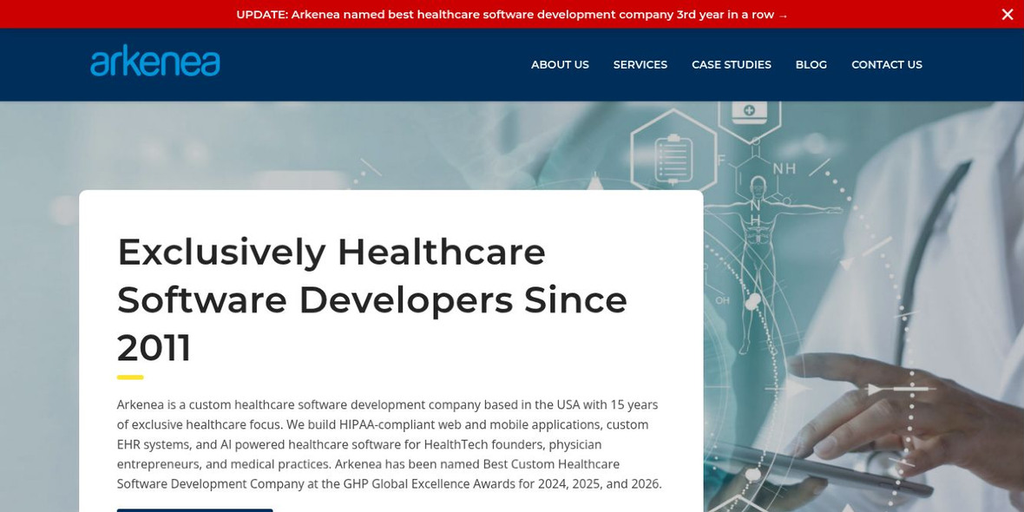
Arkenea specializes in healthcare software development. Its published work spans electronic health records (EHRs), patient-facing applications, telehealth, and tools for care teams. On its healthcare development page, the company says engagements start with a paid discovery phase that produces a functional specification. That gives clinicians and operations leads something concrete to approve before Arkenea quotes a fixed-price build.
What Arkenea’s public work shows
Hamilton Physical Therapy needed an EHR that worked across eight Montana locations. Arkenea describes building a cloud-based system around the practice’s clinical documentation and connecting it to an existing billing platform. That makes the case relevant to a group looking for custom charting while keeping its billing system. If you’re buying a replacement across multiple practices, ask what changed at each site and how the team handled the transition.
Arkenea also publishes a testimonial from Dr. Wayne Colin of ORLink. He says the work was delivered “on time and within budget.” It’s one customer’s experience, published by Arkenea. A reference from a project comparable to yours can tell you more about the company’s approach to release dates and changes in scope.
What to weigh before hiring Arkenea
A useful starting point for new products. Discovery can bring clinical and technical decisions into one specification. Ask whether you receive workflow maps, interface requirements, and enough detail for your procurement team to compare bids.
A separate commitment before the build. Confirm the discovery fee, expected outputs, and rights to use the specification if you decide to take it to another engineering team.
A distributed team. Arkenea says its leadership is in Raleigh and its development team is in Pune. Ask to meet the people who will join workflow reviews or handle a release issue during your clinical team’s working hours.
TATEEDA: Build, modernize, or add healthcare engineers
Our healthcare software development team works with US healthcare organizations and product companies from San Diego, with engineering teams in Latin America and Europe. We take on full builds, including clinical applications and patient portals, and work on systems that need new integrations, clearer interfaces, or safer ways to deploy updates. If your team already owns the architecture and backlog, our engineers can join it through staff augmentation.
What our public work shows
A US healthtech company needed to update a clinical assessment product that required repeated site-by-site installations. We moved the application to a browser-based architecture with offline data capture and later synchronization. Our case study records a six-week release against the project’s original 24-week plan. The client name is confidential. If you’re replacing software that’s already in use, the useful comparison is how the release was planned around existing workflows, including what happened when connectivity dropped.
Sal Saldivar, CTO of La Maestra Community Health Centers, recalls a “very methodical approach” to mobile app development. In the testimonial we publish, he also points to the client team’s role in providing information and making decisions. Ask how much time your own clinical and product leads should set aside.
What to weigh before hiring TATEEDA
Flexibility in who owns the work. We can run a project or supply the specific roles it lacks. For a healthcare SaaS company, that could mean an integration engineer and a QA engineer who work with your product owner and release team.
Staff augmentation requires time from your team. If you choose embedded engineers, assign someone to approve scope, answer workflow questions, and accept releases. If those decisions are already stretched across several teams, ask us to scope delivery ownership in the proposal.
Rates vary by the work and the people required. Our published rate range is $45–$95 per hour. System architects and specialized healthcare integration engineers sit nearer the upper end. Request a role-by-role estimate that covers implementation, testing, and handoff.
How to choose an Arkenea alternative
Shortlist Arkenea for a build that starts with clinical discovery. Take one workflow that needs to change, such as a therapist completing an assessment and passing the visit to billing. Ask how discovery captures variants, who signs off on them, and what you receive at the end.
Talk to us if your product is live or your team needs specific help. Say a customer wants you to add a second EHR while the first one is already in production. Give us the integration goal, who owns the existing interface, and your next release window. That will help us work out whether to take on the integration or add engineering capacity alongside your team.
Ask both vendors to price the same work. Give them the same workflow, target system, test-environment status, and first release milestone. Compare the hours assigned to discovery, data mapping, testing, deployment, and support. A rate for development alone leaves you guessing about the cost of getting the work into production.
For either vendor, get the security and data-access terms in writing before giving the team access to patient data. Ask which staff and subcontractors can access each environment, how that access is logged, and what changes at handoff. When the vendor acts as a HIPAA business associate, address the required written agreement before making protected health information available. See HHS guidance on business associate contracts.
Still building your shortlist? See our comparison of healthcare software development companies for more options.
Frequently asked questions
What is a good Arkenea alternative for healthcare software development?
TATEEDA is an alternative if you want one company that can take on a full healthcare build, modernize an existing product, or supply engineers who work as part of your team. If discovery is your priority, compare the cost and ownership of the resulting specification in both proposals.
How much does Arkenea charge compared with TATEEDA?
Arkenea lists $50–$75 per hour for healthcare SaaS work billed on a time-and-materials basis. TATEEDA publishes $45–$95 per hour for full-cycle outsourcing and staff augmentation. Compare the proposed team, estimated hours, and work included in each quote to find the expected cost of your first release.
Can both companies help with EHR integration?
Both describe work with EHRs and standards such as HL7 and FHIR. Ask for experience with your exact EHR, the data you need to read or write, and the access required to test the connection. Our EHR development and integration services cover those decisions for new and existing systems.
Can I hire a team to take over an existing healthcare application?
Yes. Start with a review of the codebase, deployment process, and integrations. Ask who will own support during the transition and how the new team plans to deliver its first change. At TATEEDA, you can bring in individual engineers or ask us to take responsibility for a defined modernization project.
What should I ask before signing a healthcare development contract?
Confirm who supplies the engineering team, who approves clinical changes, what you’ll receive at handoff, and who maintains the product after launch. Bring your security and privacy leads into discussions about access, subcontractors, and a business associate agreement where applicable.
Ready to compare approaches for your project? Talk with our CTO. Bring the workflow or integration you need to ship, the systems it touches, and any deadline already on the calendar.